

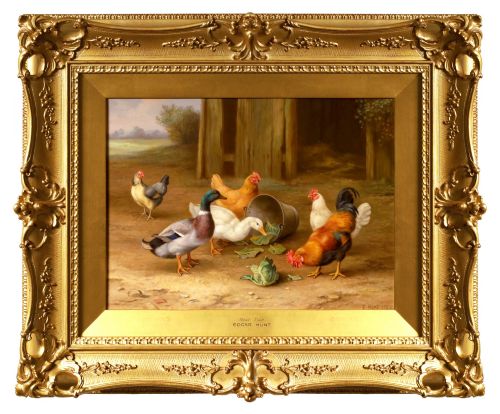


Rural Farmyard Canvas Artwork
Rural farmyard canvas artwork brings the rustic charm of 19th-century and early 20th-century agrarian life directly into your interior.
Rural Farmyard Canvas Artwork
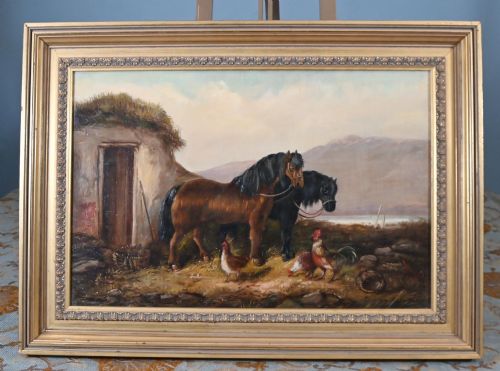
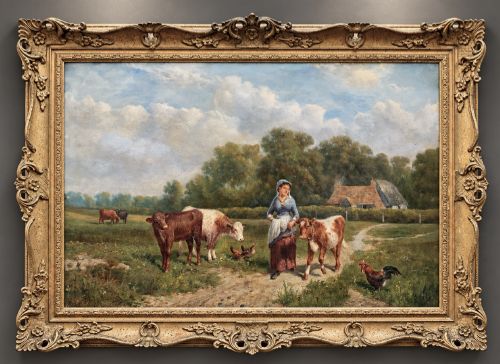
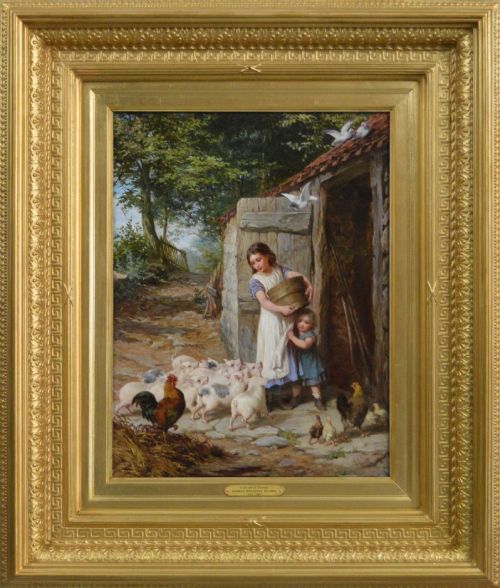
Rural farmyard canvas artwork comprises oil paintings on canvas depicting agricultural scenes, livestock, and rural laborers from the Victorian era up to the 1930s. These works capture specific moments of daily country life, featuring horses, cattle, pigs, and poultry situated around traditional barns and farmhouses.
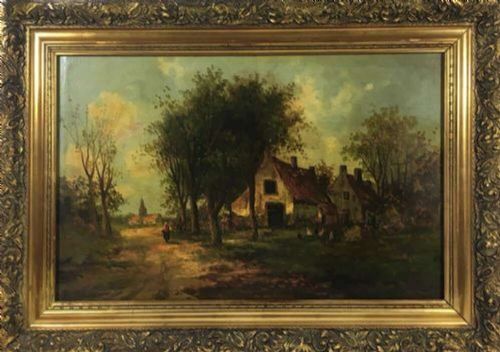
The pieces appearing here span British Impressionism, the Barbizon School, and Victorian pastoral realism. They range from intimate depictions of feeding animals to expansive landscapes detailing farmyard buildings and surrounding fields.
Works by named artists such as John Frederick Herring Jnr, Edgar Hunt, and Samuel Joseph Clark sit alongside unsigned canvases from the nineteenth century. Buyers encounter both detailed animalier studies and broader genre scenes focusing on human labour in the countryside.
How they were made
These works are executed in oil paint applied to stretched woven canvas, utilising the rich texture of the fabric to hold thick impasto and subtle glazes alike. Painters built up their compositions through layers of oil pigment, allowing for deep tones in shaded barns and luminous highlights on livestock.
Many of these canvases are housed within their original wooden frames, often finished with gesso and gold leaf or giltwood detailing. The traditional stretcher frame supports the canvas, while decorative mouldings provide a finished architectural border.
Rural Farmyard Canvas Artwork Retail Price Guide 2026
Typical asking prices for rural farmyard canvas artwork among the pieces listed under this phrase on Sellingantiques today, from the lower quarter to the upper quarter. They describe what is for sale here now, not the wider market.
Several canvases faithfully record the stubborn expressions of pigs and goats that clearly refused to stand still for the artist.
What varies in quality
Quality in these rural scenes rests upon the artist's ability to render animal anatomy and light convincingly. Superior examples demonstrate precise observation of livestock textures, such as the sheen of a horse's coat or the plumage of poultry, set within a balanced composition.
The handling of atmospheric perspective and the integration of figures into the landscape environment distinguish accomplished canvases from more formulaic productions. Framing also plays a role, with period giltwood mouldings enhancing the visual impact of the artwork.
Samuel Joseph Clark·George Augustus Holmes·Edgar Hunt·Herbert Royle·Frederick W. Jackson·John Linnell·Ralph Dorrance·John Frederick Herring Jnr·Julius Caesar Ibbetson·Arthur Charles Dodd·Robert Russell MacNee·Owen Bowen·John Frederick Herring·John Percy Cooke·Arthur Walker Redgate·Ernest Higgins Rigg·Georgina Lara·Thomas Blinks·James William Booth·Kershaw Schofield
The Rural Farmyard Canvas Artwork Glossary
- Oil on Canvas
- A traditional painting medium where pigments are bound with drying oils and applied to a woven fabric support. This combination allows for a wide range of opacity and rich colour blending.
- Gesso
- A plaster-like mixture applied to wooden frames as a smooth base before gilding with gold leaf. It provides the crisp surface necessary for detailed decorative moulding.
- Barbizon School
- A French movement of painters dedicated to realism in landscape art, focusing on rural and farmyard subjects. Their work emphasises natural light and unidealised countryside views.
- Animalier
- An artist who specialises in the realistic depiction of animals. These painters capture the distinct characteristics and physical forms of farm livestock and working horses.
- Genre Realism
- Art that depicts aspects of everyday life by portraying ordinary people engaged in common activities. In farmyard scenes, this includes laborers resting or children feeding animals.
Rural Farmyard Canvas Artwork: Frequently Asked Questions
What subjects appear in these paintings?
The canvases depict agricultural settings filled with working horses, cattle, sheep, pigs, and poultry alongside barns and farmhouses. Many include farm labourers or children engaged in daily rural tasks.
Scenes range from quiet pastoral landscapes to detailed animal studies situated in Yorkshire, Nottinghamshire, and rural Wales.
How do I date a farmyard canvas?
Dating relies on the artist's active period, stylistic markers of Victorian and Edwardian painting, and occasionally inscribed dates within the composition or on the reverse. Costume details on human figures also help narrow down the decade.
The materials, such as nineteenth-century canvas types and original gesso frames, provide further chronological context.
Where were these rural scenes painted?
Artists painted these scenes across British and European agricultural regions, capturing specific locales such as Yorkshire farms and Welsh valleys. Some works reflect the influence of French realism through the Barbizon School.
Painters observed working farms firsthand, recording the architecture of old cart sheds and barns.
How should I hang and light an oil painting?
Hang oil paintings away from direct sunlight and fluctuating heat sources to protect the canvas and oil pigments. Stable indoor environments prevent the wood stretcher and canvas from warping.
Use picture lights designed for fine art to illuminate the canvas evenly without generating excessive heat close to the paint surface.