



Victorian Extending Book Slide
A Victorian extending book slide keeps your library in order with a clever sliding action that adjusts to hold any shelf of volumes.
Victorian Extending Book Slide
A Victorian extending book slide is a desk or table accessory designed to support a growing or shrinking row of volumes between two upright ends. Most examples on offer date from the nineteenth century, often appearing in rich timbers fitted with extending scissor actions or sliding panels.
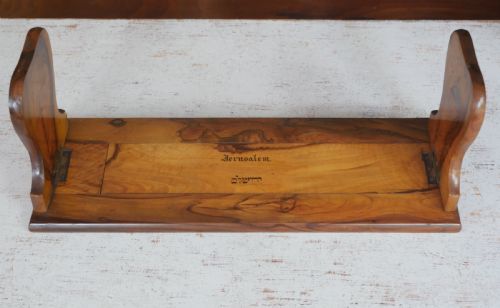
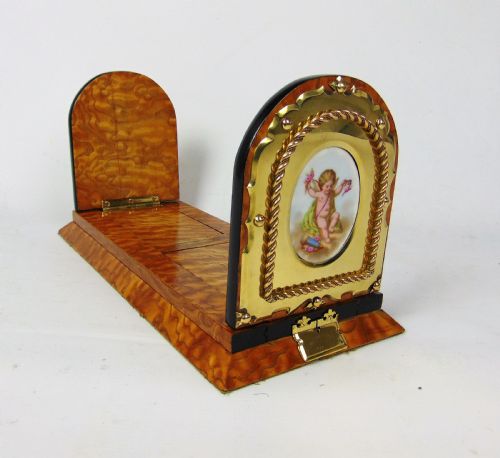
Makers produced these pieces in forms ranging from simple wooden rests to elaborate architectural designs and novelty rests. You will frequently encounter walnut and brass mounted versions alongside olive wood, maple, and ebonised variants.
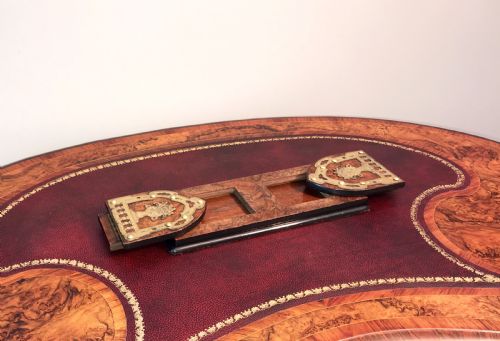
These items served scholars and readers on desks and library tables where portable book storage was necessary. The sliding mechanism allows the base to expand smoothly while keeping the upright ends vertical and steady.
Materials and construction
Cabinetmakers utilised dense hardwoods such as walnut, mahogany, oak, and rosewood for the main body and upright ends. These timbers were selected for stability and polished to highlight the natural grain.
Brass mountings, hinges, and extending mechanisms provided both structural reinforcement and decorative contrast against the dark wood. Inlays, pietra dura panels, and carved details such as Gothic Revival motifs further decorated the surfaces.
The listings on this site feature nineteenth-century dates including the Regency period alongside Victorian and Edwardian eras.
Assessing quality
Quality rests on the precision of the sliding mechanism and the rigidity of the action when fully extended. Superior pieces move smoothly without binding and lock securely into position.
The choice of materials and decorative enrichment dictate the grade of an example. Fine timbers paired with quality brass mounts, detailed inlays, or specialised stonework represent the higher tiers of production.
Tiffany & Co
The Victorian Extending Book Slide Glossary
- Extending book slide
- A desk accessory with a sliding base that adjusts in length to hold varying quantities of books upright between two decorative ends.
- Pietra dura
- An inlay technique using cut and fitted polished coloured stones to create pictorial designs on the ends of the rest.
- Gothic Revival
- A nineteenth-century architectural and decorative style utilising pointed arches, heavy mouldings, and medieval motifs.
- Tunbridge Ware
- Woodworking craftsmanship characterised by precise geometric mosaics made from thousands of tiny dyed wood blocks.
- Brass bound
- Edges and corners reinforced with fitted brass strips and mounts to protect the wood from wear.
Victorian Extending Book Slide: Frequently Asked Questions
How do extending book slides work?
These pieces use a clever expanding mechanism, often built with overlapping wooden sections or a folding scissor action beneath the base. As you pull the ends apart, the platform stretches to accommodate more volumes.
The design ensures that the upright ends remain vertical as the overall length changes, keeping the books supported securely without sliding or tipping over.
What woods were used for book slides?
Cabinetmakers primarily selected durable hardwoods like walnut, mahogany, oak, and rosewood for their strength and attractive grain patterns. Exotic materials such as coromandel, olive wood, and maple also appear on finer examples.
Makers frequently combined these timbers with brass hardware, ebonised finishes, or decorative inlays to create striking desktop accessories for Victorian libraries.
Where were book slides placed?
Owners typically kept these rests on writing desks, library tables, and study surfaces to corral small groups of frequently referenced volumes. They provided a portable alternative to fixed shelving.
The adjustable nature meant readers could keep a working selection of books close at hand in offices, drawing rooms, or home libraries.
How do I spot a Gothic Revival piece?
Gothic Revival examples display architectural characteristics inspired by medieval design, such as pointed arches, chamfered edges, and heavy carved tracery. They are frequently constructed from oak or mahogany.
These pieces often feature robust proportions and dark finishes that echo the ecclesiastical architecture popular during the nineteenth century.