
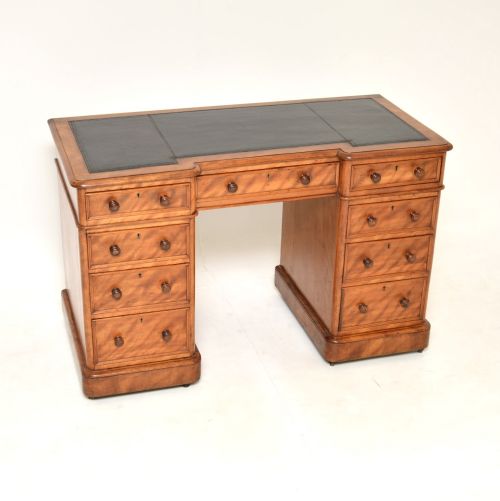
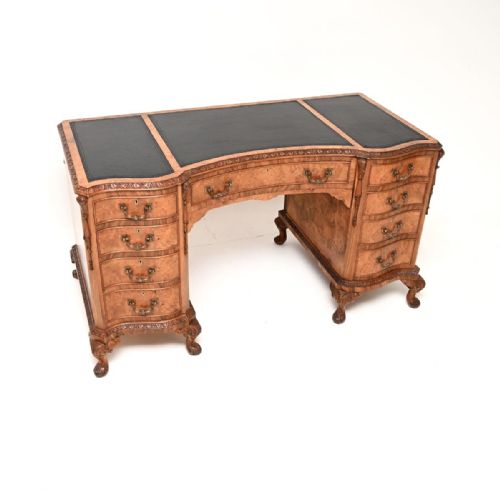
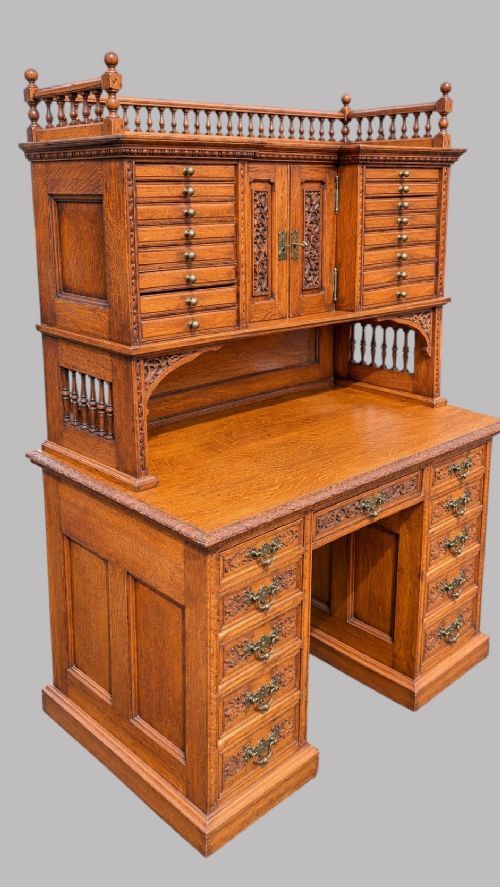
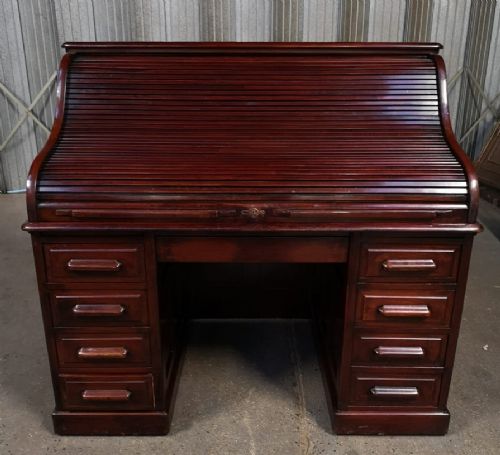


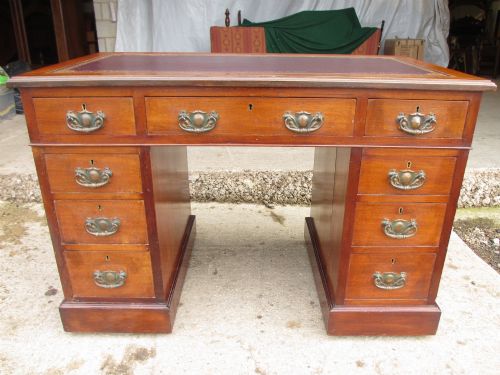
Victorian Executive Table
A victorian executive table brings monumental presence and working utility to a room through solid timber and leather.
Victorian Executive Table
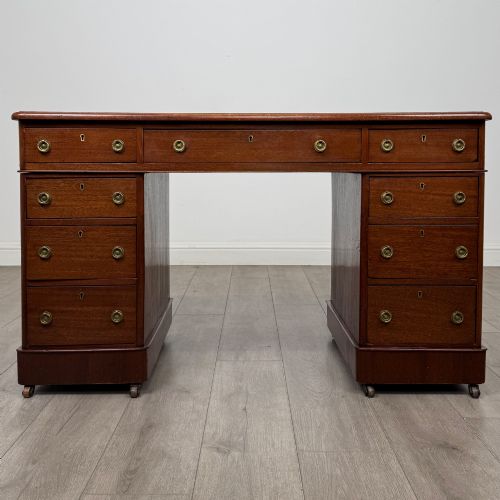
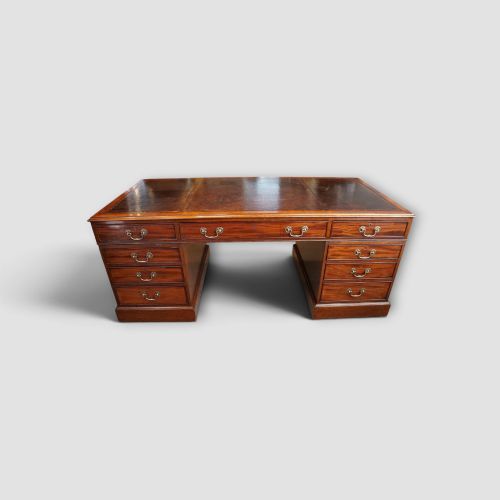
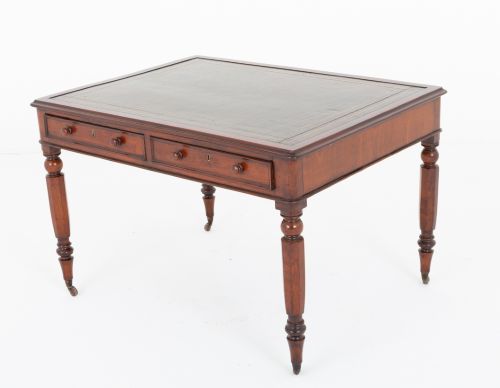
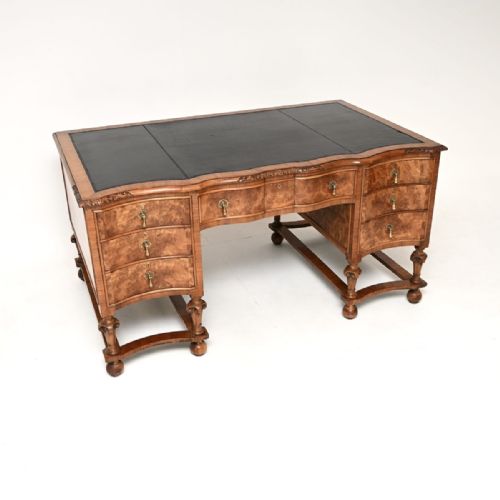
A victorian executive table encompasses pedestal desks, partners desks, and library tables spanning the nineteenth century. These pieces serve as substantial workspaces, often finished on both sides for freestanding placement in a room.
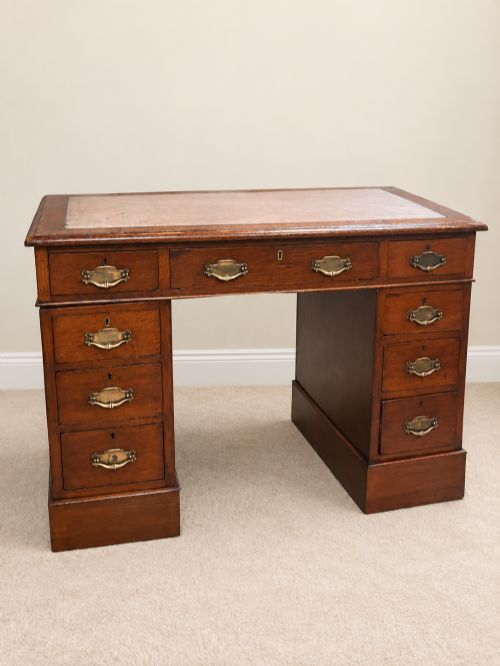
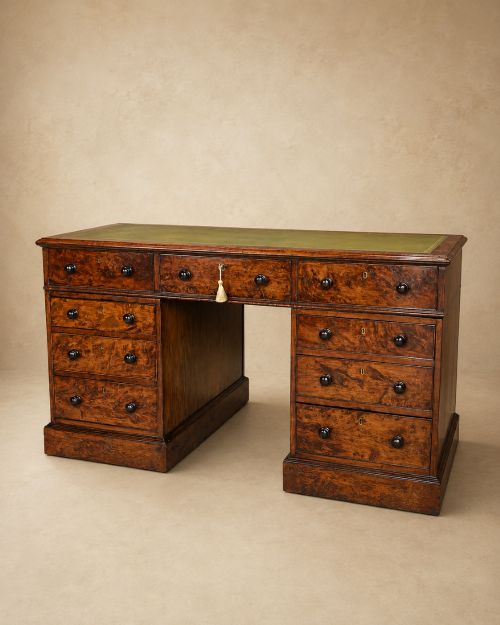
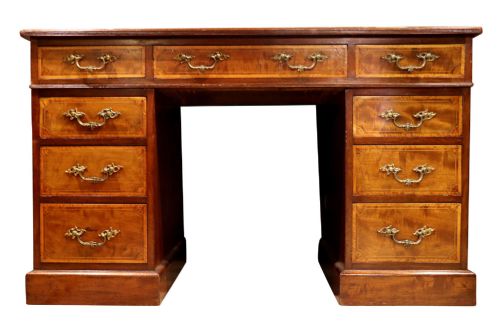
Mahogany and walnut appear frequently, alongside oak and burr walnut, shaped into pedestal forms with multiple drawers or large writing tables with leather inserts. The selection ranges from early nineteenth century examples to late victorian designs.
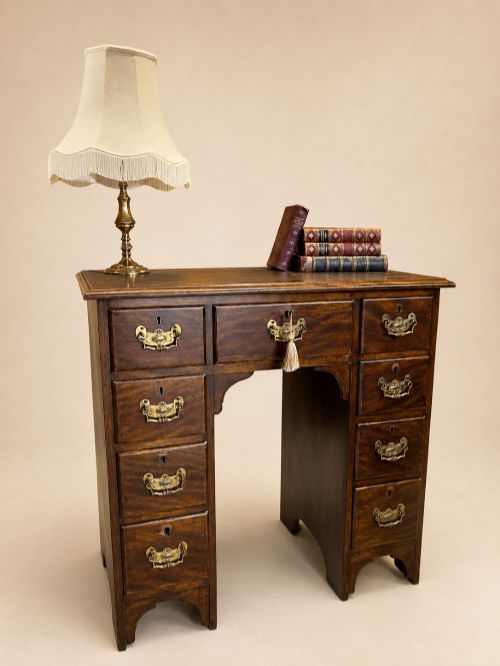
Makers and revival styles shape the offerings, moving from straightforward mahogany construction to inlaid surfaces and aesthetic movement details. Buyers encounter everything from compact kneehole desks to large double-sided partners desks.
Materials and construction
Cabinet makers built these pieces using solid timbers like mahogany, oak, and walnut, frequently applying burr walnut or rosewood veneers to primary surfaces. Brass hardware, including original handles and locks, completes the structural assembly.
Writing surfaces employ tooled leather inserts, often edged in gold tooling, set directly into the timber top. Secondary woods appear inside drawer boxes, where traditional dovetail joinery secures the framework.
Listings feature mahogany, burr walnut, and oak across pedestal desks and library tables.
Evaluating construction and finish
The standard of timber selection and veneer matching defines the visual weight of the piece, particularly where burr walnut or figured mahogany is employed. Grain continuity across drawer fronts and the depth of the cabinet work separate standard output from high workshop production.
The integrity of the original leather writing surface, brass hardware, and secondary framing indicates how well a desk survives its working life. Free-standing execution with finished backs requires greater joinery skill than wall-facing variants.
Edwards and Roberts·Maple and Co·Hobbs and Co·Trollope and Sons·Johnstone and Jeanes·Charles Andrea Nosotti
The Victorian Executive Table Glossary
- Partners desk
- A large pedestal desk designed with drawers and cupboards on both sides, allowing two people to work opposite one another.
- Kneehole desk
- A smaller desk featuring a central recess for the legs, flanked by pedestals of drawers on each side.
- Pedestal desk
- A heavy table comprising two drawer-filled pedestals supporting a wide top, often fitted with a leather writing insert.
- Library table
- A large freestanding table used for reading and writing, generally lacking the banks of pedestal drawers found on executive desks.
- Bureau plat
- A freestanding writing table, often french in inspiration, featuring a wide top and slender legs rather than heavy pedestals.
Victorian Executive Table: Frequently Asked Questions
What is a partners desk?
A partners desk provides workspace on both sides through opposing banks of drawers and cupboards.
This configuration allows two users to sit face to face in the centre of a room.
How do I care for leather tops?
Leather writing surfaces require periodic cleaning and conditioning to prevent drying and cracking.
Avoid excessive moisture and direct sunlight to preserve the gold tooling and colour.
Are these desks freestanding?
Many nineteenth century executive tables feature finished panelling on all sides for central room placement.
Some simpler variants remain designed to sit directly against a wall.
What distinguishes walnut from mahogany?
Walnut offers a lighter, highly figured grain pattern often enhanced by burr veneers.
Mahogany provides a dense, reddish brown tone with a straight and reliable grain structure.