

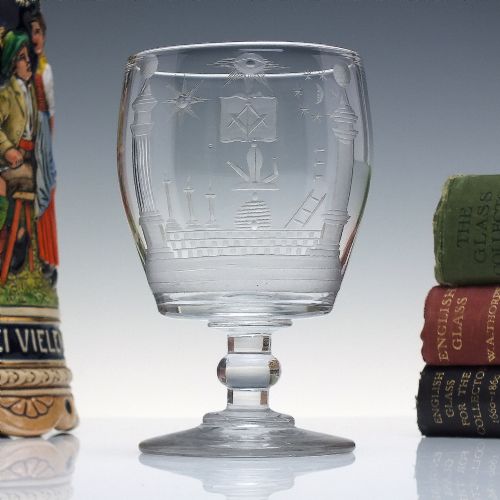


Victorian Etched Drinking Glasses
Victorian etched drinking glasses are tablewares carrying period patterns, and collectors want them for authentic nineteenth-century dining.
Victorian Etched Drinking Glasses
Victorian etched drinking glasses comprise wine glasses, rummers, tumblers, beakers, and goblets originating from the nineteenth century. These vessels range from sets of six or eight dessert wine glasses to pairs of rummers and individual goblets. The pieces span decades such as the 1860s, 1870s, 1880s, and 1890s, capturing the diverse glassware output of the era.
Makers and origins include notable names like Stevens and Williams alongside Bohemian workshops producing engraved ruby glass. Buyers frequently encounter clear glass, lead crystal, and flint glass adorned with acid cut cameo work, frosting, and surface engraving. Sets appear in harlequin arrangements or matching groups alongside amber and ruby flash variations.
How they were made
Makers utilised heavy lead crystal and flint glass as foundations for these vessels, shaping them through blowing and cutting. Artisans then applied surface decoration using acid etching, wheel engraving, or cameo techniques to achieve frosted and clear contrasts.
Colour was introduced via ruby flash glass and amber glass formulas before the final decorative cutting took place. Workshops balanced structural thickness in rummers and goblets with delicate walled execution in dessert wine glasses.
Some nineteenth-century drinkers needed glasses substantial enough to double as small hand weights between toasts.
What varies in quality
Depth and precision of the wheel engraving or acid etching determine the visual sharpness of the pattern against the glass body. Crisp execution in cameo layers and well-defined facets on cut stems separate standard examples from finer studio output.
Clarity of the underlying metal, whether clear glass, lead crystal, or flashed ruby, dictates the refractive quality of the piece. Uniformity across larger sets, such as harlequin groups or matched multi-piece services, influences desirability.
Stevens and Williams
The Victorian Etched Drinking Glasses Glossary
- Rummer
- A large, heavy drinking glass popular in the nineteenth century for ale, wine, or punch. These vessels typically feature a short stem and a capacious bowl.
- Flint glass
- A heavy, brilliant variety of glass containing lead oxide, known for its high refractive index. This material forms the base of many nineteenth-century cut and engraved tablewares.
- Ruby flash glass
- Clear glass coated with a thin layer of ruby-coloured glass before being cut away to expose the clear layer beneath. This technique creates high-contrast decorative panels.
- Acid cut cameo
- A method where glass layered in different colours undergoes selective acid treatment to dissolve upper layers and reveal a raised design. Stevens and Williams produced notable examples of this technique.
- Harlequin set
- A collection of drinking vessels that match in form or period but vary individually in colour or decorative detail. Such groupings were assembled for informal nineteenth-century dining.
Victorian Etched Drinking Glasses: Frequently Asked Questions
What are Victorian rummers used for?
Victorian rummers served heavier beverages such as ale, cider, or punch during nineteenth-century social gatherings.
Their robust proportions and short stems made them stable and practical for daily dining use.
How do I identify a Victorian wine glass?
Look for characteristics such as lead crystal weight, hand-cut facets, and wheel-engraved or acid-etched botanical motifs.
These manufacturing traits distinguish nineteenth-century tablewares from later machine-pressed reproductions.
What is ruby flash glass?
Ruby flash glass consists of a clear glass body coated with a thin superficial layer of red glass.
When artisans cut through this outer layer, the clear glass underneath emerges to form contrasting patterns.
Are these glasses safe for daily use?
Historic glassware requires careful handling and hand washing to preserve the integrity of the lead crystal and etched surfaces.
Avoid thermal shock from hot liquids to protect nineteenth-century glass structures.
What is a harlequin set?
A harlequin set is a matched group of glasses that share a common form but differ in colour or pattern.
This style allowed nineteenth-century hosts to present colourful tables without requiring identical matching services.