


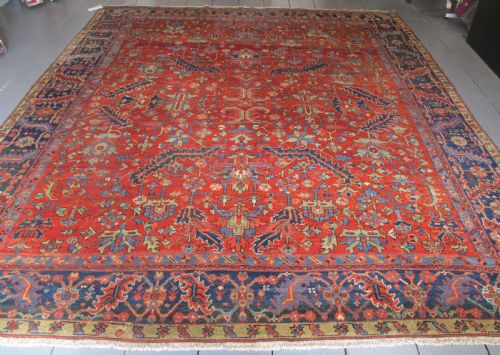


Victorian Era Wool Rug
These Victorian era wool rug examples span Persian tribal, Anatolian and Indian weaving traditions from the late nineteenth century.
Victorian Era Wool Rug
Persian workshops and tribal groups dominate the selection, including Fereghan, Hamadan, Karaja, Khorasan and Ziegler carpets. Alongside these Persian pieces appear Ottoman Ushak carpets, South Caucasian tribal rugs, Turkmen Turkic tribal weavings and Indian Agra productions. Each piece represents the specific aesthetic of its origin while belonging to the broader nineteenth-century timeline.
Formats range from elongated runner rugs to large square carpets intended for principal rooms. Regional variations supply distinctive formats, such as the Chuval bag faces produced by Turkmen weavers or the expansive field patterns seen in Agra and Ziegler carpets. These items bridge the gap between nomadic utility and Victorian domestic interior decoration.
Materials and Construction
The foundation of a Victorian era wool rug typically relies on cotton warps and wefts, paired with wool pile hand-knotted by regional artisans. Certain nomadic and tribal pieces incorporate hand-spun wool throughout the pile and foundation, yielding a more irregular texture. The interplay of these natural fibres determines the weight and drape of each rug.
Dyes utilised in these nineteenth-century floor coverings comprise natural vegetal and insect-derived colorants that have matured over time. Weavers secured the edges with overcast selvedges and finished the ends with original kilim ends where preservation allowed. Knot density varies considerably between the fine workshop carpets of Persia and the coarse, robust construction of tribal work.
Victorian Era Wool Rug Retail Price Guide 2026
Typical asking prices for victorian era wool rug among the pieces listed under this phrase on Sellingantiques today, from the lower quarter to the upper quarter. They describe what is for sale here now, not the wider market.
Some nineteenth-century tribal weavers included deliberate minor errors in their geometric patterns to ward off the evil eye.
Assessing Quality and Execution
Quality in a Victorian era wool rug rests upon the precision of the knotting, the handling of the wool and the sophistication of the design. Finer workshop pieces exhibit high knot counts and intricate drawing, whereas tribal pieces derive distinction from bold graphic layouts and saturated natural dyes. The integrity of the foundation and the completeness of the borders influence the overall standing of an individual textile.
The depth and longevity of the pile dictate how well a rug has weathered a century of use. Superior examples retain substantial pile height alongside crisp, unblemished secondary colours in the field and borders. Variations in wool quality, from lustrous hand-spun fleece to tighter commercial wool yarns, directly affect the tactile experience of the surface.
The Victorian Era Wool Rug Glossary
- Chuval
- A large Turkmen storage bag face often woven with repetitive guls. These nomadic textiles were utilised inside traditional yurt dwellings.
- Gul
- A medallion motif frequently repeated across Turkmen and tribal carpets. Each distinct tribal group employed its own characteristic form.
- Mina Khani
- A repeating floral lattice pattern seen across Persian carpets. This geometric arrangement connects blossoms and leaves with delicate trellises.
- Selvedge
- The bound outer edge of a rug running parallel to the warp threads. Proper finishing prevents the pile knots from unravelling.
- Warp
- The vertical foundation threads stretched lengthwise on the loom before knotting begins. Cotton is the standard warp material in nineteenth-century urban workshop rugs.
Victorian Era Wool Rug: Frequently Asked Questions
What is a Victorian era wool rug?
A Victorian era wool rug is a hand-knotted floor covering or tribal textile produced during the reign of Queen Victoria, predominantly between eighteen-eighty and eighteen-ninety.
These pieces originate from weaving centres across Persia, Anatolia, the Caucasus, Turkmenistan and India, imported into British homes during the nineteenth century.
How do I care for a wool rug?
Living with a nineteenth-century wool rug requires regular gentle vacuuming without a rotating beater brush to protect the delicate antique pile.
Keep the rug out of direct sunlight to prevent fading of natural dyes, and use a breathable underlay to cushion the cotton foundation against hard floors.
How are Persian and tribal rugs different?
Persian workshop carpets display refined, curvilinear floral designs planned on graph paper by master designers in urban centres like Fereghan or Tabriz.
Tribal rugs from regions such as Baluchistan or the Caucasus feature geometric motifs, memory-woven patterns and bolder colour palettes created by nomadic weavers.
How do I identify a nineteenth-century rug?
Dating a rug relies on examining the structural materials, such as cotton foundations paired with hand-spun wool pile, alongside the specific chemical or vegetal dye palette.
Stylistic markers like Mina Khani variants, specific Turkmen guls and nineteenth-century Persian workshop signatures help place the piece within the Victorian era.