

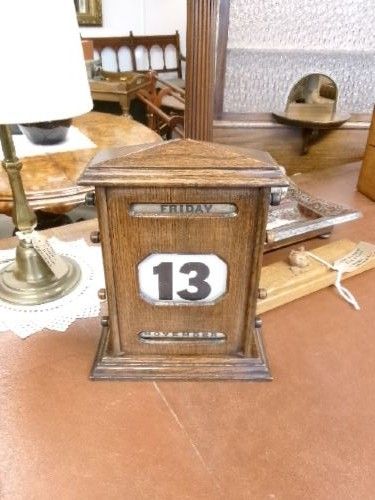
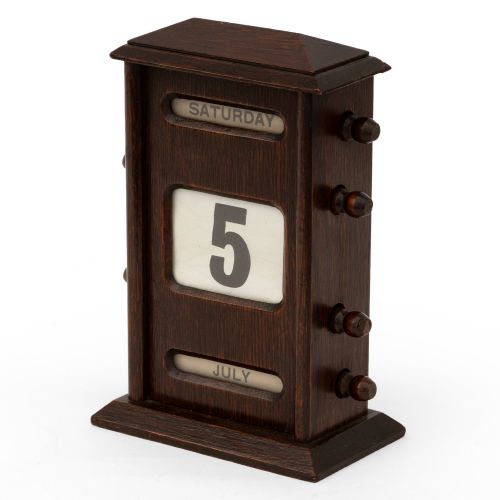
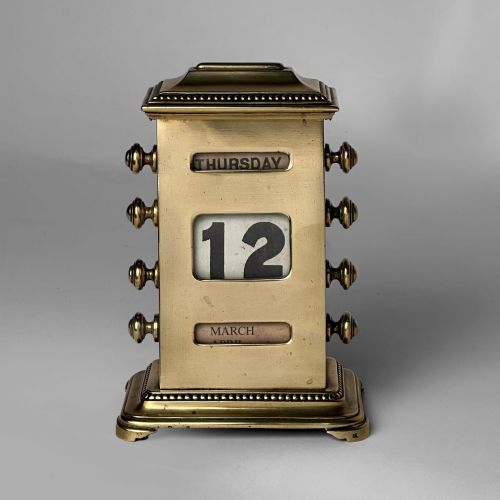
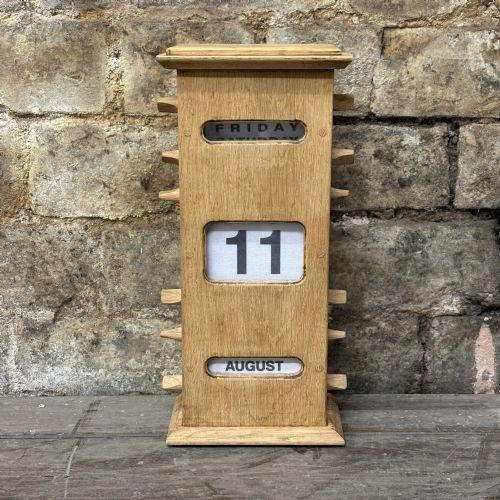
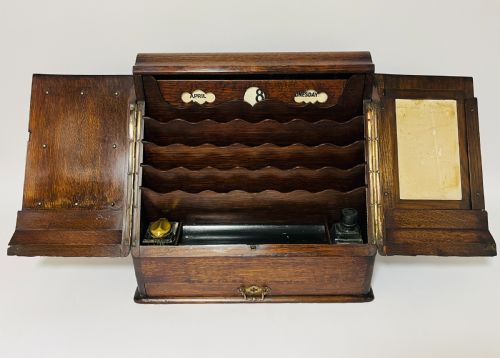


Victorian Desk Perpetual Calendar
These Victorian desk perpetual calendar pieces keep your workspace organised with timeless mechanical charm.
Victorian Desk Perpetual Calendar
A Victorian desk perpetual calendar is a functional office accessory designed to display changing dates year after year without replacement. The selection here brings together oak frames, brass mountings, and slate clock combinations spanning the nineteenth and early twentieth centuries.
Most examples you will encounter take the form of compact oak desktop blocks or combined stationery cabinets fitted with adjustable date mechanisms. Alongside these standard wooden versions, makers also produced wall-mounted mahogany pieces and decorative brass designs influenced by Egyptian revival motifs.
Makers occasionally combined these calendars with mantel clocks or incorporated them into larger stationery cabinets to create multifunctional desk furniture. The prevailing materials are oak, brass, and slate, reflecting the robust standards of nineteenth-century desk accessories.
Materials and construction
Makers relied on solid oak and mahogany for the primary bodies, often pairing timber frames with heavy cast brass dials, paper cards, and enamel markers. These materials ensured durability for daily office use while providing a substantial platform for complex internal date mechanisms.
Specialist workshops incorporated polished Belgium slate for architectural clock-calendar combinations, adding considerable weight and formal presence to the desk or mantel. Finishes ranged from dark oak polishes to intricate brass etchings and applied enamel details.
Victorian Desk Perpetual Calendar Retail Price Guide 2026
Typical asking prices for victorian desk perpetual calendar among the pieces listed under this phrase on Sellingantiques today, from the lower quarter to the upper quarter. They describe what is for sale here now, not the wider market.
Distinguishing quality and workmanship
Quality reveals itself in the precision of the moving parts and the crispness of the lettering on the date cards or brass drums. Superior examples feature fully working mechanisms by established makers that operate smoothly without sticking.
The choice of materials also dictates the grade of the piece, moving from simple softwood structures up to substantial oak stationery cabinets and heavy slate clock combinations. Integrated complications, such as clock movements by known horologists, elevate the piece from a simple desk accessory to a sophisticated instrument.
William Tonks of Birmingham·Brocot·Asprey
The Victorian Desk Perpetual Calendar Glossary
- Perpetual calendar
- A mechanical device designed to show the day, date, and month correctly across different year lengths without manual resetting beyond leap years. These mechanisms use rotating drums, sliding panels, or card wheels.
- Stationery cabinet
- A desk box featuring internal compartments for writing paper, envelopes, and inkwells, frequently fitted with an integrated calendar on the fall-front or top. They organise the writing desk.
- Boulle
- An elaborate marquetry technique using tortoiseshell and brass inlay developed in France and utilised on luxury desk accessories. It provides a decorative tortoiseshell and brass surface.
- Equation of time
- A horological complication showing the difference between apparent solar time and mean solar time. It appears on advanced nineteenth-century clock combinations.
- Slate
- A fine-grained metamorphic rock used for architectural mantel clock bodies during the nineteenth century. It offers a heavy, polished black surface.
Victorian Desk Perpetual Calendar: Frequently Asked Questions
How do perpetual desk calendars work?
These calendars use manual adjustments via knobs, rollers, or cards to advance the days and months without needing a new printed calendar each year. The internal drums or paper strips rotate to align the correct day with the corresponding date.
Most traditional desk models require a gentle turn at the start of each month or week to maintain the correct display. The mechanisms rely on simple gearing or sliding panels hidden behind the wooden or brass facade.
Where were these calendars typically placed?
They sat primarily on large writing desks, library tables, or partner desks in nineteenth-century offices and studies. Their robust construction suited the heavy daily administrative tasks of the period.
Some variants were built into larger stationery cabinets or mounted directly onto walls to save valuable desk space. Others took pride of place on mantelpieces when combined with clock movements.
How do I date a calendar?
Dating relies on examining the construction timber, brass casting techniques, and stylistic clues such as Gothic or Egyptian revival motifs. Materials like solid oak and heavy slate point firmly towards nineteenth-century production.
Maker signatures or patent stamps stamped into the brass or wood provide the most accurate chronological markers. The complexity of the mechanism and the font used on the date cards also help narrow down the decade.
Are the clock movements reliable?
Nineteenth-century mechanical movements, particularly those by established makers like Brocot, were built to high standards of craftsmanship. When properly maintained, they keep accurate time alongside the calendar function.
Clocks integrated into slate or marble bodies require careful handling and occasional professional servicing to ensure the gear trains remain clean and operational. The calendar mechanism itself operates independently of the clockwork in most desk models.