
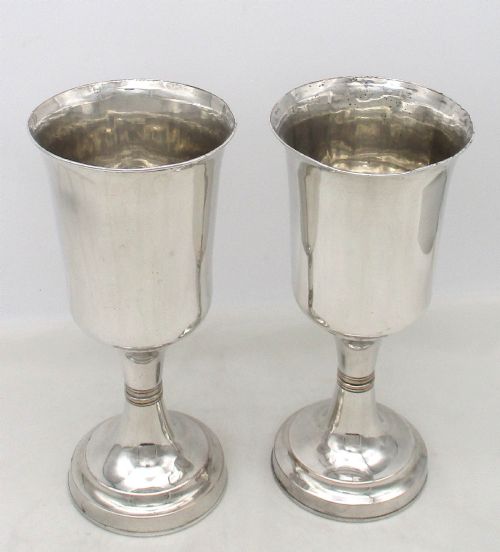

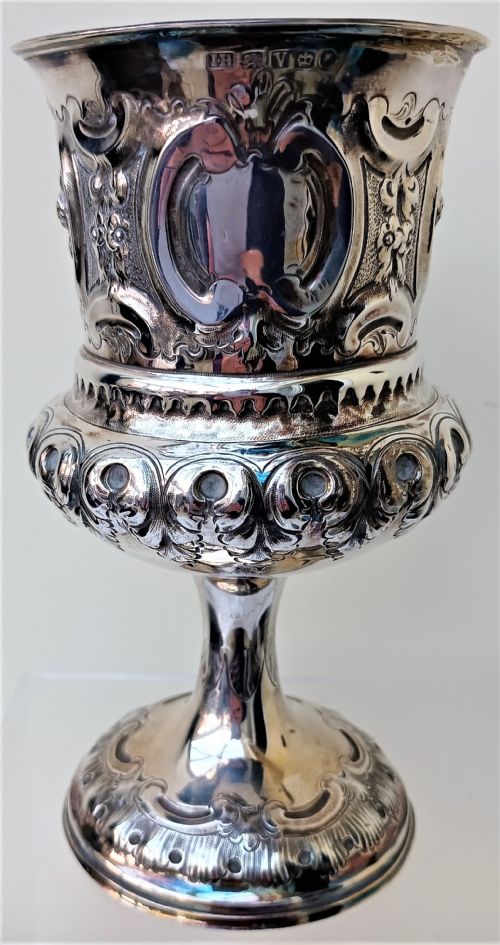


Victorian Communion Goblet
These Victorian communion goblet pieces are substantial silver and silver-plated vessels designed for ecclesiastical service.
Victorian Communion Goblet
Buyers will encounter both sterling silver examples bearing hallmarks and Old Sheffield plated or silver-plated church chalices. Forms vary from single tall cups to matched pairs and larger communion sets designed for church altars.
How They Were Made
Silversmiths utilised sterling silver and Old Sheffield plate, often applying gold gilt, gold gilding, or a gold wash to the interior bowls of the chalices. These metals provided the necessary durability and visual dignity required for sacred services.
Techniques combined traditional silversmithing with early plating methods, while non-metal examples such as turned walnut demonstrate alternative craftsmanship found within the period.
Materials documented across the inventory comprise sterling silver, silver plate, Old Sheffield plate, copper, gold gilt, gold gilding, gold wash, and turned walnut.
What Varies in Quality
Quality rests upon the weight of the metal and the precision of the ecclesiastical ornamentation. Sterling silver examples with clear hallmarks and parcel gilt interiors generally represent higher tier production compared to standard plated wares.
The sophistication of the Victorian and Gothic revival detailing, along with the intactness of any gold wash, separates standard ecclesiastical vessels from finer silversmith workshop output.
George Unite·John Hunt and Robert Roskell·Elkington Mason
The Victorian Communion Goblet Glossary
- Victorian
- The period spanning the reign of Queen Victoria during the nineteenth century. Most ecclesiastical metalwork seen here dates from the middle to late decades of this era.
- Old Sheffield Plate
- A method of fusing a thin layer of silver onto a thicker copper base. This technique was widely utilised for church chalices before modern electroplating became dominant.
- Parcel Gilt
- Silver objects that are partially gilded with gold, usually on the interior bowl of a communion goblet. This practice protected the silver from communion wine.
- Sterling Silver
- An alloy containing a high proportion of pure silver, universally marked with official assay office hallmarks. It provides the highest intrinsic material value for these chalices.
- Gothic Revival
- An architectural and decorative style popular during the Victorian era that drew inspiration from medieval forms. It heavily influenced the design of church chalices and communion sets.
Victorian Communion Goblet: Frequently Asked Questions
How were communion goblets used?
These vessels were employed in church services to hold the sacramental wine for holy communion. Their deep bowls and sturdy stems made them suitable for communal passing or altar service.
Over time, many transitioned from active church use into private collections or decorative ecclesiastical displays.
How do I identify a Victorian chalice?
Examination of hallmarks, stylistic cues, and manufacturing methods helps determine the date. Sterling silver pieces typically carry date letters and maker marks corresponding to the nineteenth century.
Old Sheffield plate and distinct Gothic revival ornamentation also point directly to the Victorian period.
What is parcel gilding on a goblet?
Parcel gilding refers to the application of gold leaf or wash to a specific part of the vessel, most commonly the interior bowl. This was done for both aesthetic contrast and practical preservation.
The gold protected the underlying silver or copper from tarnishing when exposed to sacramental wine.
Can these goblets be used today?
While many buyers acquire them for display or collection, silver and silver-plated chalices remain usable for ceremonial purposes. Proper cleaning with suitable silver care products is essential to maintain the metal.
Care should be taken to understand whether the piece is solid sterling silver or plated ware before undertaking regular maintenance.