


Victorian Column Mantel Clock
A victorian column mantel clock brings weighty architecture and precise movement into a room, anchoring a mantelpiece with brass and stone.
Victorian Column Mantel Clock
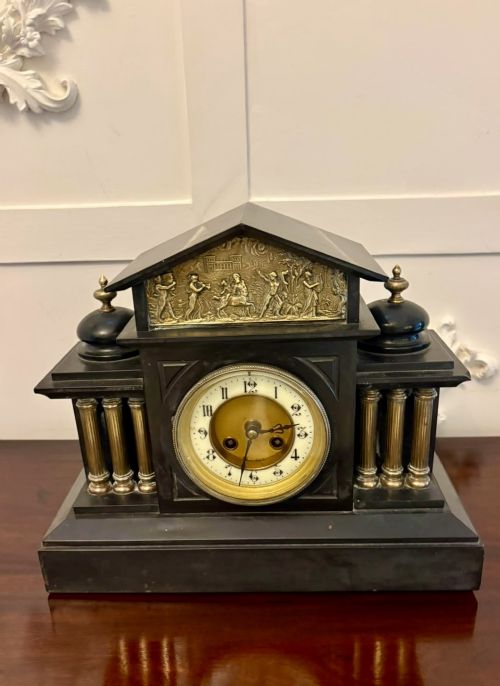
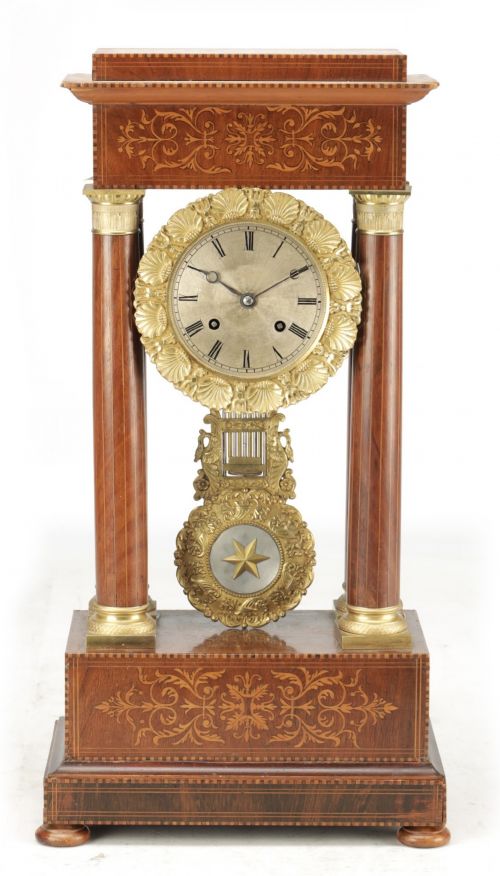
A victorian column mantel clock takes the classical architectural forms of the nineteenth century and turns them into domestic timepieces. These objects range from heavy black marble and slate architectural cases to slender portico models inlaid with contrasting woods.
Most examples found here hail from the Victorian period and the wider nineteenth century, drawing heavily on Classical Revival, French Empire, and Neoclassical styles. Makers frequently incorporated columns, capitals, and pediments into the stone or wooden housings.
Alongside large marble architectural mantel clocks, buyers will encounter carriage clocks fitted with frets and columns. These portable brass designs often feature enamel dials and mechanical movements housed beneath glass panels.
How they were made
Case construction combined robust natural stones like marble, slate, and faux marble with cast metals such as brass, gilt brass, ormolu, and gilt bronze. Wood versions utilised rosewood and lemon wood inlay to create geometric contrast on portico frames.
Movements relied on eight-day mechanisms, sometimes with repeating capabilities or striking trains, paired with white enamel dials. Glass domes protected delicate carriage clocks, while architectural cases integrated heavy stone blocks into stable, monumental structures.
Listings feature brass, glass, enamel, marble, and slate across Victorian and Edwardian periods.
What varies in quality
The distinction between standard production and top-tier work rests on the crispness of the architectural casting and the selection of materials. Superior pieces display finely detailed Corinthian capitals on brass columns and deeply polished black or pink marble.
Signed works from notable makers or retailers demonstrate superior mechanical execution alongside heavier, more solid stone and metal housings. Lesser examples rely on simpler wooden or faux marble carcasses with standard dial decoration.
Philippes Paris·Baby and Jannings·Mappin and Webb·Delépine·H. Bilton
The Victorian Column Mantel Clock Glossary
- Portico clock
- A mantel clock designed with architectural columns supporting a lintel above the dial. These pieces often feature wood inlay and glass domes.
- Garniture
- A set comprising a central mantel clock matched with a pair of side ornaments such as urns or vases. They create a balanced display across a fireplace.
- Ormolu
- Finely ground high-carat gold mercury-gilded onto a bronze object. This technique imparts a rich metallic sheen to decorative mounts on clock cases.
- Carriage clock
- A small, portable spring-driven timepiece fitted with a carrying handle and glass panels. They frequently incorporate repeating mechanisms and enamel dials.
- Grande Sonnerie
- A complex striking train that chimes both the hours and the quarters automatically. This mechanical complication appears on high-grade nineteenth-century movements.
Victorian Column Mantel Clock: Frequently Asked Questions
What is a portico clock?
A portico clock is an architectural timepiece supported by vertical columns, often made from wood with delicate inlay or stone.
These designs reflect classical building styles scaled down for domestic interiors during the nineteenth century.
How do carriage clocks work?
Carriage clocks rely on spring-driven mechanical movements housed within brass and glass cases for portability.
Many examples feature eight-day movements that require weekly winding using a dedicated key.
What is a clock garniture?
A clock garniture is a matched decorative set featuring a central mantel clock flanked by matching side pieces.
These sets were designed to sit together on a mantelpiece as a unified decorative arrangement.
Are these clocks mechanical?
These timepieces operate entirely through mechanical spring or weight-driven movements rather than electronics.
Many incorporate striking mechanisms that ring the hours or quarters on bells and gongs.