


Victorian Colonial Armchair
A victorian colonial armchair brings substantial nineteenth-century presence and deep-seated comfort into a room through generous proportions and dense tropical timbers.
Victorian Colonial Armchair
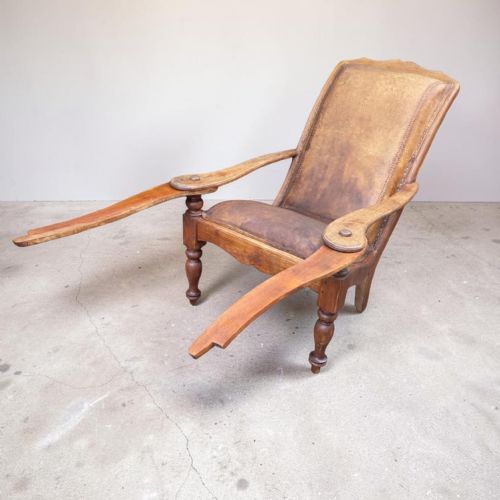
A victorian colonial armchair encompasses substantial nineteenth-century seating built for use in distant regions under British influence, combining deep seats with robust frames. Buyers seeking a victorian colonial armchair find distinctive forms such as monumental planter's chairs with extended arms, folding campaign seats, and throne chairs.
The pieces appearing on this page originate predominantly from the nineteenth century, reflecting periods described variously as Victorian, Anglo-Indian, and colonial. Makers working in regions including Ceylon, Bombay, and Burma adapted traditional European seating designs to suit tropical climates.
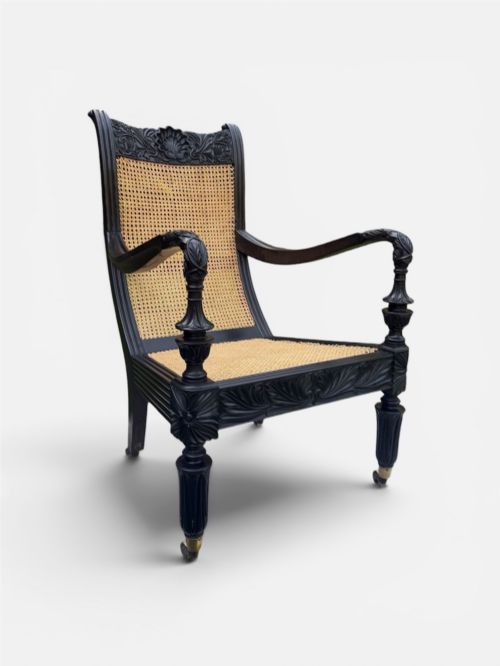
Common regional variants include heavily carved hardwood armchairs, solid ebony frames, and rosewood planter's chairs fitted with original leather or cane. These forms prioritise deep comfort and heavy timber construction over delicate ornamentation.
Materials and construction
These armchairs are constructed from dense exotic timbers such as solid ebony, Burmese hardwood, Bombay rosewood, and teak. Artisans shaped these heavy woods by hand, often incorporating elaborate surface carving into the structural framework.
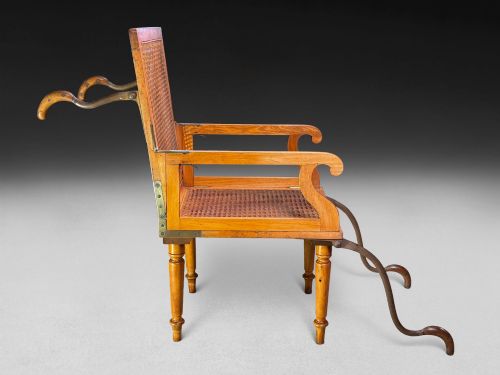
Seating areas frequently utilise woven cane or original leather upholstery to handle warm climates. Metal elements such as brass appear on folding campaign mechanisms and structural joints.
Judging quality and character
Quality in these armchairs rests upon the density and selection of the timber, alongside the crispness and depth of any hand-carved ornamentation. Pieces fashioned from solid ebony or finely figured rosewood sit at the upper end of the range.
The integrity of the original construction, whether a folding campaign mechanism or a monumental planter's frame, dictates the durability and visual impact of the chair. Surviving original leather upholstery and intact cane work add significant authenticity to the piece.
The Victorian Colonial Armchair Glossary
- Planter's chair
- A specialised nineteenth-century armchair featuring exceptionally long, flat arms designed to support outstretched legs. These chairs were utilised in colonial households for resting during the hottest parts of the day.
- Campaign armchair
- A portable seating form engineered with folding or dismantling frames for transport during military or administrative travel. Such pieces frequently incorporate brass hinges and pins.
- Anglo-Indian
- A descriptive term for furniture made in India by local craftsmen working to British commissions, combining European furniture forms with indigenous decorative carving. This style defines many pieces originating from the subcontinent.
- Ceylonese
- Pertaining to furniture manufactured in nineteenth-century Ceylon, now Sri Lanka, known for distinct regional carving styles and the use of native hardwoods. These items display unique local interpretations of British silhouettes.
Victorian Colonial Armchair: Frequently Asked Questions
What is a planter's chair?
A planter's chair is a nineteenth-century seating form featuring very wide, extended arms designed for resting legs upon. They were built for comfort in warm colonial climates.
These chairs often include reclining backs and deep seats constructed from heavy tropical hardwoods.
How do campaign chairs fold?
Campaign chairs utilise hinged or dismantling wooden frames secured with brass pins and fittings. This allowed British officers and travellers to pack seating flat for transport.
Original folding mechanisms require careful handling to preserve the nineteenth-century joints and metalwork.
Which woods were used?
Maker workshops utilised dense tropical timbers available locally in the regions where British colonial furniture was produced. Common varieties include solid ebony, Burmese hardwood, Bombay rosewood, and teak.
These heavy woods provided exceptional durability and resisted humidity.