

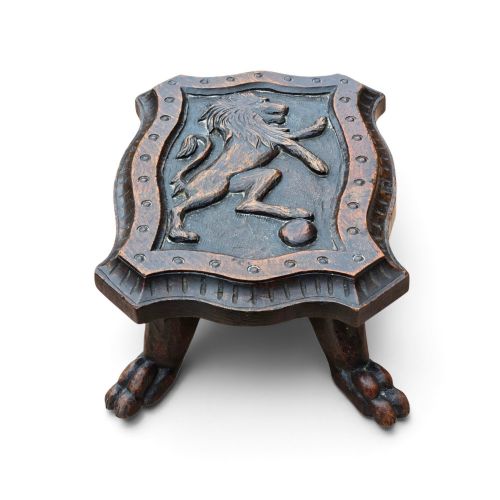


Victorian Claw Foot Stool
A victorian claw foot stool grounds a room with carved timber and cast-metal paws, offering a sturdy perch that collectors prize for its sculptural weight.
Victorian Claw Foot Stool
A victorian claw foot stool provides a low seat raised on animalistic supports, taking the form of footstools, piano stools, and occasional stools. These pieces appear across the nineteenth century alongside earlier Georgian and Regency examples, as well as later Edwardian and twentieth-century variations.
The assortment on this page spans distinct stylistic revivals and regional interpretations, featuring Anglo-Indian carvings, Rococo Revival curves, Chippendale motifs, and industrial ironwork. Stools range from simple revolving tops to elaborately carved oak frames bearing heraldic motifs and damask upholstery.
Materials and construction
These items rely on dense timbers such as mahogany, oak, rosewood, and general hardwood, shaped through detailed hand-carving. Brass and cast iron frequently form the distinct paw terminals or mechanical swivel components.
Upholstery relies on traditional fabrics including damask, supported by sturdy timber frames built for regular weight-bearing use.
Victorian Claw Foot Stool Retail Price Guide 2026
Typical asking prices for victorian claw foot stool among the pieces listed under this phrase on Sellingantiques today, from the lower quarter to the upper quarter. They describe what is for sale here now, not the wider market.
A heraldic lion rampant motif stands guard on one oak footstool, ensuring your ankles rest beneath royal protection.
What separates the best from the rest
Depth and crispness of hand-carving dictate the visual standard of the wooden frame, separating deeply modelled foliage and animal motifs from flat or mechanical work. The integration of the brass or iron foot with the timber leg shows the maker's structural ambition.
Upholstery finish and the smooth operation of adjustable swivel or revolving mechanisms distinguish superior examples from basic utilitarian seating.
The Victorian Claw Foot Stool Glossary
- Claw-and-ball
- A decorative foot motif depicting an animal claw gripping a ball, commonly rendered in carved timber or cast brass. This classical detail roots many nineteenth-century furniture designs in earlier decorative traditions.
- Swivel top
- A rotating seat mechanism allowing the top of the stool to turn independently of the base. This engineering is typical of piano stools designed for adjustable seating heights.
- Damask
- A reversible figured fabric traditionally woven with intricate patterns, frequently utilised for formal upholstery. It brings a textured, decorative surface to nineteenth-century seating.
- Rococo Revival
- A nineteenth-century design movement favouring asymmetrical scrollwork, naturalistic curves, and ornate floral carving. This style informs the more exuberant frames found in this category.
Victorian Claw Foot Stool: Frequently Asked Questions
What is a claw foot stool?
A claw foot stool is a low seat supported by carved or cast animal paws, designed for resting feet or for use at a piano.
These pieces combine decorative woodwork with functional seating, reflecting the diverse revival styles of the nineteenth century.
How were these stools used?
They served primarily as footrests beside armchairs or as adjustable seating for musicians at pianos and dressing tables.
Many examples incorporated swivel mechanisms to let players adjust their height or position easily during performance.
Are all these stools from the Victorian era?
While the Victorian period dominates, the selection also includes Georgian, Regency, and Edwardian pieces, along with later revivals.
Stylistic influences range from Chippendale revival to Anglo-Indian carving and industrial ironwork.
What woods were commonly used?
Craftsmen relied on durable hardwoods including mahogany, oak, and rosewood to support intricate carving.
Brass and cast iron were frequently integrated for feet, paw terminals, and internal swivel mechanisms.