



Victorian Church Oil Painting
These Victorian church oil painting examples capture ecclesiastical and rural architecture in oils on canvas or board.
Victorian Church Oil Painting
A victorian church oil painting brings nineteenth-century ecclesiastical and rural architecture into domestic spaces through canvas and board mediums. You will most frequently encounter nineteenth-century British landscapes and village scenes featuring historic churches.
The selection ranges from academic realism to naive folk art and primitive interpretations. Works often depict specific locations such as Yorkshire or Cornwall alongside imaginative or rural compositions.
Religious scenes and quiet churchyards reflect the period preoccupation with faith, community, and the changing English countryside. These paintings serve as historical records of local architecture as it stood during the Victorian era.
Materials and construction
Artists painted primarily with oil paint on stretched canvas or prepared wooden boards. These traditional supports received priming layers before the application of oil pigments.
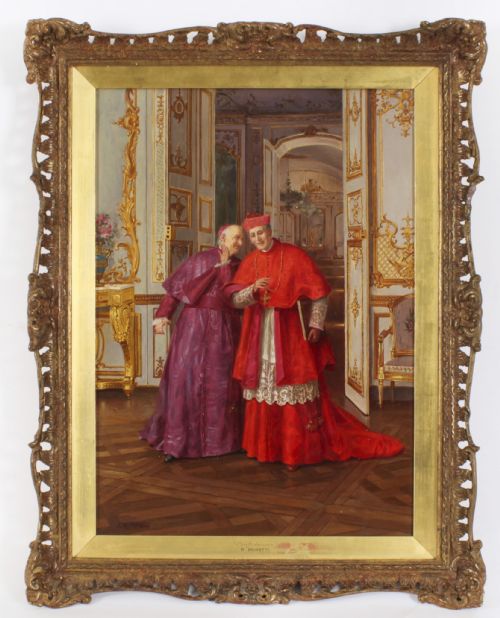
Many surviving works retain their original gilded wood frames finished with gold leaf. The combination of oil on canvas within period wooden mouldings defines the physical structure of these pieces.
Victorian Church Oil Painting Retail Price Guide 2026
Typical asking prices for victorian church oil painting among the pieces listed under this phrase on Sellingantiques today, from the lower quarter to the upper quarter. They describe what is for sale here now, not the wider market.
One coastal church scene quietly flies the Red Duster merchant navy flag.
Assessing quality and execution
Quality rests upon the confidence of brushwork and the handling of light, particularly in moonlight or evening scenes. Finer examples demonstrate precise architectural perspective and atmospheric depth.
The distinction between academic realism and naive folk art lies in anatomical and structural proportion rather than subject matter. Stronger paintings sustain compositional balance across the entire canvas.
Renato Moretti·Walter Meegan·William Greaves·Frederick Underhill·Daniel Sherrin
The Victorian Church Oil Painting Glossary
- Academic Realism
- A style of painting produced under the influence of European academies, prioritising accurate rendering and smooth brushwork. It results in highly finished depictions of architecture and landscape.
- Naive Folk Art
- Art produced by painters without formal academic training, characterised by flattened perspective and direct use of colour. These works possess a charmingly unpretentious quality.
- Oil on Canvas
- Pigment mixed with drying oil applied to a woven fabric support stretched over a wooden frame. This remains the most common medium for nineteenth-century fine art.
- Gilded Wood
- Woodwork coated with a thin layer of gold leaf or metallic powder. It provides decorative framing for period paintings.
Victorian Church Oil Painting: Frequently Asked Questions
What periods do these paintings cover?
The available selection spans the nineteenth century, including specific dates from eighteen-fifty to nineteen-hundred.
Most pieces align with the Victorian era and Edwardian transition, reflecting nineteenth-century British artistic styles.
How were these paintings displayed originally?
Owners typically hung them in domestic parlours, drawing rooms, or studies within substantial frames. They served as focal points for interior decoration and expressions of personal taste.
Many retain their original gilded wood frames, which complement the tonal range of the oil paints.
Are all these paintings by named artists?
Some works carry signatures or attributions to recorded nineteenth-century painters, while others originate from anonymous British schools.
Naive folk art pieces often lack signatures yet offer distinct regional charm and historical interest.
What subjects accompany the churches?
Churches appear alongside rural landscapes, village streets, coastal settings in Cornwall, and gardens with herbaceous borders.
Certain compositions include incidental details like figures walking to service, agricultural labourers, or specific flags on local buildings.