



Victorian Carved Oak Hallstand
A victorian carved oak hallstand welcomes visitors with robust natural grain and deep relief, offering a practical anchor for coats and umbrellas.
Victorian Carved Oak Hallstand
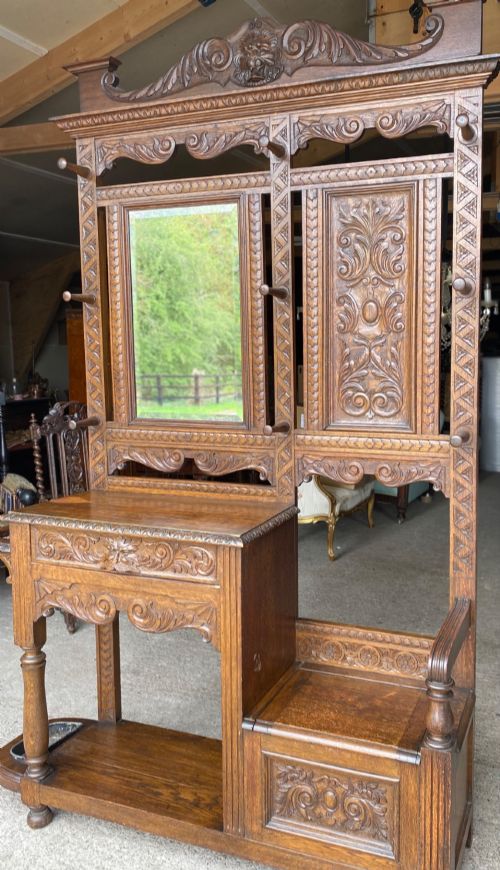
When you search for a victorian carved oak hallstand, you are looking at substantial hallway furniture designed during the nineteenth century to organise outdoor garments. These pieces typically combine coat hooks, a central mirror, umbrella wells with drip trays, and occasionally a box seat for storage.
The versions most commonly met on this page span from the 1880s through to the late nineteenth century, reflecting both country house grandeur and domestic utility. Makers produced varying scales, from narrow hall stands suited to compact porches to very large Flemish Renaissance Revival proportions.
Alongside standard configurations, the selection includes related forms such as oak umbrella stands and coat racks without mirrors. Whether executed in plain Victorian oak or heavily carved with gothic and rustic motifs, each piece serves the traditional function of hallway reception.
How they were made
Construction relies heavily on solid oak, selected for its durability and capacity to take deep, sculptural chisel work. Workshops utilised brass for hanging hooks and metal or zinc for internal umbrella drip pans to manage wet weather gear.
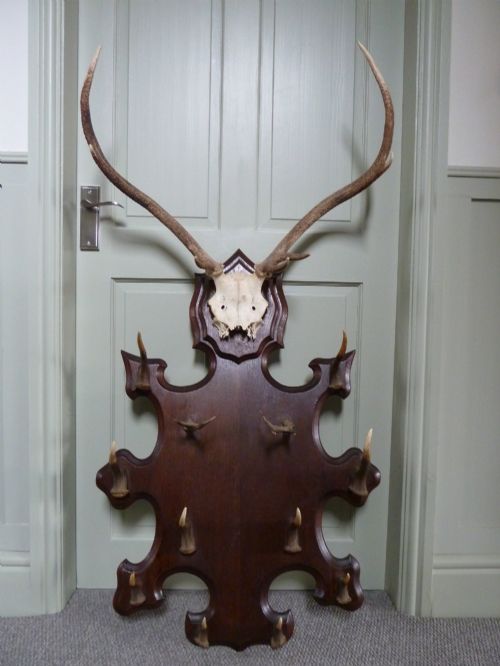
Surface ornamentation ranges from geometric mouldings to elaborate relief carving depicting knights, heraldry, and mythological figures such as the Greenman. Subsidiary materials like stag horn, bone, and glass appear on specific country house variants to accent the rustic aesthetic.
Victorian Carved Oak Hallstand Retail Price Guide 2026
Typical asking prices for victorian carved oak hallstand among the pieces listed under this phrase on Sellingantiques today, from the lower quarter to the upper quarter. They describe what is for sale here now, not the wider market.
Materials recorded across these pieces include solid oak, brass fittings, glass mirrors, and occasional accents of stag horn and bone.
What varies in quality
The distinction between ordinary and exceptional examples lies chiefly in the ambition and depth of the carving. Master carvers produced crisp relief work with distinct facial expressions on figures and deeply undercut foliage, whereas lesser pieces rely on shallow, mechanised stamping or repetitive machine routing.
Proportion and structural integrity also separate the tiers, as larger Flemish or Gothic Revival hall stands require balanced architectural elements to hold heavy mirror plates and multiple brass hooks securely. Original details, such as matching drip pans and undamaged horn or bone mounts, elevate the integrity of a piece.
Ray and Miles of Liverpool·Hinton Hall Shropshire
The Victorian Carved Oak Hallstand Glossary
- Greenman
- A sculptural motif depicting a human face emerging from or entwined with foliage. It represents rebirth and symbolises nature in nineteenth-century decorative arts.
- Gothic Revival
- An architectural and decorative style drawing inspiration from medieval forms. It appears on hall stands through pointed arches, tracery, and heavy panel construction.
- Flemish Renaissance Revival
- A revival style characterised by exuberant, deep relief carving, scrolled pediments, and bold architectural elements. Pieces in this style often display Flemish or Dutch influence.
- Drip tray
- A removable metal or zinc pan placed at the base of umbrella stands to catch moisture. Original trays are valued for authenticity in hallway furniture.
- Box seat
- A hinged bench compartment integrated into the base of certain hall stands. This feature provided hidden storage for outdoor accessories while doubling as a place to sit.
Victorian Carved Oak Hallstand: Frequently Asked Questions
What is a victorian carved oak hallstand used for?
These pieces functioned as the central organizational hub in nineteenth-century entrance halls, providing hooks for heavy outdoor coats and hats.
They also incorporated dedicated wells and trays for wet umbrellas alongside mirrors for final appearance checks before stepping outside.
How do I spot a Greenman hallstand?
Look closely at the wooden crests and central panels for carved faces surrounded by carved leaves, vines, or bursting foliage.
This distinct woodland motif is a hallmark of nineteenth-century revivalist furniture, particularly common in oak hall stands from the 1880s.
Where should I place a large hall stand?
Position your piece against a sturdy wall in a generous entrance hall, porch, or wide corridor where the structural weight and proportions balance the room.
Ensure there is sufficient clearance around the base for umbrella wells and enough ceiling height to accommodate taller carved pediments.
How do I care for nineteenth-century oak?
Maintain the wood by applying a quality beeswax periodically to nourish the grain and preserve the deep patina developed over decades of use.
Keep the piece away from direct heat sources and sudden temperature shifts to prevent the solid oak panels and carved details from splitting.