

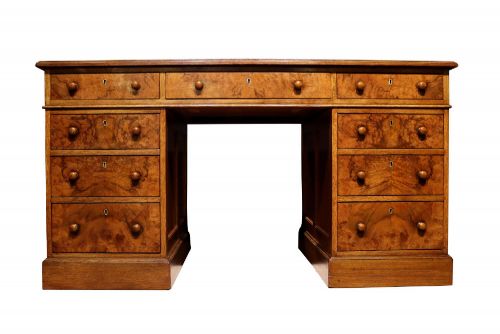
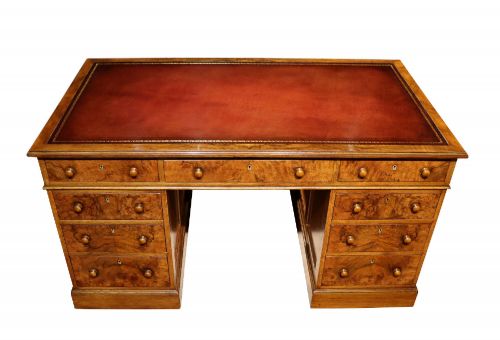


Victorian Burr Oak Desk
A victorian burr oak desk brings warmth and striking timber grain to a study, built to last through generations of daily writing.
Victorian Burr Oak Desk
When searching for a victorian burr oak desk, buyers encounter heavy nineteenth century writing furniture designed for domestic studies and libraries. The selection on this page centres primarily on pedestal desks, kneehole desks, and compact davenport forms alongside occasional library tables.
Most examples date from the Victorian era and the broader nineteenth century, utilising oak frames paired with highly figured burr veneers. These pieces range from twin pedestal formats with multiple drawers to smaller sloping writing boxes fitted with internal compartments.
How they were made
Cabinet makers constructed these desks using solid oak carcases overlaid with decorative burr oak, pollard oak, or burr walnut veneers to display swirling grain patterns across flat surfaces. Drawer interiors frequently incorporated secondary timbers such as maple, while brass handles, leather writing inserts, and turned stretchers completed the fittings.
The technique relied on precise timber selection, matching figured veneers across drawer fronts and desk tops to create symmetrical patterns. Joinery utilised traditional dovetailed drawers and sturdy framing to support heavy writing surfaces and pedestals.
Victorian Burr Oak Desk Retail Price Guide 2026
Typical asking prices for victorian burr oak desk among the pieces listed under this phrase on Sellingantiques today, from the lower quarter to the upper quarter. They describe what is for sale here now, not the wider market.
What varies in quality
Quality in these desks rests upon the density and visual impact of the burr timber figuring across the primary surfaces. Finer examples display richly patterned grain matched symmetrically across multiple drawers, whereas simpler items utilise plainer oak with minimal veneer decoration.
James Winter and Sons·Williams and Gibton
The Victorian Burr Oak Desk Glossary
- Burr oak
- Timber harvested from tree growths or burls, producing a dense, swirling grain pattern used extensively for decorative veneers on Victorian furniture.
- Pedestal desk
- A large freestanding writing table supported by two banks of drawers reaching down to the floor, often featuring a leather inset top.
- Davenport desk
- A compact writing box featuring a sloping hinged lid above a bank of drawers accessed from the side, popular during the nineteenth century.
- Library table
- A large freestanding table designed for central room placement, equipped with drawers beneath the top and finished on all sides.
- Pollard oak
- Oak timber taken from trees that were pollarded, resulting in clustered branch growth and a distinctive spotted or knotted grain figure.
Victorian Burr Oak Desk: Frequently Asked Questions
How do I care for the leather top?
Protect the leather writing surface from direct sunlight and excessive moisture by using coasters and blotters during daily use.
Feed the leather periodically with neutral balms to maintain flexibility and prevent cracking across the writing area.
Are these desks suitable for daily laptop use?
These nineteenth century desks accommodate modern technology well, provided the writing height and knee clearance match your seating requirements.
Ensure cords are managed carefully to avoid straining original drawer mechanisms or catching on modesty panels.
How do I identify burr oak from walnut?
Burr oak displays a lighter, golden-brown tone with dense swirling knots characteristic of oak growth patterns.
Burr walnut tends toward darker, richer chocolate hues with a finer, more fluid grain structure across the veneered surfaces.
Where should I place a pedestal desk?
Freestanding pedestal desks and library tables suit central room placement because their back panels are finished with the same attention as the front.
Kneehole and partner formats work effectively against walls or floating in open study spaces depending on the room layout.