
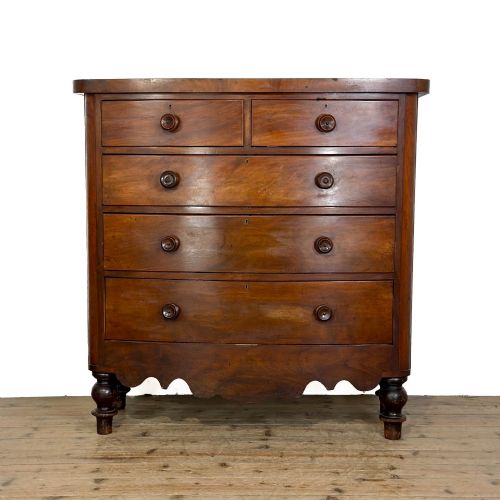
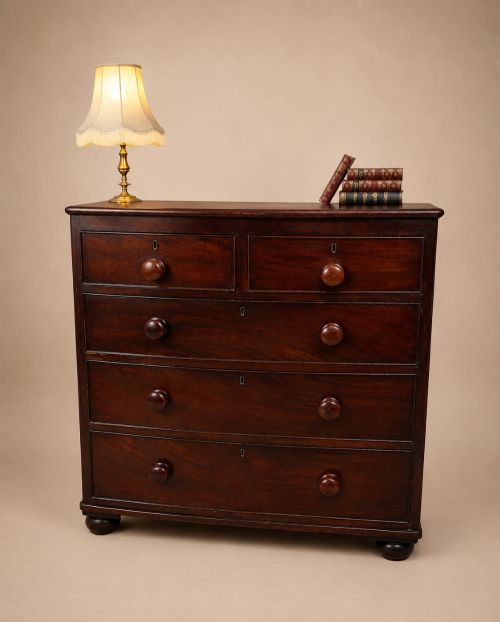
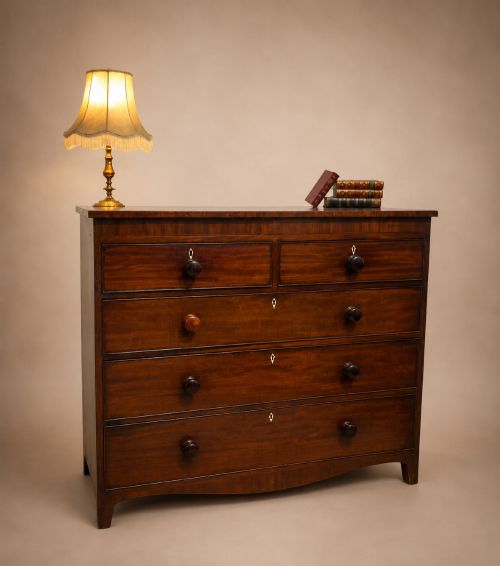
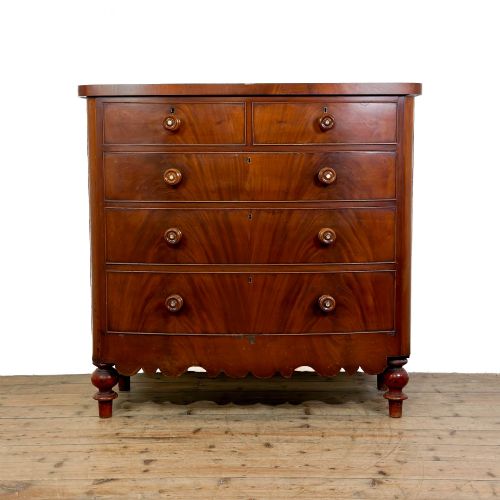
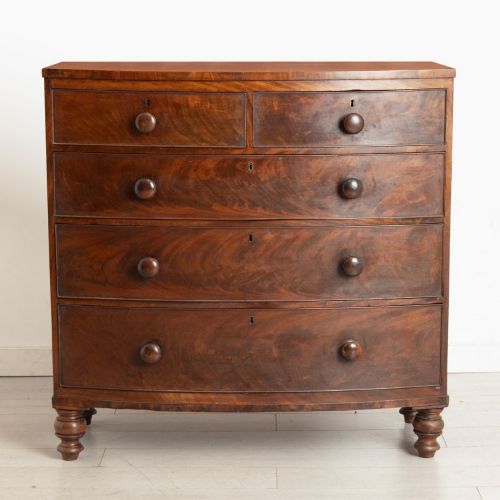
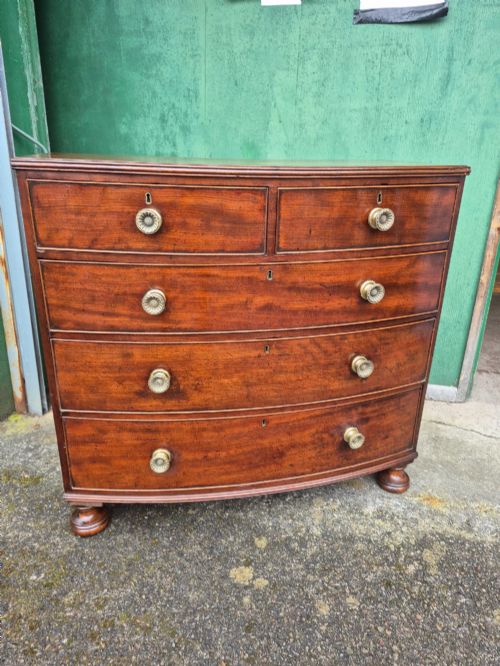
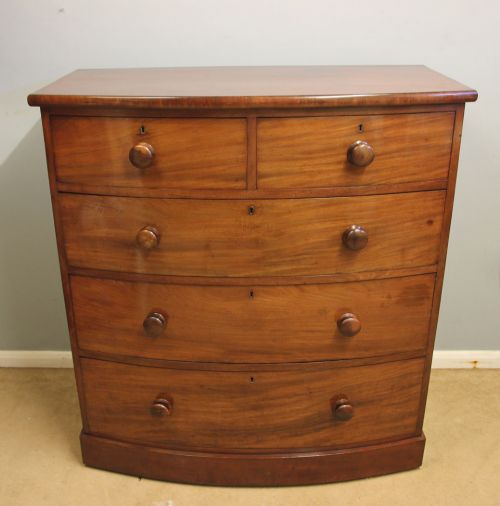

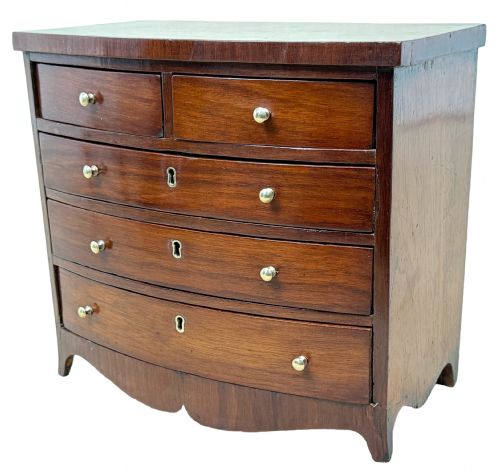
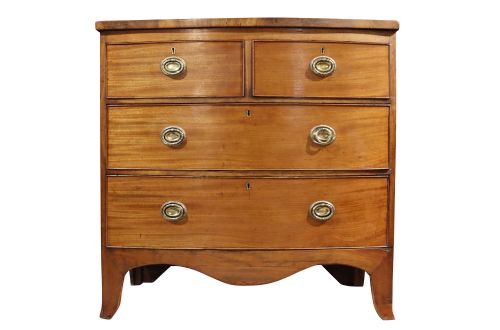


Victorian Bowfront Chest Drawers
These robust victorian bowfront chest drawers offer curving fronts and deep storage, built for practical rooms.
Victorian Bowfront Chest Drawers
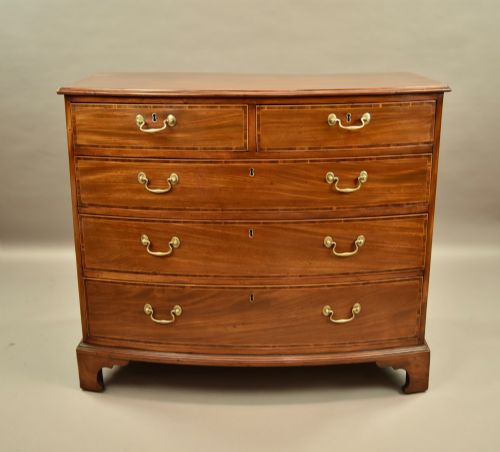
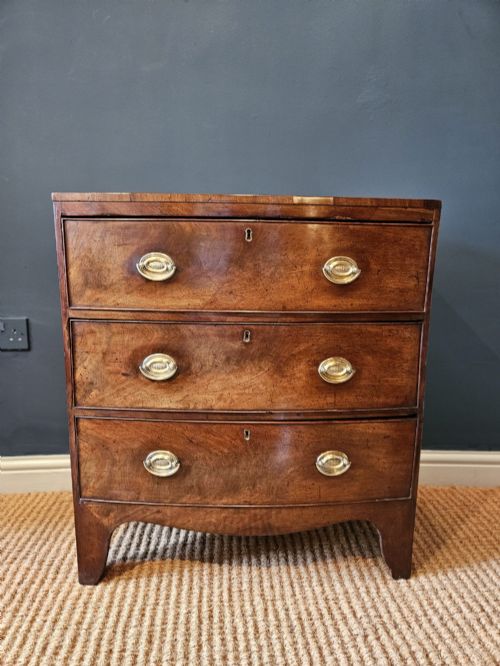
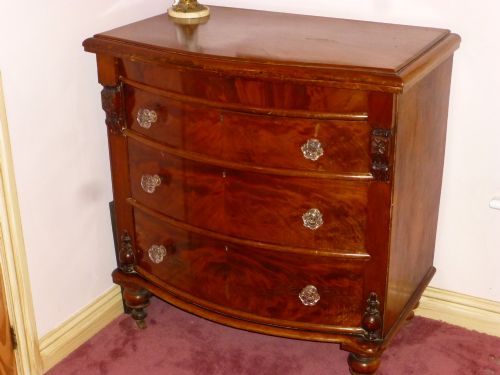
A victorian bowfront chest drawers presents a curved projecting front designed to soften room lines while holding bulk storage in bedrooms. The main examples on this page date from the nineteenth century, often span large or small proportions, and occasionally appear as miniature or bedside versions.
Makers shaped these storage pieces using solid timbers and rich veneers across decades spanning the mid to late nineteenth century. Alongside standard drawer configurations, variations incorporate secret compartments, marble tops, and commode inserts within the same curved silhouette.
Materials and construction
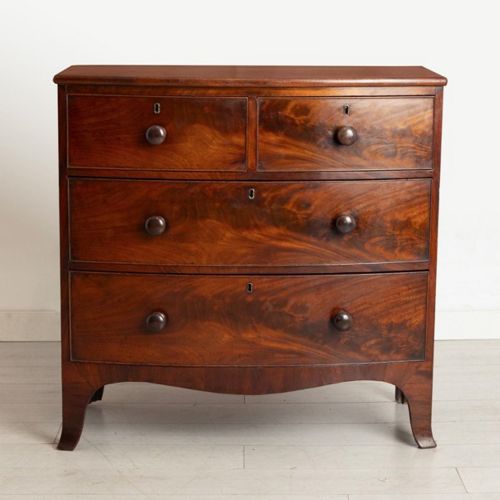
Workshops relied primarily on mahogany and flame mahogany veneer, supported by secondary pine for drawer linings and internal frames. Brass hardware appears on handles, while bone inlay and marble tops feature on specific regional and washstand variants.
Cabinetmakers bent and shaped thick timber veneers over solid carcases, turning wooden knobs and fitting drawer dividers by hand. Joinery incorporates dovetailed drawer construction to withstand daily weight and movement.
A secret drawer waits hidden in the moulding, holding quiet items away from casual view.
Defining craftsmanship and proportion
Superior examples display balanced proportions in the curve of the front and crisp figuring in the mahogany veneer. Finer pieces maintain uniform drawer movement and tight joints without relying on heavy modern repairs.
The choice of secondary timbers, the neatness of turned handles, and the presence of integrated secret compartments separate standard utility furniture from more ambitious cabinet work.
The Victorian Bowfront Chest Drawers Glossary
- Bowfront
- A convex curved cabinet front that projects outward from the corners. This shape defines the primary profile of these pieces.
- Flame mahogany
- Timber cut from the fork of the mahogany tree to create a distinctive flickering flame pattern. Cabinetmakers prized this veneer for principal drawer fronts.
- Secret drawer
- A concealed compartment built behind mouldings or within the frieze above the main drawers. These hidden spaces require specific release mechanisms to open.
- Apprentice piece
- A small-scale model demonstrating a maker's skill for trade guild entry. Miniature chests often reflect this detailed craftsmanship.
Victorian Bowfront Chest Drawers: Frequently Asked Questions
Where did people put a bowfront chest?
These chests served primarily in bedrooms and dressing rooms for storing folded garments, linens, and personal effects. Their curved projection allowed them to stand against walls while softening the geometry of the room.
Smaller versions functioned as bedside chests or washstands, fitting into narrower spaces where full-sized furniture proved impractical.
How do I date a bowfront chest?
Dating relies on observing construction methods, timber choice, and handle styles across the nineteenth century. Earlier pieces often display finer mahogany veneers and hand-cut dovetails, while later decades introduce standardised turned wooden knobs.
Associated dates in the evidence span from the 1840s through the Edwardian period, with distinct shifts in proportion and decorative inlay marking the progression of styles.
What is a Scotch chest?
A Scotch chest denotes a regional variant of drawer storage originating from Scotland during the nineteenth century. These pieces frequently incorporate a deep top drawer flanked by smaller accessory drawers above the main bank.
They share the curved bowfront profile but exhibit heavier proportions and distinct internal framing compared to standard English equivalents.
Are miniature chests apprentice pieces?
Miniature chests represent small-scale cabinet work created either as masterworks by trainees or as specialised salesman samples. These scaled-down pieces duplicate the joinery and curved drawer configuration of full-sized furniture in miniature.
They provide the same visual presence and storage utility on a compact scale suited for tabletops or small surfaces.