


Victorian Aesthetic Jewellery
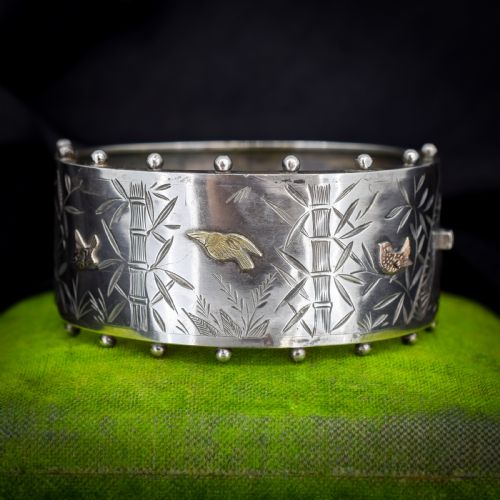
These pieces of victorian aesthetic jewellery bring together silver, gold, and bamboo motifs from the nineteenth century.
Victorian Aesthetic Jewellery
When you search for victorian aesthetic jewellery, you are looking at nineteenth-century ornaments and small accessories designed during the height of the Aesthetic Movement. These items encompass bangles, earrings, and lockets alongside larger receptacles such as jewellery boxes and collectors cabinets.
The pieces you are most likely to meet on this page date from the eighteen-eighties and eighteen-nineties, frequently combining silver and gold. They reflect a distinct shift away from heavy high-Victorian ornamentation towards cleaner lines and Japanese-inspired natural motifs.
Bird and bamboo designs recur across the cuffs, bracelets, and lockets listed here, capturing the period's fascination with nature. Alongside personal adornment, the selection includes fitted boxes and bowls that served the dressing table or cabinet.
Materials and construction
Makers utilised sterling silver, rose gold, and brass to form the structural foundations of these bangles, earrings, and lockets. Precious metals were frequently combined within a single piece, contrasting silver bodies with yellow or rose gold highlights on engraved or applied motifs.
Cabinetmakers and box makers employed coromandel, painted wood, and metal hardware to construct storage pieces like jewellery boxes and collectors cabinets. Metalwork involved chasing, studding, and hinged construction to create functional clasps and secure closures.
Swallows and bamboo stalks appear repeatedly in silver, ensuring your wrists and lockets stay resolutely avian.
Distinctions in quality
Quality in victorian aesthetic jewellery rests upon the crispness of the engraved natural motifs and the integration of mixed metals. Pieces that display sharply defined bird and bamboo details or precise studding stand apart from plainer, more commercial output.
For larger items and boxes, the standard of construction is judged by the selection of timbers like coromandel and the structural integrity of internal fittings. The balance between decorative surface work and durable mechanics dictates the overall standing of each piece.
James Hennell
The Victorian Aesthetic Jewellery Glossary
- Aesthetic Movement
- A late nineteenth-century design movement that emphasised visual beauty over narrative or moral content. It drew heavily from Japanese art and nature.
- Cuff Bangle
- A rigid, open or hinged bracelet that encircles the wrist. In this period, they often featured textured surfaces and mixed metal applications.
- Coromandel
- A dense, dark cabinet wood prized for its rich grain and contrasting figure. It was frequently utilised for high-end nineteenth-century boxes.
- Sterling Silver
- A silver alloy containing substantial pure silver alongside other metals to ensure durability. Hallmarks on these items often indicate the year and place of assay.
Victorian Aesthetic Jewellery: Frequently Asked Questions
How do I wear a cuff bangle?
Cuff bangles sit directly on the wrist as standalone statement pieces. Hinged versions secure firmly around the arm for daily wear.
Their mixed metal construction allows them to pair easily with both silver and gold items.
How were lockets used?
Lockets held miniature portraits, locks of hair, or small mementoes close to the body. They hung from chains or were integrated into broader jewellery ensembles.
Swallow and bird motifs on these pieces carried sentimental meanings popular during the period.
How do I care for coromandel boxes?
Coromandel boxes require stable humidity and temperature away from direct sunlight to protect the dense wood grain. Gentle dusting preserves the polished finish.
Internal velvet or silk linings should be kept dry and protected from sharp objects.
How can I tell the period?
Nineteenth-century pieces often bear hallmarks, maker's marks, or registration dates stamped into the metal. Stylistic markers like bamboo texturing also point directly to the eighteen-eighties and nineties.
Construction techniques, such as hinged cuff mechanisms and applied gold work, corroborate the era.