


Upholstered Ottoman Trunk
An upholstered ottoman trunk is a versatile storage seat for the home, combining a concealed box with a cushioned top.
Upholstered Ottoman Trunk
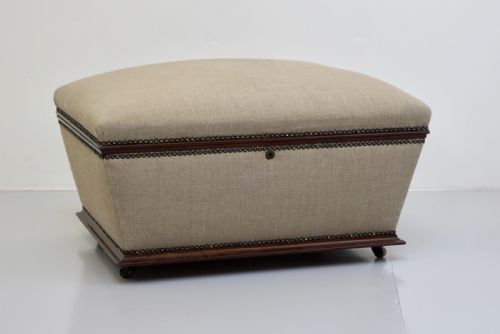
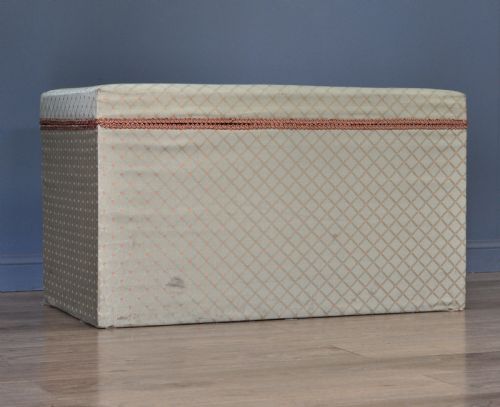
When searching for an upholstered ottoman trunk, you are looking for a dual-purpose piece of furniture that functions as both a storage chest and a comfortable seat. The examples seen on this page span the Victorian period and the early 20th century, encompassing styles such as Victorian Country and English Country House.
You are most likely to encounter pine and mahogany storage chests, alongside walnut hall benches and blanket boxes. These pieces often feature textile coverings ranging from beige linen to crewel work and yellow upholstery, sometimes shaped with concave profiles.
The forms vary from simple pine kist chests to large country house storage ottomans and deep buttoned variants. Makers such as Hallett & Sons appear in the record alongside pieces from the 1860s, 1870s, 1880s, 1900s, 1910s, 1920s, and 1930s.
Materials and Construction
The primary structural woods recorded are pine, mahogany, walnut, birch, and general wood, providing sturdy carcasses for daily seating and storage. These wooden frames are complemented by hardware and supports in brass and iron.
Surface treatments and upholstery utilise fabric, linen, leather, and crewel work. Construction techniques include deep buttoning and concave shaping of the padded lids.
One recorded pine chest doubles as a toy box, preserving centuries of domestic clutter.
Factors of Quality
The grade of an upholstered ottoman trunk rests upon the selection of timber and the execution of the woodwork. Dense hardwoods like mahogany and walnut indicate a higher tier of production than standard pine.
Quality also appears in the upholstery work, where deep buttoning and detailed textile choices such as crewel work demonstrate greater labour and refinement than plain fabric coverings.
Hallett & Sons
The Upholstered Ottoman Trunk Glossary
- Ottoman
- A padded seat or bench without a back or arms, typically featuring a hinged lid that opens to reveal storage space. It serves as both furniture for sitting and a practical chest.
- Blanket box
- A large rectangular chest traditionally used for storing linens, blankets, and textiles. In this context, it is modified with padding to function as a seat.
- Kist
- A traditional regional word for a heavy wooden storage chest or trunk. These pieces are often constructed from pine and built for robust domestic utility.
- Crewel work
- Traditional embroidery executed with wool yarn on a plain fabric ground. It appears on the upholstered lids of Victorian examples.
- Concave
- A curved inward profile shaping the sides or front of the ottoman. This silhouette is frequently observed on Victorian mahogany and walnut pieces.
Upholstered Ottoman Trunk: Frequently Asked Questions
What is an upholstered ottoman trunk used for?
These pieces provide concealed storage for blankets, linens, and household items while doubling as a functional seat.
They sit easily in bedrooms at the foot of a bed, in hallways, or within living spaces as occasional seating.
How do I date an antique ottoman?
Dating relies on identifying timber choices, hardware, and upholstery styles recorded across the 19th and early 20th centuries.
Victorian pieces often feature mahogany or pine with deep buttoning, while Edwardian and later examples introduce lighter woods and alternative textiles.
Are these trunks suitable for daily seating?
The internal wooden frames and padded tops are constructed to support the weight of sitting.
Heavier hardwood models in mahogany or walnut offer particularly robust foundations for regular use in busy rooms.
What materials should I expect to find?
The structural bodies are built from woods including pine, mahogany, walnut, and birch, sometimes reinforced with brass or iron fittings.
Upholstery finishes cover a spectrum from plain leather and linen to decorative crewel work and textured fabrics.