


Underglaze Printed Ceramic
Underglaze printed ceramic pieces carry enduring blue and white transfer designs beneath a glossy protective glaze, offering collectors tangible fragments of Georgian and Victorian domestic history.
Underglaze Printed Ceramic
Underglaze printed ceramic items encompass a range of domestic tableware produced across the eighteenth and nineteenth centuries, including decorative plates, serving platters, tea bowls, and pickle dishes. When exploring this selection, buyers most frequently encounter blue and white transfer printed pieces originating from English potteries during the Georgian and Victorian eras.
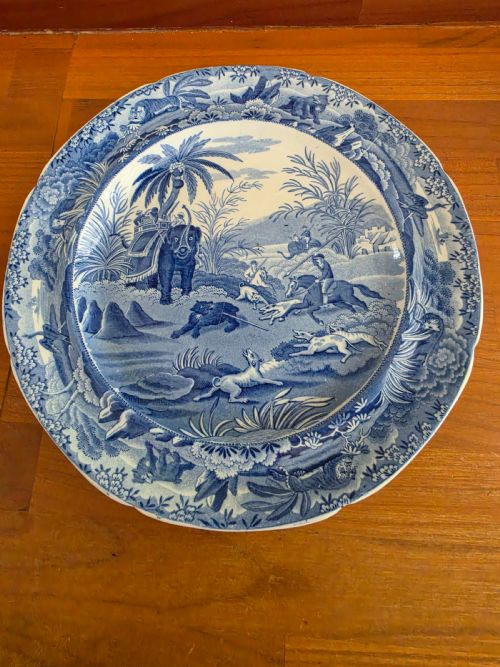
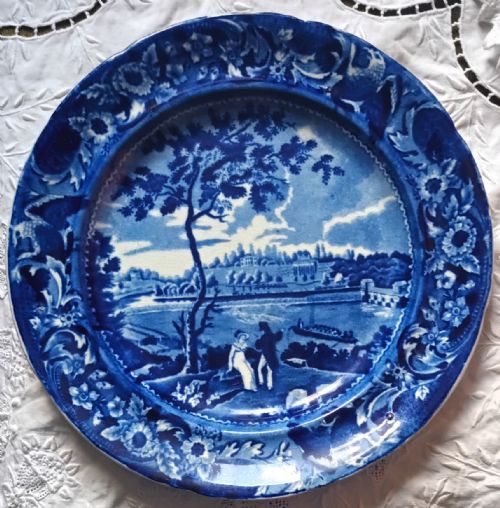
The inventory on this page spans several distinct periods, reaching from eighteenth-century soft-paste porcelain tea bowls to nineteenth-century earthenware meat dishes and serving platters. Makers applied specific topographical views, architectural subjects such as mausoleums, and animal patterns including water dogs and elephants directly onto the clay body before firing.
Forms vary from utilitarian bread stands and asparagus dishes to delicate spoon trays and decorative plates. Each piece demonstrates the translation of copperplate engravings onto curved ceramic surfaces, capturing landscape scenes and exotic narratives popular in British households of the time.
Materials and production methods
Potters utilised earthenware, pearlware, and porcelain as the primary foundational bodies for these wares, shaping them into plates, platters, and small trays. Earthenware and pearlware provided a stable porous base that absorbed the pigment successfully during the kiln process.
Cobalt underglaze pigment formed the basis of the transfer print, applied via paper pulled from engraved copper plates onto the biscuit ceramic. A transparent glaze coat was then applied over the printed design before the final high-temperature firing locked the pigment permanently beneath the surface.
Listings feature earthenware, pearlware, and porcelain across the Georgian and Victorian periods, with forms ranging from tea bowls to large meat platters.
Markers of quality and execution
Quality in these ceramics rests upon the crispness of the transfer print and the clarity of the underlying paste. Finer examples display sharp lines in complex pictorial scenes without blurring or smudging from the copperplate application.
The depth and uniformity of the glaze contribute significantly to the finished object, protecting the cobalt pigment while providing an even, lustrous sheen across earthenware and porcelain forms alike.
Stubbs·Worcester·Copeland and Garrett·Mason·John Rogers and Son
The Underglaze Printed Ceramic Glossary
- Underglaze
- A decoration method where pigments are applied to the unglazed ceramic body before the glaze coating is fired. This protects the design beneath a glassy layer.
- Transferware
- Pottery decorated by pulling a printed design from an engraved copper plate onto tissue paper, which is then transferred onto the clay body. It enabled mass production of detailed pictorial scenes.
- Pearlware
- A refined earthenware developed in the late eighteenth century featuring a subtle bluish glaze that pooled in crevices to mimic Chinese porcelain. It served as a common ground for blue printing.
- Soft-paste porcelain
- A ceramic composition fired at lower temperatures than hard-paste porcelain, common in eighteenth-century English factories. It yields a warm, translucent body.
- Biscuit
- Unglazed ceramic fired once in the kiln to harden the body before the application of glaze and subsequent secondary firing. It provides a porous surface for absorbing transfer prints.
Underglaze Printed Ceramic: Frequently Asked Questions
What is underglaze printing?
Underglaze printing involves applying a pigment design onto the ceramic body before the glaze is added and fired. This technique ensures the decoration is permanently sealed beneath a protective glass layer.
In these listings, cobalt blue was typically used with copperplate engravings to transfer intricate topographical and pictorial scenes onto plates and platters.
How do I date these ceramics?
Dating relies on identifying the ceramic body type, such as pearlware versus later nineteenth-century earthenware, alongside stylistic clues in the printed borders and scenes. Factory marks where present also provide specific chronological markers.
Pieces range from eighteenth-century soft-paste tea bowls to Victorian meat dishes, each reflecting the manufacturing standards of their respective decades.
Were these pieces used daily?
Many items, such as meat platters, bread stands, and serving dishes, were designed for active use at the dining table during the Georgian and Victorian periods. Others, like tea bowls and small pickle dishes, served more specific social and culinary functions.
Their durability stems from the successful fusion of the cobalt print beneath the high-fired glaze during production.
How do I care for antique transferware?
Care involves gentle hand washing in warm water with mild soap to preserve the nineteenth-century glaze and earthenware bodies. Harsh abrasives and modern dishwashers should be avoided to protect the historic surfaces.
Displaying them safely on stable surfaces or plate stands ensures these ceramic items remain protected for daily appreciation.