


Two Section Tallboy
A two section tallboy offers exceptional storage by dividing its imposing height into manageable halves, making these stacked chests remarkably practical for period interiors.
Two Section Tallboy
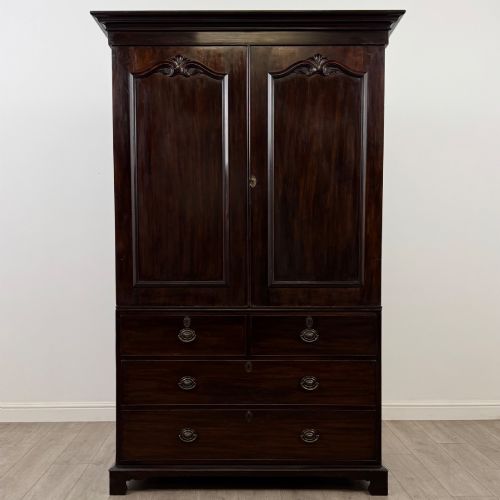
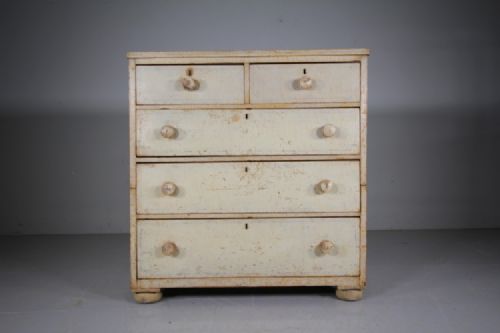
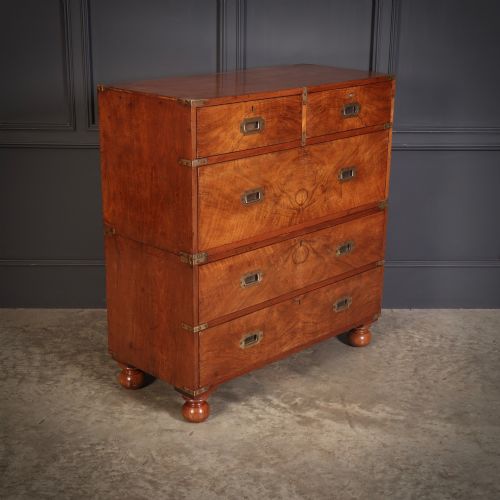
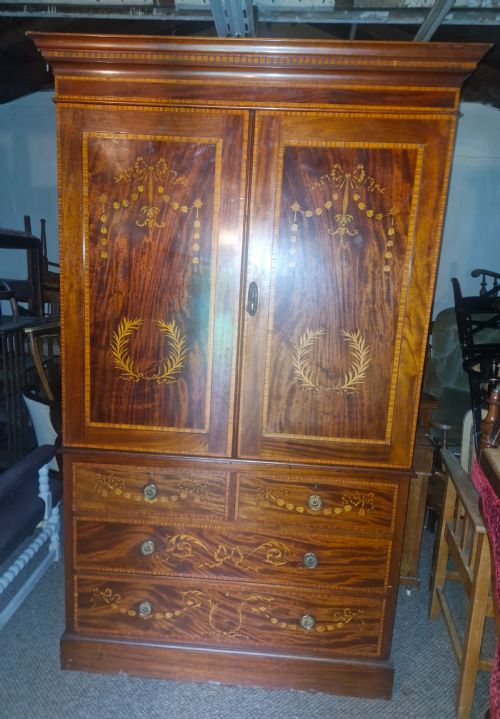
A two section tallboy comprises two distinct carcasses stacked one atop the other, functioning primarily as a chest of drawers or linen press for bedroom storage. These pieces combine substantial vertical capacity with the crucial ability to separate for transport.
The versions encountered here span from the seventeenth century through to the Edwardian period, manifesting in styles ranging from Georgian and Regency to Victorian military campaign. Cabinets, linen presses, and chests of drawers form the main variations within this selection.
Materials and Construction
Cabinetmakers utilised durable hardwoods such as mahogany, oak, walnut, teak, and padauk, often selecting figured veneers and burr walnut for decorative impact. Brass fittings and recessed handles appear frequently on campaign pieces designed for travel.
The defining characteristic of these objects is the two-part construction, where a top chest rests securely upon a lower base or chest. Secondary woods and traditional joinery methods support the heavy framework of these tall structures.
Mahogany and teak dominate the wood selections across these listings, appearing alongside oak and walnut in both campaign and domestic forms.
Assessing Quality and Execution
Quality rests upon the selection of timbers, such as finely figured mahogany or richly patterned burr walnut, and the precision of crossbanding or inlay work. The crispness of geometric mouldings and the integration of brass hardware distinguish superior examples.
Structural integrity depends on how cleanly the two sections meet and align when stacked. Original surface patination and untouched cabinetwork elevate pieces above later alterations or heavy restorations.
Druce & Co.·Army & Navy·Whytock & Reid of Edinburgh
The Two Section Tallboy Glossary
- Tallboy
- A tall chest of drawers formed of one section stacked upon another, providing high-capacity storage. These items maximise vertical space in traditional rooms.
- Campaign chest
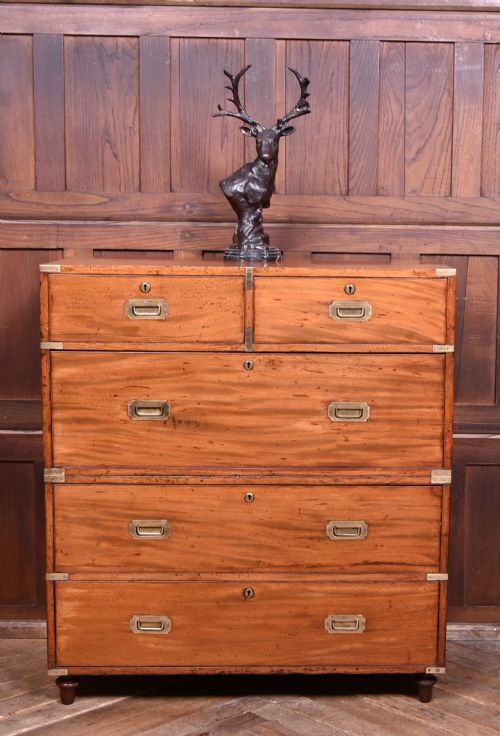
- A portable chest of drawers built in two separate sections with recessed brass handles and corner brackets. Officers utilised these for easy transport during military campaigns.
- Linen press
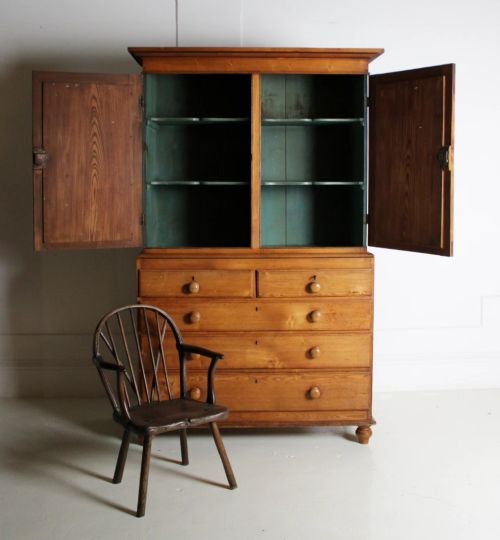
- A tall cabinet featuring upper cupboard doors enclosing sliding trays or shelves, positioned above a base of drawers. Households used these to store and press textiles.
- Crossbanding
- A decorative border of veneer laid around the perimeter of a drawer front or panel with the grain running perpendicular to the central field. This technique frames the wood figure effectively.
- Padauk
- A dense tropical hardwood with a rich reddish-brown tone, often found in Anglo-Indian furniture. Craftsmen valued this timber for its strength and resilience.
Two Section Tallboy: Frequently Asked Questions
Why were these made in two sections?
Splitting a tall piece of furniture into two separate boxes made it considerably easier to transport up narrow staircases and move between rooms. This modular approach also aided travel for military officers.
Over time, this practical design feature became a defining stylistic characteristic for tall storage chests and campaign furniture.
How do I tell a campaign chest apart?
Military campaign pieces typically feature brass corners, flush-fitting handles that do not protrude, and a construction explicitly designed to separate into two distinct carcases. They often utilise durable timbers like teak or mahogany.
Standard domestic tallboys lack these portable hardware details and usually remain as single tall units or two-part chests without military reinforcement.
What is inside a linen press?
Opening the upper doors of a linen press reveals sliding wooden trays, known as slides, originally intended for flat linens and garments. The lower section contains standard drawers for additional clothing storage.
Many examples have been converted internally over the decades to accommodate hanging clothes instead of traditional sliding trays.