

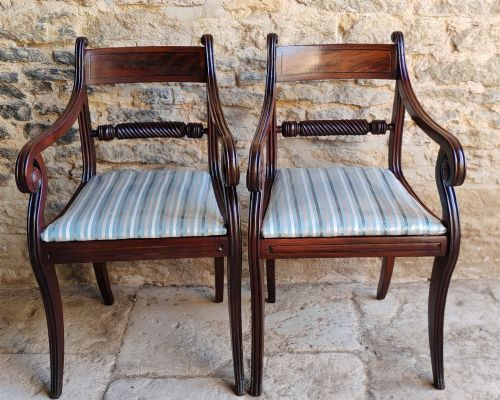


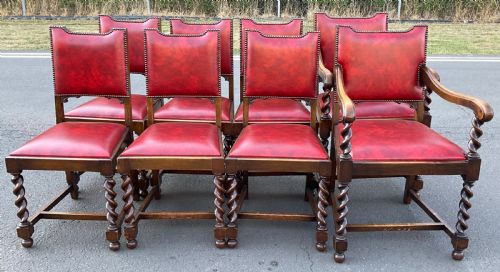


Twist Leg Armchair
A twist leg armchair brings structural rhythm and tactile warmth to a room through its characteristic turned supports.
Twist Leg Armchair
When you search for a twist leg armchair, you enter a lineage of seating that spans centuries of British cabinet making, from early seventeenth-century laburnum and walnut pieces to nineteenth-century oak and mahogany revivals. These chairs combine functional arm support with the decorative turning of timber legs and stretchers, offering both visual interest and sturdy construction for daily use.
On this page, the pieces you meet most often date from the Georgian, Regency, and Victorian eras, alongside later revival interpretations in oak and mahogany. Forms range from library armchairs and open arm carvers to substantial throne and dining chairs fitted with upholstery fabric, leather, velvet, or cotton calico.
The regional origins and workshop traditions behind these chairs dictate their proportions and the tightness of their turnings, reflecting the prevailing styles of their respective periods. A buyer encounters everything from seventeenth-century walnut frames to mid-nineteenth-century barley twist library seating, each demonstrating a distinct approach to domestic comfort.
Materials and construction
The makers of these chairs relied primarily on hardwoods such as oak, mahogany, walnut, and laburnum to achieve the structural integrity required for armchairs. Timber selection dictated the definition of the turned elements, with dense grain allowing for crisp execution along the legs and stretchers.
Upholstery techniques varied widely across the centuries, utilising materials ranging from traditional horsehair and webbing beneath cotton calico to velvet, leather, and fabric top covers. Brass components occasionally appeared in castors or decorative hardware on later Regency and Victorian examples.
Listings feature oak, mahogany, walnut, and laburnum timbers across periods from the seventeenth century to the twentieth.
Assessing quality and proportion
Quality in these chairs rests upon the crispness of the timber turning and the harmony of the proportions between the arms, legs, and back. Superior examples display deep, uniform definition in the twist without timber splitting, maintaining structural balance under weight.
The integration of the upholstery with the wooden frame separates standard production from finer work, where the covering sits flush against the contours without masking the architectural lines of the turned supports.
The Twist Leg Armchair Glossary
- Carver chair
- An armchair, typically designed en suite with a set of dining chairs to sit at the head of a table. These pieces feature supportive armrests integrated into the framing.
- Bergere
- An enclosed armchair with upholstered back and sides, often featuring exposed wooden frames and cane or upholstered panels. The style provides a deep, comfortable seat.
- Barley twist
- A type of decorative turning resembling a twisted rope or column, prevalent in seventeenth-century furniture and later revived during the Victorian era. This form catches the light along its helical ridges.
- Stretchers
- The horizontal wooden rails connecting the legs of a chair to provide structural stability. In twist leg seating, these rails frequently feature matching turned decoration.
- Revival
- A nineteenth-century design movement that looked back to earlier historical periods, such as Jacobean, Carolean, and Gothic styles. These pieces reinterpreted historic forms using contemporary workshop methods.
Twist Leg Armchair: Frequently Asked Questions
How do I date a twist leg armchair?
Dating relies on identifying the timber species, the sharpness of the turning profile, and the construction joints used in the frame. Earlier pieces from the seventeenth century often utilise dense hardwoods like walnut or laburnum, while nineteenth-century revivals favour oak and mahogany.
Examining the wear patterns and upholstery methods beneath the surface also helps establish the era of manufacture. Comparing the stylistic cues of the arms and backrest to documented period examples confirms the approximate decade.
What is the difference between a carver and a library chair?
A carver chair is traditionally built with open arms and a lighter frame to serve alongside a set of dining chairs. Library chairs are typically broader, deeper, and heavily upholstered for extended periods of reading and relaxation.
Library armchairs often feature padded armrests and lower seats to enhance comfort. Carver chairs prioritise upright posture and ease of movement around a dining table.
How should I care for timber frames and upholstery?
Maintain the timber by keeping the chair away from direct heat sources and applying appropriate furniture wax sparingly. Regular dusting prevents particulate buildup in the crevices of the turned legs.
Protect fabric or leather upholstery by avoiding prolonged exposure to direct sunlight. Professional cleaning is recommended for delicate textiles like velvet and historical cotton calico.