
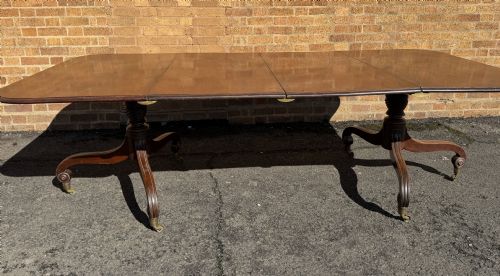
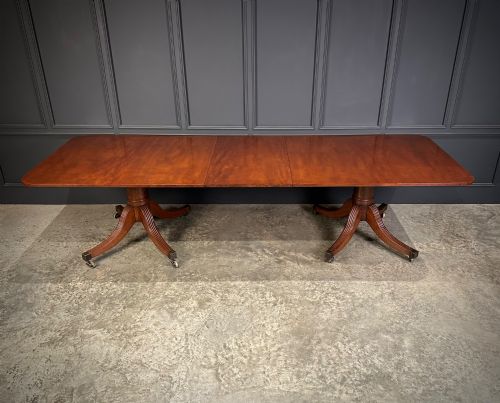
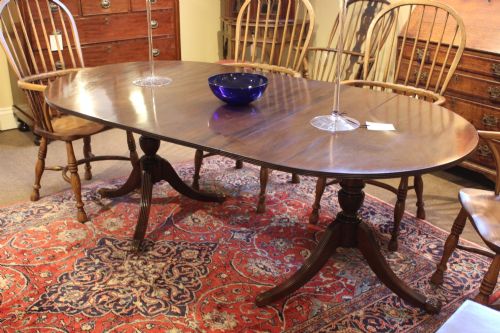

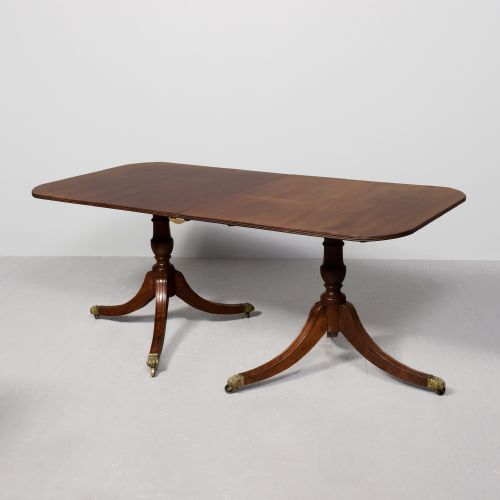


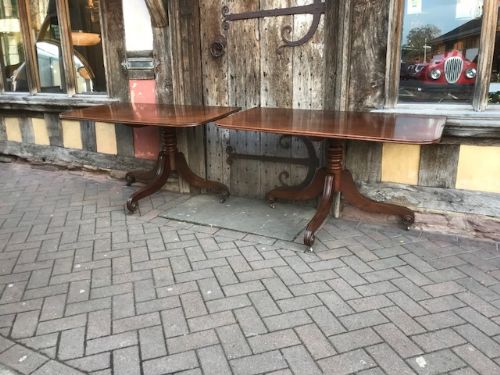

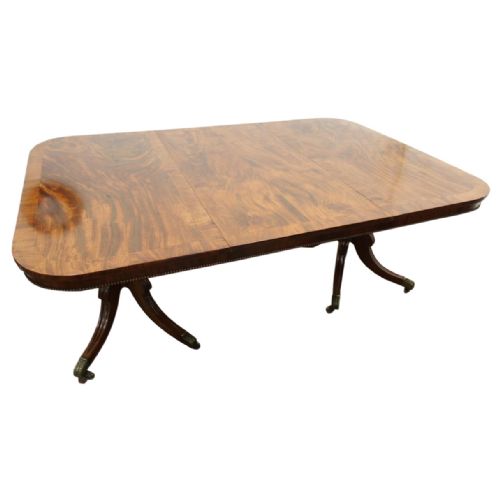


Twin Pillar Conference Table
A twin pillar conference table brings generous proportion and formal balance to a large room, offering a commanding surface built for gathering.
Twin Pillar Conference Table
A twin pillar conference table provides a substantial mahogany surface supported by two distinct pedestals, designed originally for dining and readily adapted for meetings. These pieces emerge primarily from the Georgian, Regency, and Edwardian eras, extending through the nineteenth and early twentieth centuries in various revivals.
Buyers encounter formats labelled as dining tables that function equally well as boardroom desks, spanning lengths that accommodate twelve to sixteen seats. The prevailing material remains mahogany, shaped into D-end configurations and pedestal arrangements across multiple decades.
How they were made
Cabinet makers utilised solid and figured mahogany to construct the tops and pedestals, often selecting Spanish mahogany for superior grain pattern and depth of colour. Brass components frequently appear on the feet, providing both decorative contrast and protection.
The structural integrity relies on the twin pillar configuration, where central columns branch out into supporting legs that bear the weight of the extended top. Carpenters joined separate leaves with precision to ensure the surface remains level when expanded.
Some nineteenth-century tables include clever brass mechanisms hidden beneath the leaves to keep everything aligned during lively debates.
What varies in quality
The distinction between standard and exceptional pieces rests in the selection of the timber, particularly the figuring visible across the mahogany top. Finer examples display intricate grain patterns and careful matching of leaves that indicate higher grade materials.
Proportion and construction execution dictate the overall standard, separating utilitarian workshop output from master cabinet work. Refined turning on the pedestals and well-cast brass fittings elevate certain examples above simpler contemporary equivalents.
William Trotter
The Twin Pillar Conference Table Glossary
- Twin pillar
- A table design supported by two distinct central pedestals rather than four corner legs. This construction allows greater legroom along the sides.
- D end
- A semicircular table end that resembles the letter D, often found on modular dining tables. These sections detach or attach to alter the overall length.
- Spanish mahogany
- A dense and richly figured timber prized by cabinet makers for high-status furniture. It displays deep reddish-brown tones and distinctive grain patterns.
- Regency style
- A British design movement spanning the early nineteenth century characterised by classical restraint and neoclassical motifs. Furniture from this period often incorporates bold mahogany veneers and brass detailing.
- Removable leaf
- A separate section of timber inserted into the centre of a table to expand its surface area. These components allow the table to adjust for different gatherings.
Twin Pillar Conference Table: Frequently Asked Questions
What is a twin pillar conference table?
A twin pillar conference table is a large antique dining table supported by two central pedestals, which provides ample legroom and a formal appearance suited for boardrooms.
These pieces typically date from the Georgian and Regency periods through to the early twentieth century, constructed primarily in mahogany.
How do you use extra leaves?
Extra leaves slide into the centre of the table when separated at the pedestals, secured by mechanical brass clips or wooden pegs.
This mechanism allows the table to expand or contract depending on the seating requirements of the room.
How do I care for mahogany surfaces?
Mahogany requires regular dusting with a soft cloth and occasional treatment with quality beeswax to preserve the natural lustre of the timber.
Avoid placing these tables in direct sunlight or near heat sources to prevent the wood from drying out or splitting.
How do I identify Regency style?
Regency style furniture exhibits clean classical lines, architectural restraint, and a strong reliance on figured mahogany veneers without excessive ornamentation.
Subtle brass inlays and reeded edges often accompany the pedestals and D-end sections of tables from this era.