


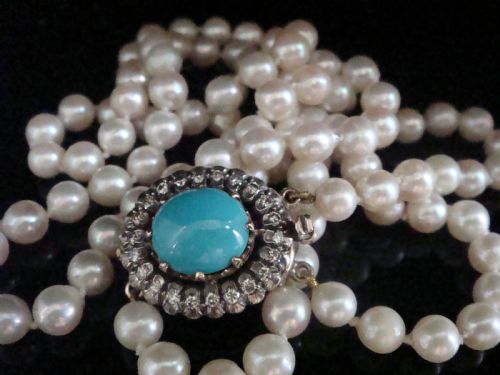


Turquoise Pearl Necklace
A turquoise pearl necklace brings together vibrant blue stones and lustrous organic gems in gold or silver settings from the Victorian and Edwardian eras.
Turquoise Pearl Necklace
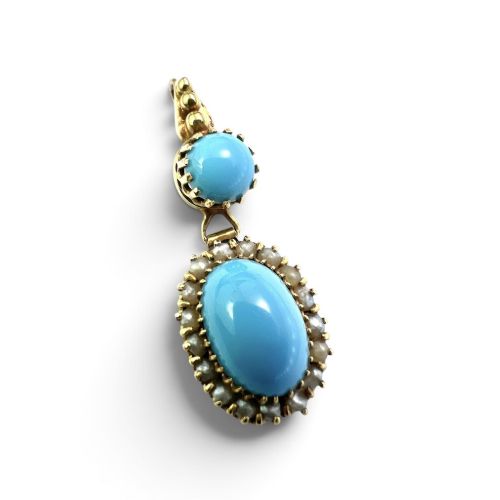
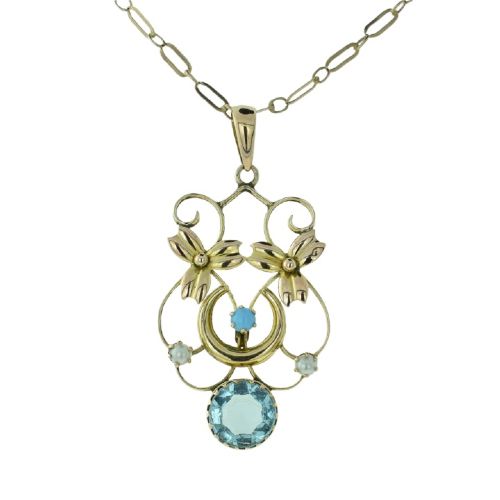
A turquoise pearl necklace combines bright blue stones and delicate pearls in pendant, chain, and bar configurations. These antique items emerge most frequently from Victorian and Edwardian workshops, utilising gold and silver.
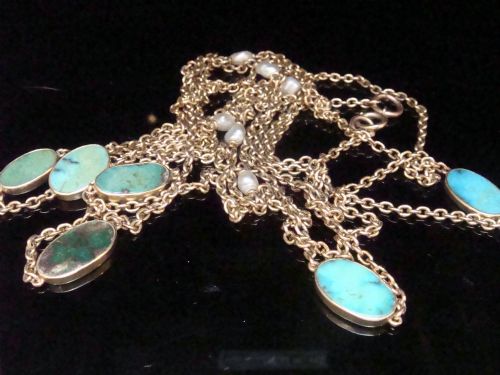
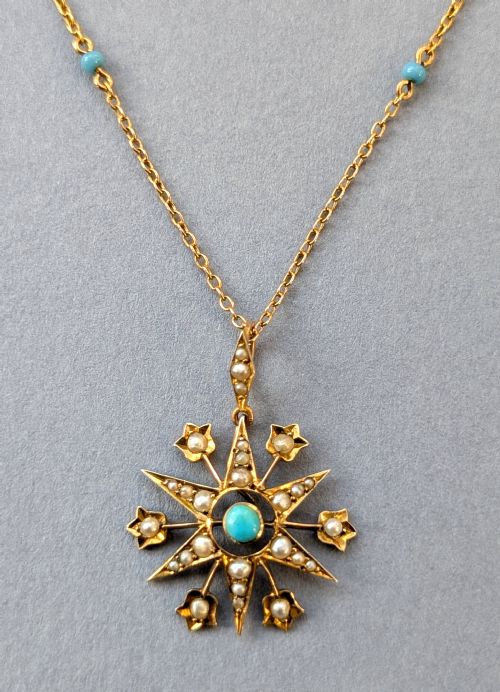
The pieces on this page span several decades, featuring classic traditional designs alongside distinct Arts and Crafts creations. Pendants and longuard chains dominate the selection, often pairing the blue minerals with seed pearls.
Makers of the period arranged these materials into stars, crosses, hearts, and floral motifs. Buyers encounter both delicate collar lengths and substantial thirty-two-inch chains intended to be doubled or tripled.
How they were made
Goldsmiths utilised nine carat, fifteen carat, and eighteen carat gold alongside silver to mount the gems. Metalwork ranges from simple bezels to intricate wirework and enamel integration.
Pearls and turquoise stones are typically set into closed or open backs using claw settings or adhesive techniques common to the nineteenth and early twentieth centuries. Natural, seed, blister, and cultured pearls appear alongside solid turquoise and turquoise matrix.
Makers constructed pendants with articulated drops, hollow links, and integrated chains. Enamel work and secondary stones such as diamonds, white sapphires, and blue topaz supplement the primary turquoise and pearl combinations.
Several pieces squeeze turquoise, pearls, doves, and hearts into a single pendant, ensuring the wearer carries an entire Victorian aviary.
What varies in quality
The purity and weight of the gold mountings dictate the baseline substance of each piece, moving from nine carat up to eighteen carat gold and heavier gram weights. The presence of maker marks or attribution to known firms adds considerable distinction.
The uniformity and natural colour of the turquoise stones, alongside the orient and matching of the pearls, define the visual impact. Settings that incorporate enamelling, diamonds, or balanced matrix patterns demonstrate superior craftsmanship.
Structural integrity, including the original length of longuard chains and the survival of delicate seed pearl clusters without loss, separates well-preserved examples from heavily restored pieces.
Murrle Bennett·Liberty and Co
The Turquoise Pearl Necklace Glossary
- Seed pearl
- A tiny, naturally small pearl, typically under two millimetres in diameter. These are often drilled and threaded closely together or set in clusters.
- Longuard chain
- An extra-long necklace, frequently thirty-two inches or more in length, designed to be worn doubled or attached to a watch.
- Turquoise matrix
- Turquoise stone that retains portions of its host rock, showing web-like veining through the blue material.
- Arts and Crafts
- A design movement valuing handcraftsmanship and simple materials over mass production. Pieces from this style often feature hammered silver and prominent enamel work.
- Blister pearl
- A pearl that has grown attached to the inside shell of the mollusc, resulting in a domed shape with a hollow or flat back.
Turquoise Pearl Necklace: Frequently Asked Questions
How do I date a turquoise pearl necklace?
Dating relies on material hallmarks, metal purity standards such as nine carat or fifteen carat gold, and stylistic clues. Victorian pieces often use heavy yellow gold and sentimental motifs like hearts and stars.
Edwardian items frequently display lighter settings, platinum accents, or delicate filigree work. The inclusion of Arts and Crafts enamel points towards the turn of the twentieth century.
Were these necklaces worn every day?
Longuard chains and shorter pendants served both daily wear and formal occasions. Longer chains allowed women to suspend watches or lockets for practical daily utility.
Pendant necklaces with turquoise and pearls were frequently chosen for social gatherings and afternoon wear. Their delicate seed pearl elements meant they required care during active use.
How should I clean my antique necklace?
Turquoise and pearls are soft, porous materials that absorb moisture and chemicals easily. Avoid ultrasonic cleaners, harsh detergents, and prolonged soaking.
Wipe the gold or silver metal and the gems gently with a soft, dry cloth after wearing. Keep the piece stored away from direct sunlight and cosmetics to preserve the turquoise colour.
What is the difference between seed pearls and cultured pearls?
Seed pearls are naturally small pearls formed without human intervention, heavily utilised in Victorian jewellery clusters. They provide a tiny, uniform texture distinct from modern cultivated varieties.
Cultured pearls are grown with human assistance by implanting a nucleus inside the mollusc. Antique pieces predominantly feature natural seed pearls or freshwater varieties.