
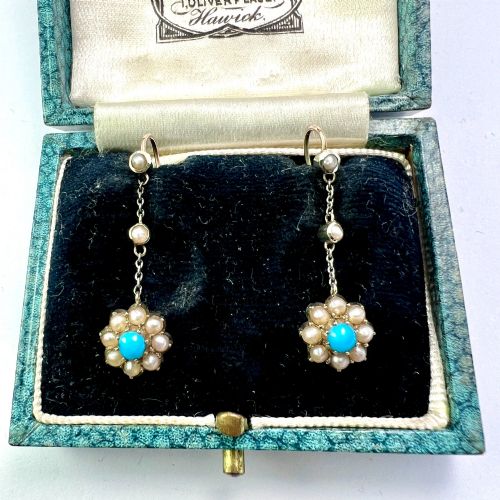
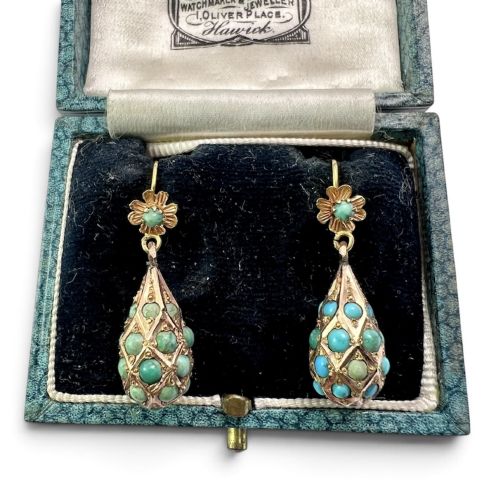
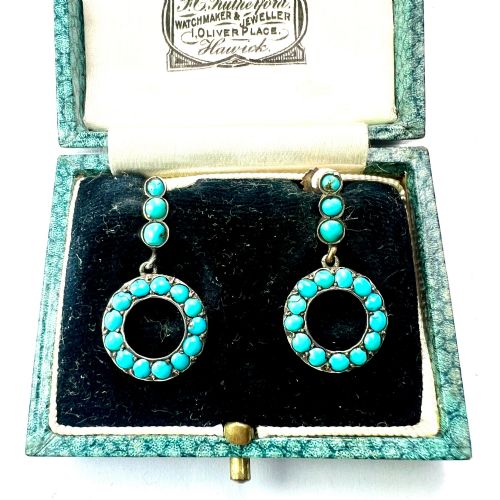
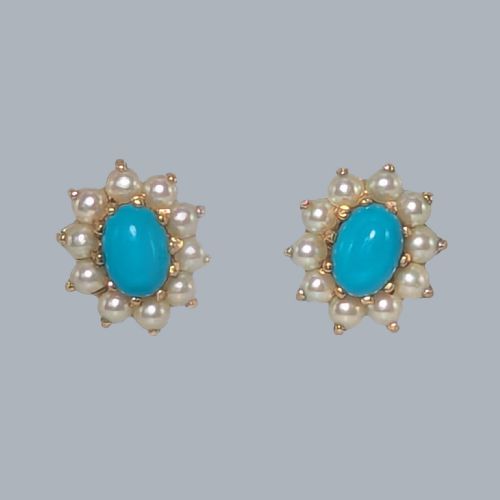


Gold Turquoise Earrings
Gold turquoise earrings bring together vivid blue stones and warm metals in drop, cluster and hoop designs across Victorian, Edwardian and mid-century periods.
Gold Turquoise Earrings
Gold turquoise earrings comprise a diverse group of period jewellery items, ranging from Victorian teardrop clusters to Edwardian drop designs and mid-century retro styles. You will frequently encounter Victorian and Edwardian examples featuring pearls alongside the central stones.
The inventory spans multiple gold purities, including nine carat, fourteen carat, fifteen carat and eighteen carat variations, often paired with silver settings in nineteenth-century pieces. Certain offerings include matching pendants or form part of larger jewellery suites.
Configurations range from simple studs and screwbacks to elaborate dangling tassels, lover's knots, vine leaves and floral motifs. The stones themselves appear as smooth cabochons, natural nuggets or calibrated clusters.
Materials and construction
Goldsmiths utilised varying purities of yellow and rose gold alongside silver, particularly in Victorian and Edwardian pieces where silver was employed to mount stones and reflect light. Turquoise cabochons and pearls are frequently set in closed or open back metalwork, sometimes complemented by diamonds, paste or quartz.
Techniques range from cast and chased gold elements to delicate wirework in Etruscan Revival and Art Nouveau styles. Hallmarks on later items, such as London hallmarks from the nineteen-sixties, confirm specific gold standards and dates of assay.
Gold Turquoise Earrings Retail Price Guide 2026
Typical asking prices for gold turquoise earrings among the pieces listed under this phrase on Sellingantiques today, from the lower quarter to the upper quarter. They describe what is for sale here now, not the wider market.
Materials recorded across the archive include turquoise, pearls, diamonds, silver and paste, fashioned into drops, clusters, hoops and matching parure sets.
Factors of quality
Quality rests upon the saturation and matrix of the turquoise stones, where even, robin-egg blue hues command greater attention than discoloured or heavily weathered matrixes. The precision of the setting work, whether in delicate seed pearl clusters or heavy gold tassels, dictates the overall refinement.
The weight and purity of the gold, alongside the survival of original fixings like hook wires, screwbacks or posts, elevate the standing of a pair. Maker attribution and documented period provenance further separate standard production items from exceptional workshop examples.
Julius Cohen
The Gold Turquoise Earrings Glossary
- Cabochon
- A gemstone shaped and polished with a smooth convex surface rather than faceted. This cut preserves the natural colour and opacity of turquoise.
- Parure
- A matching set of jewellery designed to be worn together, typically including earrings, a necklace and a brooch. Surviving suites often feature matching turquoise and pearl motifs.
- Etruscan Revival
- A nineteenth-century design movement inspired by ancient archaeological discoveries. Jewellery in this style utilises granulation and intricate gold wirework.
- Pietra dura
- An artistic technique of inlaying cut and fitted polished coloured stones to form pictures. Examples in this inventory combine mosaic stone work with gold mounts.
- Cluster
- An arrangement of smaller gemstones grouped tightly around a central stone. This setting style maximises visual impact in floral and dome earring designs.
Gold Turquoise Earrings: Frequently Asked Questions
How do I date antique turquoise earrings?
Dating relies upon examining the metal purity, gemstone cuts, fastening types and overall design motifs. Victorian pieces often use high carat gold or silver-topped gold with closed backs, while Edwardian examples favour lighter filigree and pearl pairings.
Later mid-century iterations introduce eighteen carat or nine carat gold with distinct retro styling, sometimes supported by official hallmarks. Comparing the construction methods of the gallery backs and wire hooks provides further chronological clarity.
Are turquoise stones treated in antique earrings?
Most antique and vintage turquoise stones appear in their natural, untreated state, displaying the characteristic variations in blue or green-blue hues and occasional natural matrix webbing. Nineteenth-century pieces predominantly utilise natural Persian or American turquoise.
Appraising the surface under magnification reveals the untreated porous structure typical of period stones. Stabilisation and enhancement treatments became more common in later commercial production.
Can I wear antique screwback earrings daily?
Screwback and hook fastenings from the Victorian and Edwardian eras require gentle handling during placement and removal. While durable, the delicate gold wirework and seed pearl accents benefit from careful storage away from moisture and cosmetics.
Regular inspection of the stone settings ensures the turquoise cabochons remain secure within their gold claws or bezels. Removing the earrings before swimming or sleeping preserves the integrity of the antique metal.
What is the difference between Victorian and Edwardian styles?
Victorian designs tend to feature heavier gold weights, substantial dockets, natural nuggets and dramatic motifs such as locket tassels, grape clusters and Etruscan Revival wirework. Silver is frequently paired with gold in these earlier pieces.
Edwardian jewellery shifts towards lighter, airier compositions featuring platinum or yellow gold, often incorporating delicate seed pearls, lover's knots and floral drop configurations. The overall aesthetic becomes more restrained and lace-like.