





Turned Leg Music Canterbury
A turned leg music canterbury provides partitioned storage for sheets and folios while sitting on slender supports.
Turned Leg Music Canterbury
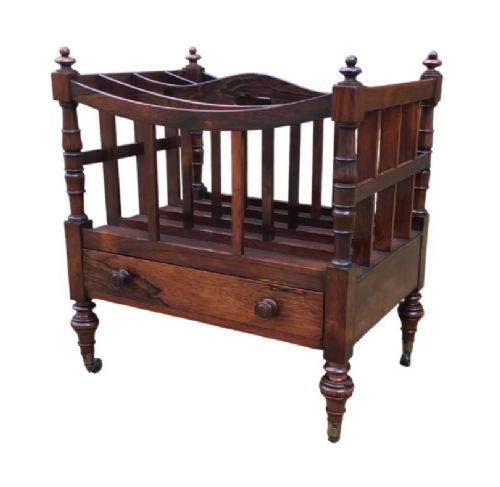
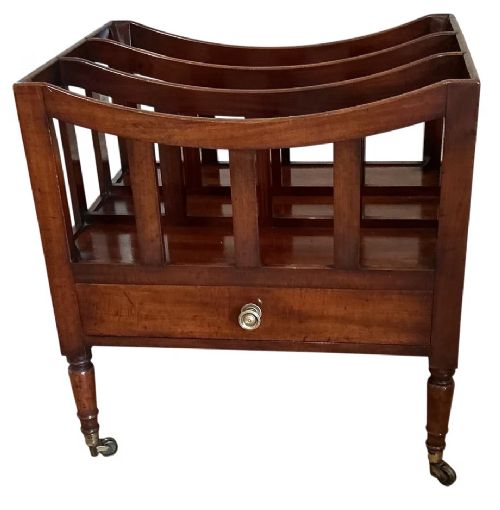
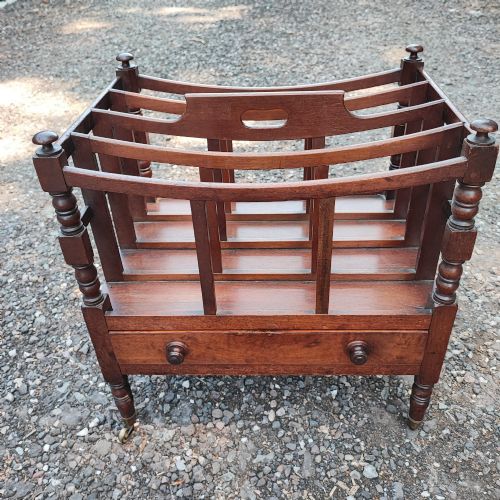
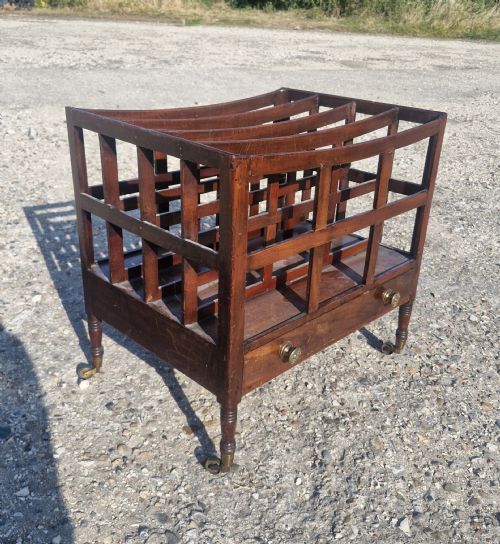
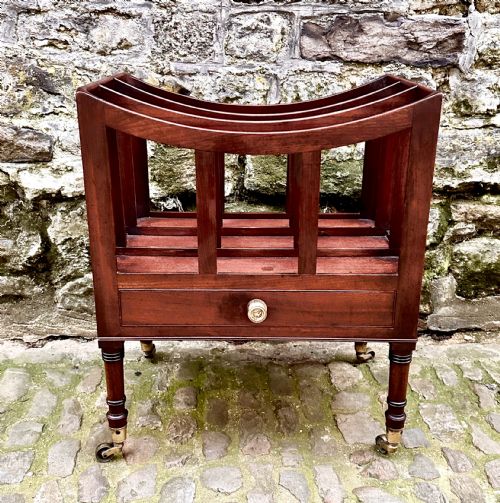
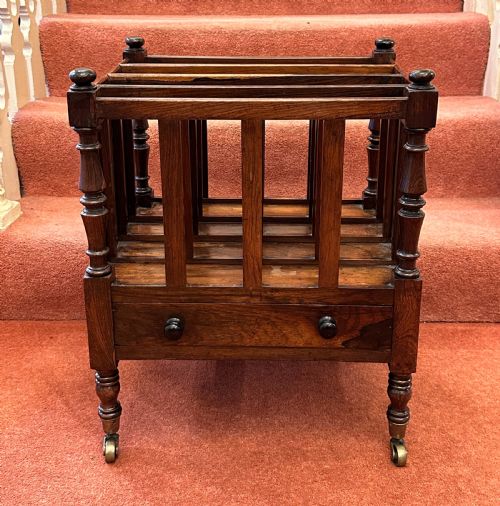
A turned leg music canterbury is a low, freestanding piece of furniture designed to hold sheet music, folios and periodicals in divided compartments. These pieces appear in forms ranging from boat-shaped designs to multi-tier freestanding canterburys and magazine racks.
The version most commonly encountered on this page originates from the Georgian, Regency, William IV and Victorian periods, spanning the early to late nineteenth century. Makers constructed them primarily in mahogany and rosewood, with occasional examples in burr walnut and oak.
These items served to keep music scores and reading materials tidy beside a piano or in a parlour. They combine compartmented divisions above with turned legs, often finishing in castors to allow easy movement across a room.
How they were made
Cabinetmakers built these pieces using solid hardwoods such as mahogany and rosewood, frequently incorporating fine inlay work to accent the woodwork. Sections were joined securely to form the distinctive divided compartments needed to support upright folios.
Supports took the form of turned legs, which were shaped on a lathe and frequently mounted on small castors for mobility. Drawer components, where present beneath the rack, utilised traditional dovetail joints.
Finishes relied on French polishing to bring out the natural grain and deep colour of the mahogany, rosewood and burr walnut timbers.
Turned Leg Music Canterbury Retail Price Guide 2026
Typical asking prices for turned leg music canterbury among the pieces listed under this phrase on Sellingantiques today, from the lower quarter to the upper quarter. They describe what is for sale here now, not the wider market.
Many a Victorian pianist relied on a wheeled canterbury to roll their sheet music smoothly across the drawing-room carpet.
What varies in quality
Quality rests in the crispness of the timber selection, such as the depth of grain in figured mahogany, rosewood or burr walnut. Finer examples display meticulous attention to the turning of the legs and the neat integration of inlay work.
Structural integrity sets apart better specimens, visible in the rigidity of the vertical divisions and the smoothness of any lower drawer action. The choice of secondary woods and the quality of the brass castors further distinguish superior cabinetwork.
The Turned Leg Music Canterbury Glossary
- Canterbury
- A low stand with upright partitions for holding sheet music, newspapers or magazines. It often incorporates a small drawer below the divisions.
- Boat-shaped
- A curved hull-like form used for the main body of certain Regency canterburys. This silhouette softens the rectangular geometry of the piece.
- Turned leg
- A vertical support shaped on a woodturning lathe to create cylindrical profiles with rings and coves. They lift the cabinet cleanly off the floor.
- Castor
- A small swivelling wheel attached to the base of each leg. It allowed nineteenth-century users to reposition heavy furniture without lifting.
- Burr walnut
- A highly figured wood veneer taken from the excrescences of walnut trees. It yields intricate swirling patterns prized for decorative surfaces.
Turned Leg Music Canterbury: Frequently Asked Questions
What is a music canterbury?
A music canterbury is a compartmented stand designed to hold sheet music and folios neatly. They usually feature several vertical sections above a low frame.
Originating in the Georgian and Regency eras, these pieces sat beside pianos or in sitting rooms to keep scores close at hand.
How were they used historically?
Owners used them to store unbound music sheets, scores and contemporary periodicals in an orderly fashion. The upright divisions kept papers from slumping or folding.
Some versions included a small drawer at the base for holding smaller accessories like tuning forks, writing implements or manuscript paper.
What woods were used?
Cabinetmakers primarily used mahogany and rosewood during the Georgian and Regency periods. These dense timbers provided the strength needed for upright vertical divisions.
Victorian makers also turned to burr walnut and oak, occasionally incorporating decorative inlay to enhance the appearance of the piece.
How do I date a canterbury?
Dating relies on observing the prevailing style and timber choices, ranging from George III mahogany up to later Victorian oak and walnut examples. Regency pieces often exhibit boat-shaped bodies and elegant turned supports.
Construction details, such as the method of joining the partitions and the style of the leg turning, provide further clues to the decade of manufacture.