
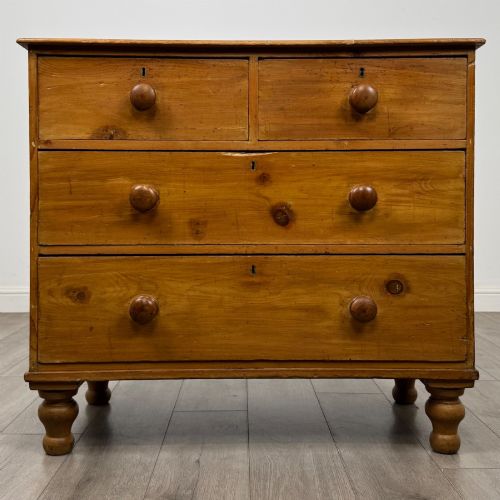
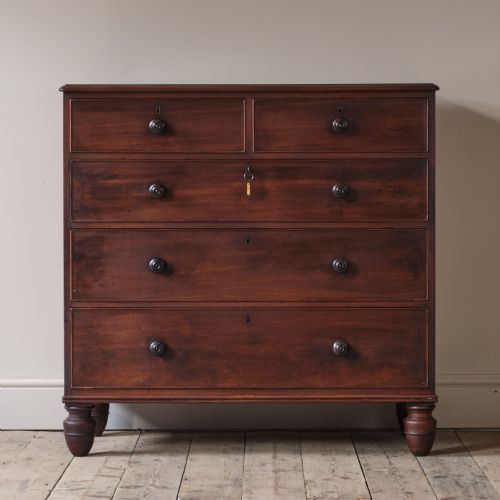
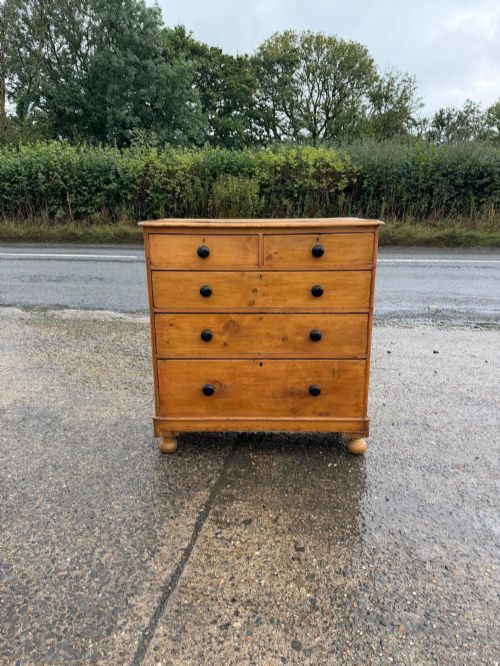
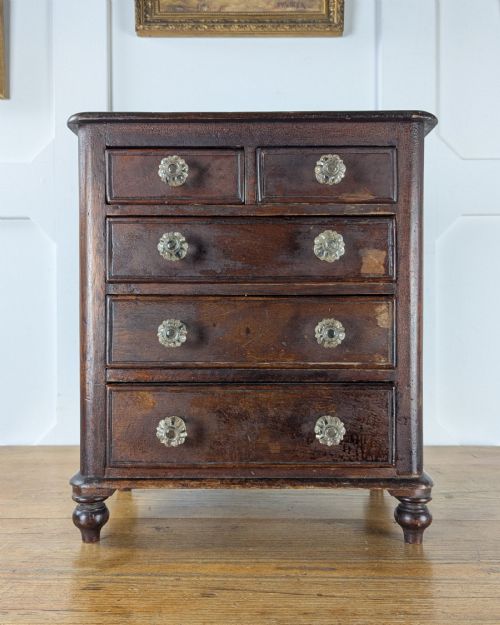
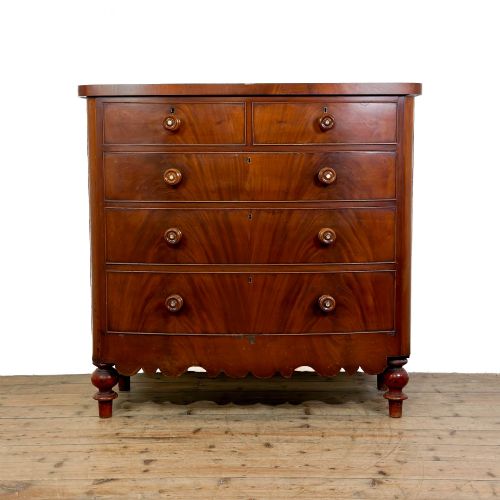
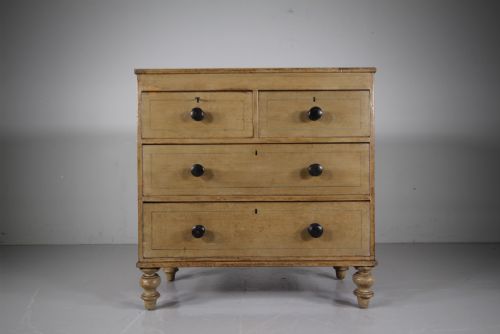
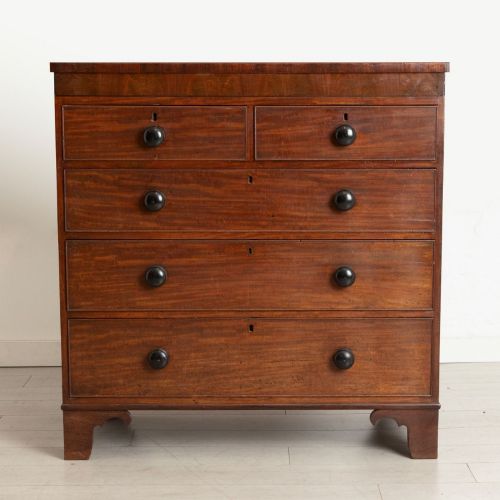


Turned Foot Chest
A turned foot chest is a sturdy timber storage piece lifted on rounded feet, offering practical depth and period character.
Turned Foot Chest
A turned foot chest is a timber storage piece raised on rounded supports, appearing across Georgian, Regency, and Victorian periods. These pieces serve as practical bedroom storage or compact collectors' items, taking the form of full-size chests of drawers, miniature chests, and coffor bach boxes.
The versions most commonly met on this page are Victorian pine examples, often retaining original paint or turned wooden knobs, alongside larger mahogany and oak pieces. Miniature apprentice chests and Welsh vernacular boxes also appear, showing how makers adapted the form for smaller scales.
Periods represented stretch from the early 18th century through to the late Victorian era, taking in stylistic shifts from Early Georgian proportion to French Empire and George IV design. Oak, mahogany, and pine provide the primary timber structures for these diverse domestic containers.
Evaluating Quality
Distinction across the range lies in the integrity of the timber and the preservation of original surfaces like early paint finishes and turned wooden knobs. Pieces retaining their uncompromised structural form and period-correct feet demonstrate higher integrity.
The finesse of the joinery and the selection of cabinet woods, from dense mahogany to figured satin birch, separate standard domestic examples from finer vernacular and formal pieces. Originality of handles, feet, and surface coatings remains central to the character of each chest.
Listings span the 18th, 19th, and Victorian periods, using pine, mahogany, oak, and paint.
T & G Seddon
The Turned Foot Chest Glossary
- Coffor Bach
- A small Welsh blanket box or chest, often fitted with a drawer beneath and raised on feet. These miniature storage pieces served traditional domestic roles in rural homes.
- Bow Front
- A convex curved front profile popular on Georgian and Regency chests of drawers. This design softens the geometric lines of the cabinet.
- T & G
- Tongue and groove timber jointing used in board construction for backs and drawer linings. This method allows wood to expand and contract naturally.
- Satin Birch
- A pale hardwood with a lustrous, shimmering grain utilised in Victorian cabinet making for decorative drawer fronts and carcases.
Turned Foot Chest: Frequently Asked Questions
How do I date a pine chest?
Dating relies on construction methods, timber preparation marks, and the style of the turned feet and drawer pulls.
Victorian pine examples often show machine-sawn elements, while 18th-century pieces display hand- cleft timber and pegged joints.
Are miniature chests apprentice pieces?
Some small chests served as trade test pieces for woodworkers, while others functioned as tabletop drawers for personal valuables.
Their exact purpose often depends on the refinement of the dovetails and proportion.
Did Regency chests use paint?
Regency cabinet makers occasionally utilised painted finishes on pine furniture, sometimes mimicking more expensive exotic hardwoods.
Surviving examples preserve these decorative coatings beneath clear protective layers.