

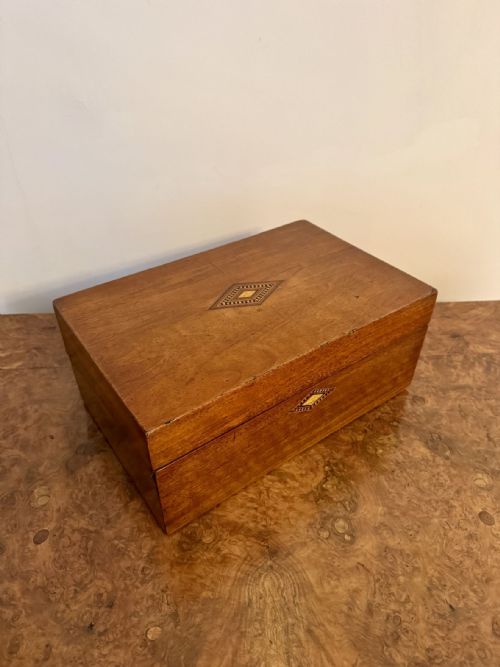


Tunbridge Ware Desk
A tunbridge ware desk accessory brings intricate wood mosaic to your workspace, offering the refined craftsmanship of nineteenth-century English makers.
Tunbridge Ware Desk
When you search for a tunbridge ware desk piece, you are looking at small wooden items decorated with precise mosaic work depicting geometric patterns or pictorial scenes. These items form a distinctive group of nineteenth-century desk accessories designed for the writing table.
The versions you are most likely to meet on this page include writing slopes, stationery boxes, and book slides executed in walnut or burr walnut. These functional objects showcase the characteristic wood mosaic panels associated with the spa town of Tunbridge Wells.
Originating predominantly in the Victorian era, particularly around eighteen-sixty and eighteen-eighty, these pieces combine utility with elaborate surface decoration. They reflect the high point of domestic desk accessory production in England.
Materials and Construction
Craftsmen built the foundations of these pieces using sturdy carcassing woods such as walnut, burr walnut, and rosewood, which provided rich natural dark tones. Boxwood and various mixed woods supplied the contrasting light and dark shades necessary for the intricate surface designs.
The characteristic decoration relies on mosaic work created by bundling tiny coloured wood blocks together, gluing them, and slicing cross-sections to form repeating geometric patterns or pictorial motifs. Inlayers applied these thin mosaic plaques alongside mother-of-pearl and brass details to the exterior surfaces of the boxes and slopes.
Tunbridge Ware Desk Retail Price Guide 2026
Typical asking prices for tunbridge ware desk among the pieces listed under this phrase on Sellingantiques today, from the lower quarter to the upper quarter. They describe what is for sale here now, not the wider market.
Makers utilised up to forty different natural wood species to provide the subtle colour palette needed for their microscopic mosaic landscapes.
Assessing Quality and Execution
The finest examples distinguish themselves through the microscopic precision and complexity of the wood mosaic panels, where thousands of tiny timber blocks form seamless pictorial or geometric designs. Simpler pieces rely on basic parquetry or limited banded borders rather than elaborate mosaic pictures.
The choice of primary timber also dictates the tier of the piece, with richly figured burr walnut carcasses sitting at the upper end compared to plain walnut or secondary woods. Furthermore, the crispness of the brass fittings and the integrity of the internal velvet or leather writing surfaces reflect the original maker's investment in materials.
Edmund Nye
The Tunbridge Ware Desk Glossary
- Tunbridge Ware
- A type of wooden decorative woodwork and parquetry produced in Tunbridge Wells, renowned for mosaic designs made from numerous tiny wood blocks. This technique creates detailed pictorial or geometric surface decoration.
- Writing Slope
- A portable sloping desk designed to hold writing paper, pens, and ink, which opens to reveal a slanted writing surface. These boxes often feature secret compartments alongside fitted storage.
- Burr Walnut
- A veneer taken from the gnarled growth or burl of a walnut tree, prized for its swirling, highly figured grain patterns. Makers used this timber on the exterior of high-status nineteenth-century boxes.
- Stationery Box
- A desk accessory constructed to hold writing paper and envelopes upright in tiered compartments. They frequently feature sloping lids decorated with mosaic panels.
- Parquetry
- A geometric mosaic of wood pieces used for decorative floors and box surfaces. It differs from marquetry by forming strictly geometric patterns rather than pictorial scenes.
- Book Slide
- An adjustable stand designed to hold a row of books upright on a desk or table. These pieces often incorporate hinged ends decorated with inlaid wood panels.
Tunbridge Ware Desk: Frequently Asked Questions
What is a tunbridge ware desk piece?
A tunbridge ware desk piece is a nineteenth-century wooden accessory, such as a writing slope, book slide, or stationery box, decorated with mosaic wood inlay. These items were produced in England during the Victorian period for use on writing tables.
They combine practical storage for correspondence with elaborate geometric or pictorial surface decoration made from numerous tiny blocks of different coloured woods.
How do I date these desk items?
Dating relies primarily on the style of the construction, the choice of timbers like burr walnut or rosewood, and specific markers such as brass hardware or maker labels. Most pieces seen here date from the Victorian era, spanning the mid to late nineteenth century.
Specific design cues, including the complexity of the mosaic bands and the form of the writing box interior, help narrow the decade of manufacture.
How were these boxes used originally?
Victorian writers used these boxes to store stationery, inkwells, pens, and private correspondence securely when writing desks were centralized or shared. Writing slopes provided a portable slanted surface for letter writing before fitted studies became common.
Book slides kept reference volumes close at hand on the desktop, while correspondence boxes organised incoming and outgoing post.
How do I care for a wooden writing slope?
Keep wooden writing slopes and desk accessories away from direct sunlight and steady heat sources to prevent the delicate mosaic veneers from drying out and lifting. Maintain a stable room temperature and dust the intricate wood surfaces gently with a dry, soft cloth.
Avoid using modern liquid polishes or harsh chemical cleaners on the antique timber and inlaid mosaic panels.