
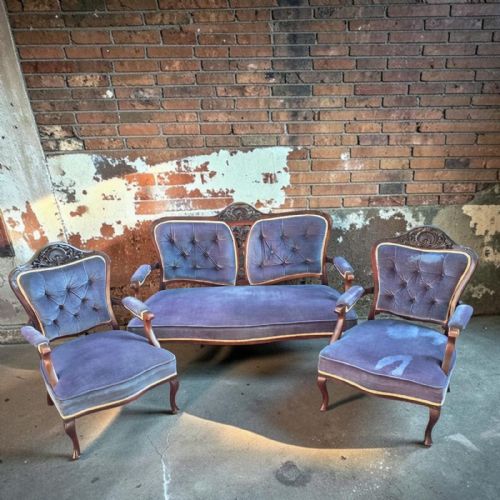


Tufted Velvet Salon Chair
These tufted velvet salon chair selections bring Victorian drawing rooms to life, offering deep buttoning and rich upholstery for any formal interior.
Tufted Velvet Salon Chair
A tufted velvet salon chair represents the formal seating of the nineteenth century, designed for drawing rooms and parlours during the Victorian period. These pieces encompass armchairs, nursing chairs, spoonback forms, and elements of larger salon suites originating between 1850 and 1910.
The version most commonly encountered on this page is the Victorian walnut or mahogany open arm chair featuring buttoned upholstery. Examples range from compact nursing seats to substantial fireside armchairs and entire drawing room suites.
Makers of the period utilised rich textiles such as velvet and calico over sprung or padded foundations, often framing the work in carved hardwood. Styles vary from traditional Victorian and French nineteenth-century influences to the distinct lines of the Aesthetic Movement.
Materials and construction
Makers constructed the supportive frames using solid hardwoods like walnut, mahogany, and rosewood, applying intricate hand-carved details to the show frames, crest rails, and cabriole legs. These wooden elements were frequently polished to a deep lustre, contrasting with the soft textiles applied to the seat and back.
Upholstery involved deep buttoning, known as tufting, which secured the velvet fabric tightly against internal padding to create a distinctive geometric pattern of folds. Additional materials such as brass castors, ceramic components, and supportive webbing completed the interior structure of each armchair.
Listings feature nineteenth-century seating primarily from the Victorian era, utilising walnut, mahogany, and rosewood with velvet upholstery.
Distinctions in quality
Quality rests upon the crispness of the timber carving and the architectural integrity of the show frame. Superior examples display deeply sculpted walnut or mahogany with seamless joints that withstand the structural tension of buttoned upholstery.
The refinement of the silhouette distinguishes finer pieces, particularly in the graceful sweep of a spoonback or the balanced proportions of an open arm chair. Furthermore, the selection of dense hardwoods and the execution of the tufting reveal the hand of skilled nineteenth-century workshops.
Blyth & Sons·Holland and Sons·C. Hindley & Sons·James Shoolbred
The Tufted Velvet Salon Chair Glossary
- Spoonback
- A padded chair back shaped like the bowl of a spoon to fit the human spine. This ergonomic form emerged during the Victorian era.
- Tufting
- A method of upholstery where string or twine is passed through the padding and tied down with buttons. This secures the filling and creates a uniform pattern of indentations.
- Show frame
- The exposed wooden framework of an upholstered chair or sofa. It allows the grain and carving of the mahogany or walnut to remain visible.
- Aesthetic Movement
- A late nineteenth-century design style emphasising artistic expression over moral purpose. Pieces from this period often incorporate ebonised wood finishes.
- Nursing chair
- A low-seated Victorian armchair designed for comfort near the hearth or nursery. These chairs typically feature open arms or lack them entirely to accommodate voluminous historical dress.
Tufted Velvet Salon Chair: Frequently Asked Questions
Where were these chairs placed?
Nineteenth-century households placed these seats in formal drawing rooms, parlours, and private chambers. They served as decorative yet functional seating for guests and family members during social gatherings.
Smaller variants like nursing chairs stood near bedroom hearths, while larger open armchairs anchored the main reception spaces alongside matching sofas.
How do I care for velvet upholstery?
Velvet requires gentle brushing with the nap to maintain its texture and prevent flattening over time. Keep these fabrics away from direct sunlight to preserve the depth of the colour.
Professional cleaning is advisable for historic textiles to avoid damaging the delicate pile and the underlying tufting work.
How do I distinguish Victorian styles?
Early Victorian seating often relies on mahogany with robust curves, while mid-to-late Victorian pieces frequently feature walnut frames with elaborate carved crests. The introduction of ebonised finishes points towards the later Aesthetic Movement.
Examining the turning of the legs and the profile of the backrest helps clarify the decade of production.
Can these chairs be used daily?
These historic chairs support regular daily use provided the internal webbing and padding remain stable. Many surviving pieces retain resilient sprung foundations built for enduring comfort.
Placing them in moderate traffic areas ensures the antique velvet and carved wooden frames experience minimal wear.