
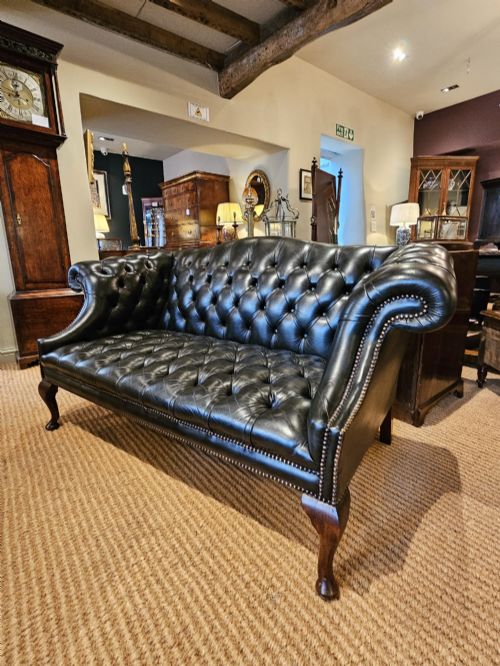
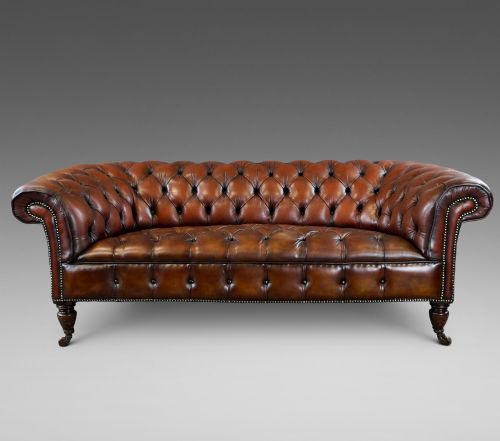


Tufted Leather Club Sofa
A tufted leather club sofa brings deep-buttoned comfort and rich hide to a room, anchoring the space with enduring style.
Tufted Leather Club Sofa
When you search for a tufted leather club sofa, you encounter deep-buttoned seating primarily spanning the Victorian era through the 1930s, alongside later mid-century examples.
The versions most common on this page are classic Chesterfields and large club-style settees, often shaped with scroll arms and serpentine fronts.
Makers and origins range from nineteenth-century London workshops to pub benches and twentieth-century suites upholstered in varied shades of leather.
How they were made
Makers built these pieces using sturdy hardwood or mahogany frames combined with metal and timber supports to ensure structural longevity.
Upholstery relied on durable leather hides, frequently dyed in shades of brown, green, or aubergine, secured by hand with brass detailing.
Listings feature items spanning the 19th Century, Victorian period, Edwardian era, 1930s, and Mid-Century.
What varies in quality
The character of the hide sets examples apart, ranging from untouched patinated leather to hand-dyed finishes achieved during restoration.
Frame construction and carving depth dictate the calibre of each piece, distinguishing simple pub benches from grand salon Chesterfields.
Hampton & Sons of Pall Mall·Howard & Sons
The Tufted Leather Club Sofa Glossary
- Chesterfield
- A traditional style of sofa characterised by deep button tufting and rolled arms of equal height. It remains a staple of British seating design.
- Button back
- An upholstery technique where indentations are formed in the padding using tufting threads or buttons. This secures the internal filling and creates a distinctive geometric pattern.
- Serpentine front
- A curved front rail that undulates gracefully with a convex centre and concave sides. It adds visual movement to heavy upholstered furniture.
- Barrel back
- A seating form featuring a curved, continuous backrest enclosing the sides. This design provides enclosed comfort and draught protection.
Tufted Leather Club Sofa: Frequently Asked Questions
How do I care for antique leather?
Feed the hide regularly with suitable leather balms to maintain flexibility and prevent the surface from drying out over time.
Keep the sofa away from direct heat sources and strong sunlight to preserve the original colour and finish.
Are these sofas comfortable for daily use?
The deep seats and supportive internal springs offer a firm yet relaxing sit suited to everyday lounging and reading.
Vintage padding provides substantial support, though comfort levels vary depending on whether the upholstery is original or restored.
How do I identify a Victorian piece?
Victorian examples often feature dense hardwood frames, hand-carved details, and heavy leather hides showing natural patination.
Construction methods and distinct styling cues from the nineteenth century help separate these older models from twentieth-century reproductions.