
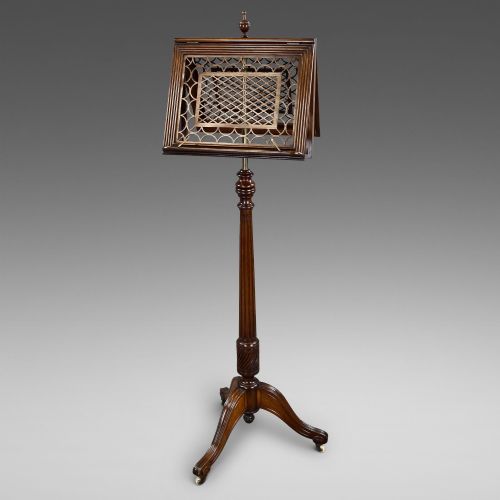
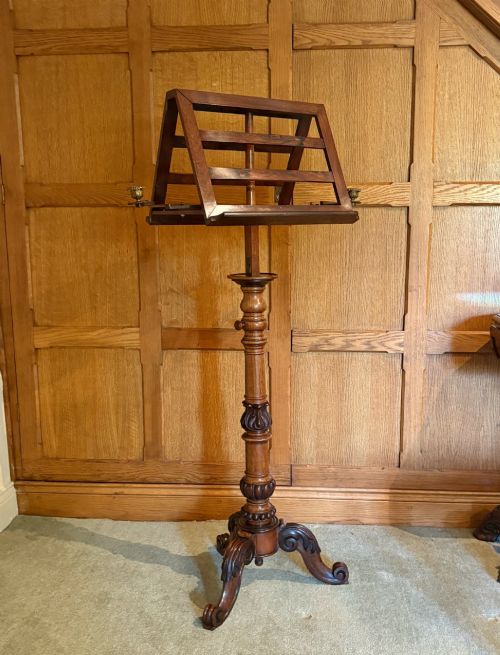
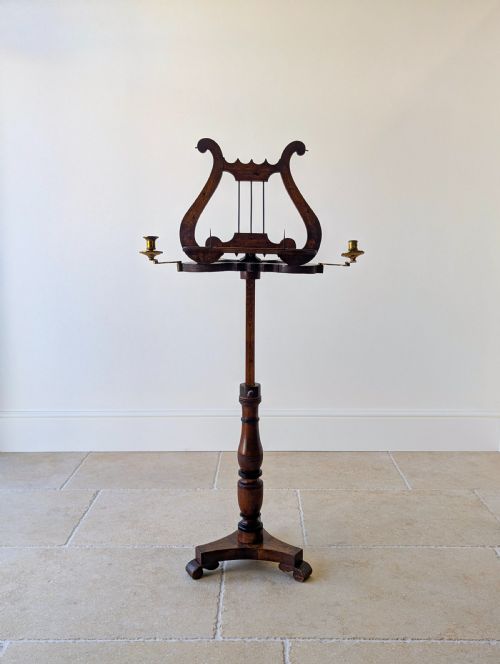


Tripod Sheet Music Stand
A tripod sheet music stand holds scores upright for practice or performance, combining practical height adjustment with fine timber and brass detail.
Tripod Sheet Music Stand
A tripod sheet music stand supports musical scores or books upon a central pillar supported by three feet. These pieces serve musicians and collectors alike, appearing in forms such as single stands, duet stands, and reading tables.
The pieces on this page span the Georgian, Regency, William IV, and Victorian periods, alongside later nineteenth and early twentieth-century examples. Mahogany, walnut, burr walnut, rosewood, and oak dominate the material record, frequently paired with brass adjustment mechanisms.
Makers and designers from the nineteenth century produced these stands with pivoting lecterns and adjustable stems. The selection includes both single reading ledges and wider duet formats designed for two musicians to share a score.
How they were made
Cabinet makers utilised dense hardwoods such as mahogany, walnut, and rosewood to construct the upright shafts and stable tripod bases. Selected pieces incorporate burr walnut veneers, satinwood inlay, and ebonised finishes to enhance the visual grain.
Metal components in brass form the adjustable reading desks, screws, and pivoting brackets that allow the user to alter height and angle. Carved details appear on the columns and cabriole or splayed legs of Victorian and Regency examples.
Lyre-form motifs frequently feature in the central support of the desk, echoing classical design vocabulary. Joinery techniques secure the pivoting mechanisms to withstand the repeated adjustment of heavy bound volumes.
Listings feature mahogany, walnut, burr walnut, rosewood, oak, satinwood inlay, and brass across nineteenth-century periods.
What varies in quality
The sophistication of the adjustment mechanism distinguishes standard production from superior workshop output. Original brass screws, smooth telescoping stems, and reliable ratchets indicate high execution by skilled makers.
Timber selection and decorative treatment set individual pieces apart. Finely figured burr walnut, intricate satinwood inlay, and crisply carved tripod bases demonstrate greater investment of time and material by the cabinet maker.
Proportion and structural integrity ensure the stand remains balanced when the desk is extended. Stands that retain their original surfaces and matching timber components command greater appreciation among collectors.
GILLOWS
The Tripod Sheet Music Stand Glossary
- Tripod base
- A three-legged support providing stability for the central column of the stand. This configuration prevents wobbling on uneven nineteenth-century floors.
- Duet stand
- A wider music stand designed to accommodate two musicians reading from the same shared score. These often feature larger or double-sided reading ledges.
- Lyre-form
- A decorative motif shaped like an ancient stringed musical instrument, frequently incorporated into the central support of the desk. It reflects the classical taste of the Regency and Victorian periods.
- Adjustable reading table
- A multi-functional piece combining a music stand mechanism with a surface suitable for writing or holding books. The top tilts and rises via a central stem.
- Gonçalo Alves
- A dense, exotic hardwood with distinctive figuring utilised in select nineteenth-century furniture. It provides a rich brown surface with darker contrasting streaks.
Tripod Sheet Music Stand: Frequently Asked Questions
Can I use it for reading books?
Many nineteenth-century examples double as reading tables or lecterns designed for heavy volumes. The pivoting ledge adjusts to a flat or angled position suitable for books as well as sheet music.
Heavier folios sit securely on stands equipped with retaining ledges or brass page holders. Ensure the tripod base is positioned on a level surface to maintain balance when holding large books.
How do I date a stand?
Dating relies upon timber choice, hardware construction, and stylistic clues from the Georgian, Regency, William IV, and Victorian periods. Regency and William IV pieces often feature classical motifs like the lyre, while Victorian examples show heavier carving and burr walnut veneers.
Examine the brass screws and adjustment mechanisms for signs of period manufacturing techniques. Later twentieth-century pieces display different machining marks compared to hand-turned nineteenth-century shafts.
Where should I place it?
These stands suit music rooms, studies, or living spaces where they can function as display surfaces or practical reading aids. Position the tripod base away from direct heat sources and strong sunlight to protect the polished hardwood and veneer.
Allow sufficient clearance around the three legs to prevent accidental knocks in narrow hallways or busy rooms. A stable corner or beside a favoured armchair provides an ideal setting.