


Triform Base Marble Table
A triform base marble table commands attention in a room, offering a sturdy three-sided foundation beneath cool stone.
Triform Base Marble Table
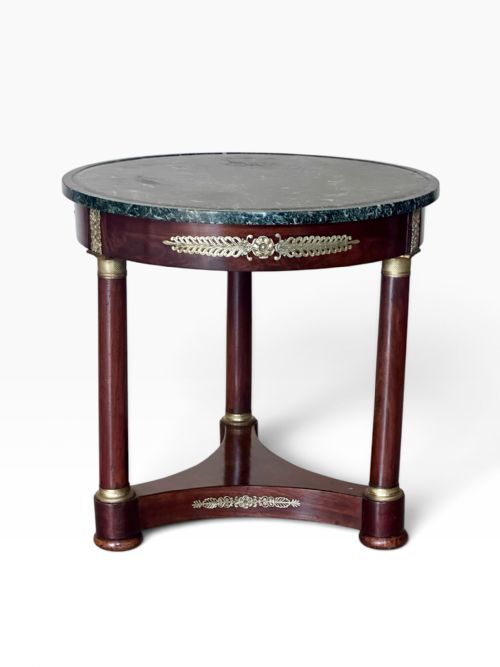
A triform base marble table brings together a tripartite support and a stone surface, frequently appearing as French guéridons, centre tables, and occasional tables. These pieces span periods from the Georgian era through the nineteenth century and into the early twentieth century, showing influences of French Empire, Regency, and Neoclassical styles.
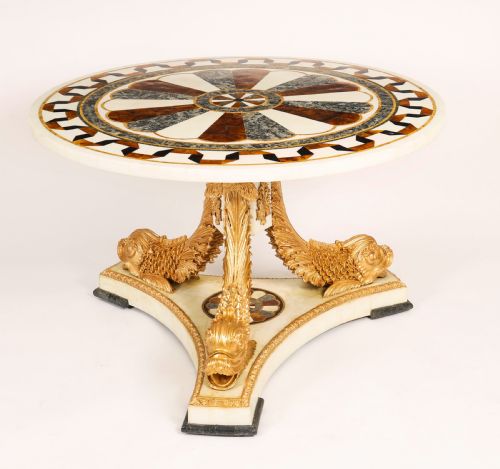
Buyers most commonly encounter circular tables featuring a central pillar supported by three distinct feet or legs, such as carved swans, dolphins, or scrolled mahogany pedestals. The stone tops range from plain white marble to intricate specimen marbles and coloured varieties set within rich timber frames.
Materials and Construction
Cabinetmakers utilised dense hardwoods such as mahogany, rosewood, flame mahogany, and burr elm to build the structural pedestals and three-way bases. These timbers were selected for their grain and stability, providing a robust counterweight to heavy stone inserts.
Surfaces incorporated polished marble slabs, occasionally accented with ormolu mounts, brass details, or giltwood carvings. The tripartite bases were joined securely to central shafts to support the considerable weight of the stone above.
Several tables rely on carved wooden dolphins and swans to hold up the heavy stone.
Assessing Quality and Execution
The sophistication of the carving on the triform base distinguishes finer examples, where animal figures or scrolled supports show crisp detail rather than soft moulding. Selection of timber also dictates grade, with figured grains and exotic woods representing higher craftsmanship.
Integration between the marble top and the wooden chassis reveals standards of production, particularly in the precision of the inset stone and the quality of the surface polish. Ormolu fittings and giltwood enrichment elevate the decorative ambition of the piece.
The Triform Base Marble Table Glossary
- Guéridon
- A small French table, typically circular and supported by a single central pillar, often fitted with a marble top. This form frequently adopts a triform base to ensure stability.
- Triform base
- A three-sided or three-legged support structure beneath a table, designed to distribute weight evenly while offering decorative geometric symmetry.
- Specimen marble
- A tabletop composed of various coloured marbles arranged in geometric patterns or geometric sections, highly prized for its decorative complexity.
- Ormolu
- Gilded bronze used for decorative mounts and accents on furniture, prevalent in French Empire and Neoclassical designs.
- Regency
- An English design period characterised by classical restraint, elegant proportions, and the use of rosewood and mahogany.
Triform Base Marble Table: Frequently Asked Questions
Where should I place a triform base marble table?
These tables function effectively as freestanding centre pieces in a hallway or principal room, where the three-sided base can be admired from all angles.
They also serve well as lamp tables or occasional tables beside seating, provided the heavy stone top is protected from sudden impacts.
How do I care for the marble top?
Clean the stone surface using a soft, damp cloth and neutral soap, avoiding acidic or abrasive household cleaners that can etch the polish.
Using coasters and mats helps prevent staining and liquid rings from penetrating porous marble varieties over time.
What is the difference between a guéridon and a centre table?
A guéridon is a specific circular French table type, traditionally designed for holding light or ornaments, though many nineteenth-century examples functioned as larger centre tables.
Centre tables encompass a broader category of freestanding tables meant to sit in the middle of a room rather than against a wall.
How do I date a nineteenth-century pedestal table?
Dating relies on observing timber choices, such as figured rosewood or flame mahogany, alongside stylistic cues from French Empire, Regency, or Victorian revival vocabularies.
Construction joints, patination, and the specific manner of the pedestal carving provide further clues to the manufacturing decade.