
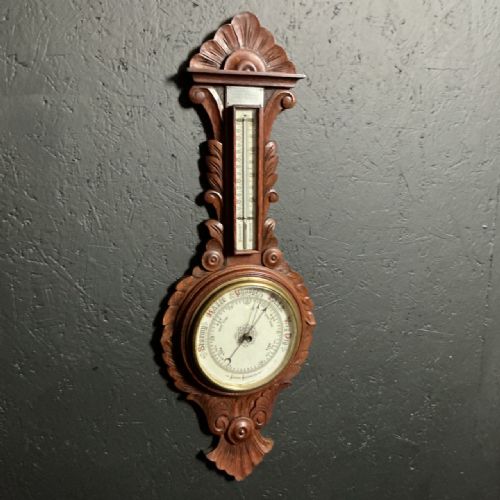

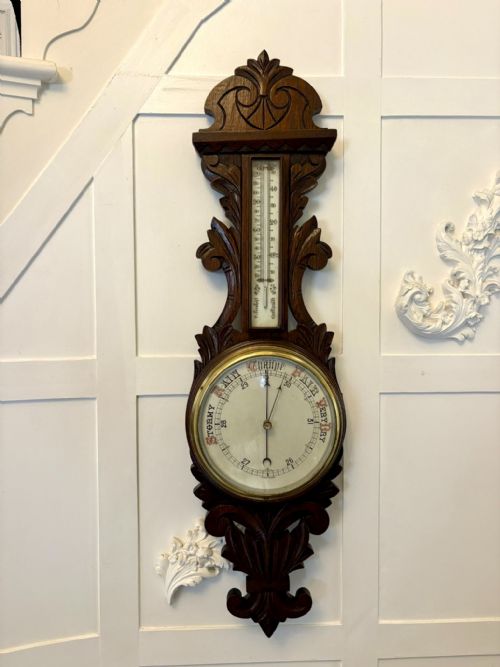


Traditional Wooden Weather Station
These traditional wooden weather station pieces measure atmospheric pressure and temperature with mechanical dials, offering a practical anchor for a period hallway.
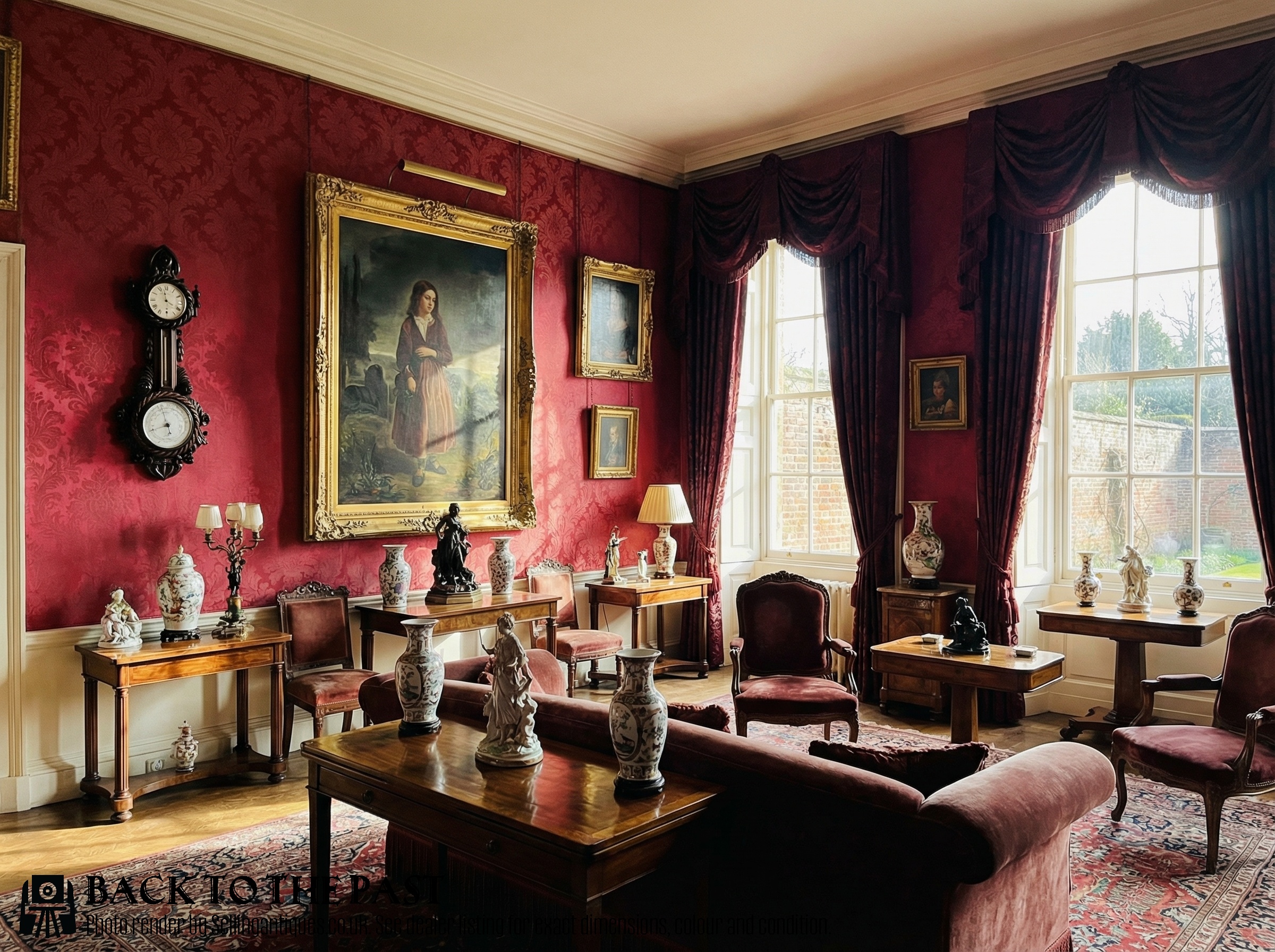
Traditional Wooden Weather Station
When you search for a traditional wooden weather station, you encounter wall-hanging instruments that combine barometers, thermometers, and occasionally clocks to track meteorological shifts. These domestic instruments span from the Victorian and Edwardian eras up to the nineteen thirties, encompassing Georgian revival interpretations alongside nineteenth century American pieces.
The versions most commonly met on this page are carved oak and walnut aneroid barometers from the late Victorian period and nineteen ten. Alongside these single-instrument wall units, you will discover banjo clock barometers and combined wall clocks that integrate multiple dials into one wooden case.
How they were made
Casings are fashioned from dense timbers such as oak, walnut, mahogany, and beechwood, often shaped with hand-carved ornamentation typical of the Black Forest style. Dial faces utilise brass bezels to frame glass covers protecting the paper or porcelain indicator scales.
Internal mechanisms rely either on traditional mercury columns or aneroid chambers that contract and expand with atmospheric pressure. These brass movements drive delicate linkage systems connected to the visible indicator needles on the face.
Listings span oak, walnut, mahogany, and beechwood, alongside porcelain and brass components.
What varies in quality
The distinction between standard domestic instruments and exceptional examples lies entirely in the ambition of the woodworking and the crispness of the carved details. Deep relief carving on Black Forest oak or walnut cases commands attention, whereas plain beechwood or simple moulded mahogany frames offer a more restrained presence.
Quality also resides in the complexity of the instrument combination itself, moving from a simple single-dial barometer to integrated assemblies housing thermometers and clocks within a unified wooden chassis.
Jenkins Of Old Swindon·Vecchio And Co Of Shaftsbury
The Traditional Wooden Weather Station Glossary
- Aneroid barometer
- An instrument that measures air pressure using an expanding metal capsule rather than liquid mercury. It serves as the primary mechanism in wall-hanging wooden weather stations.
- Banjo barometer
- A weather instrument housed in a vertical wooden case shaped like a banjo, typically featuring a circular dial at the base and a thermometer tube running up the stem.
- Mercury barometer
- A traditional device that measures atmospheric pressure by the height of a mercury column within a sealed glass tube. It represents the older baseline of meteorological recording.
- Black Forest style
- A distinctive decorative manner known for deeply carved naturalistic foliage and animal motifs executed in dark wood. It frequently characterises late nineteenth-century Victorian cases.
- Bezel
- The metal rim, usually made of polished brass, that holds the protective glass pane securely over the instrument dial. It provides a clean finish to the face of the wooden case.
Traditional Wooden Weather Station: Frequently Asked Questions
How do I read a traditional barometer?
You observe the position of the pointer relative to the engraved weather descriptions such as rain, change, or fair. Tapping the glass gently before reading ensures the mechanism settles at the true current pressure.
Changes in the dial position over several hours indicate whether atmospheric pressure is rising or falling, which signals approaching weather shifts.
Were these stations used outdoors?
These instruments were strictly designed for interior domestic use within hallways, libraries, and studies. Exposure to outdoor moisture and temperature extremes would damage the delicate internal brass linkages and warp the wooden cases.
Placement away from direct sunlight and radiators ensures the wood remains stable and the mechanical components continue to operate smoothly.
How do I tell Victorian from Edwardian pieces?
Victorian examples often feature heavier carved ornamentation, darker walnut or oak timbers, and elaborate Black Forest styling. The lettering on the dial faces tends to be more ornate.
Edwardian pieces generally lean towards simpler, cleaner lines in lighter oak or beechwood cases, reflecting a shift in domestic interior taste towards understated forms.
What is a banjo barometer?
A banjo barometer is a wall-hanging weather instrument enclosed in a elongated wooden case that resembles the stringed musical instrument. The bulbous lower section houses the main dial while the stem carries a thermometer.
This specific silhouette became a staple of nineteenth-century home decor, combining utility with decorative wall presence.