

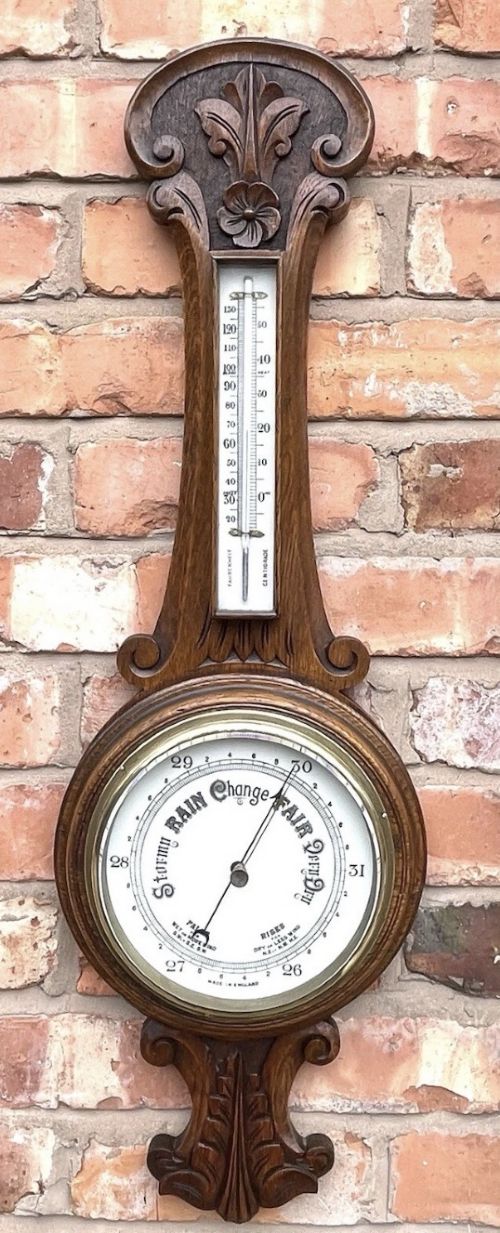


Carved Wood Barometer Clock
These carved wood barometer clock instruments combine timekeeping and weather forecasting within substantial oak, walnut, and mahogany frames.
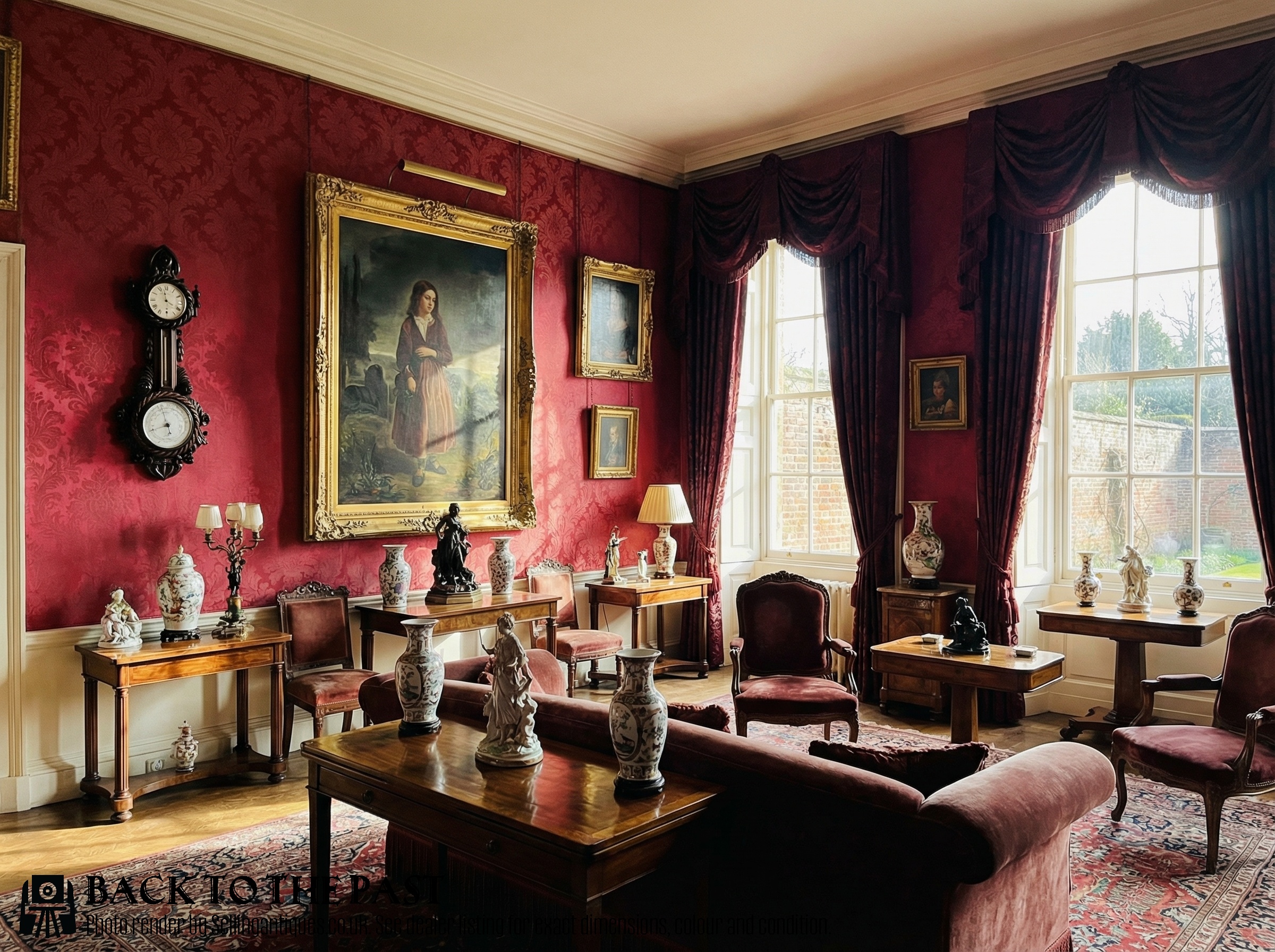
Carved Wood Barometer Clock
A carved wood barometer clock brings together multiple functional instruments housed within a single decorative wooden case. These combination pieces unite timekeeping with meteorological recording, offering both a clock and an aneroid barometer alongside subsidiary thermometers.
The versions most commonly met on this page span the Victorian and Edwardian eras, predominantly taking the banjo form. Oak and walnut serve as the primary woods, shaped into wall-hanging formats defined by carved ornamentation and glazed dials.
Origins stretch across British workshops as well as Continental European traditions, notably encompassing Black Forest production and Dutch styling. Specific examples incorporate ceramic dials or display skeletonised interior mechanisms beneath glass.
How they were made
Construction relies heavily on dense timbers such as oak, walnut, and mahogany, chosen for stability and responsiveness to intricate hand-carving. Artisans shaped these woods into banjo profiles and architectural wall cases designed to support the weight of internal mechanical movements.
Precision brass components form the internal barometer and clock mechanisms, protected behind bevelled glass dial covers. Ceramic elements appear on specific instrument faces, contrasting with the warm tones of the surrounding carved cabinetry.
Carved Wood Barometer Clock Retail Price Guide 2026
Typical asking prices for carved wood barometer clock among the pieces listed under this phrase on Sellingantiques today, from the lower quarter to the upper quarter. They describe what is for sale here now, not the wider market.
Listings span the nineteenth and early twentieth centuries, capturing Victorian, Edwardian, and Art Nouveau design periods.
What varies in quality
The refinement of the woodwork dictates much of the distinction between standard examples and superior specimens, particularly in the depth and crispness of the hand-carving. Timber selection plays a vital role, with well-figured walnut and substantial oak commanding greater presence.
The pedigree of the dial maker and the complexity of the combined movement elevate certain instruments above others. Multi-functional pieces integrating thermometers, clocks, and barometers demonstrate higher technical ambition in their execution.
Hyde & Sons Sleaford·Negretti & Zambra
The Carved Wood Barometer Clock Glossary
- Aneroid barometer
- An instrument that measures atmospheric pressure without the use of liquid, relying instead on a flexible metal capsule. This mechanism expands and contracts with pressure changes to move an indicator needle.
- Banjo barometer
- A wall-mounted weather glass housed within a distinctive elongated wooden case shaped like a banjo. The upper section typically holds a circular dial whilst the lower body contains a thermometer or spirit tube.
- Skeletonised
- A design approach where the structural plates of a clock or barometer movement are cut away to reveal the internal wheels and escapement. This exposes the mechanical workings to view through a glass cover.
Carved Wood Barometer Clock: Frequently Asked Questions
What is a carved wood barometer clock?
A carved wood barometer clock is a combined instrument that brings together a mechanical clock and a weather-measuring aneroid barometer within a decorative wooden case.
These pieces often include a thermometer, housing multiple instruments in a single wall-mounted wooden frame.
How do you read an aneroid barometer?
An aneroid barometer uses a pointer that moves across a graduated dial to indicate changes in atmospheric pressure. Rising pressure points toward fair weather, while falling pressure suggests approaching rain or storms.
Many of these combination instruments feature a secondary setting hand that allows you to mark the current reading and track whether pressure rises or falls over the course of the day.
Where should a wall barometer be hung?
Wall barometers require a stable indoor location away from direct sunlight, radiators, and heavy draughts that might affect the internal mechanism. Hanging them securely on a solid interior wall ensures the pendulum or internal linkages remain undisturbed.
Because these combination pieces often feature heavy carved oak or walnut frames, appropriate wall fixings are essential to support their weight safely.
How do you date these instruments?
Dating relies on stylistic clues, timber choices, dial construction, and the signature of the maker inscribed on the face or movement. Victorian and Edwardian examples display distinct carving styles, ranging from elaborate foliate motifs to simpler geometric framing.
Inscriptions naming firms such as Hyde & Sons Sleaford or Negretti & Zambra help anchor the piece to a specific period of production.