
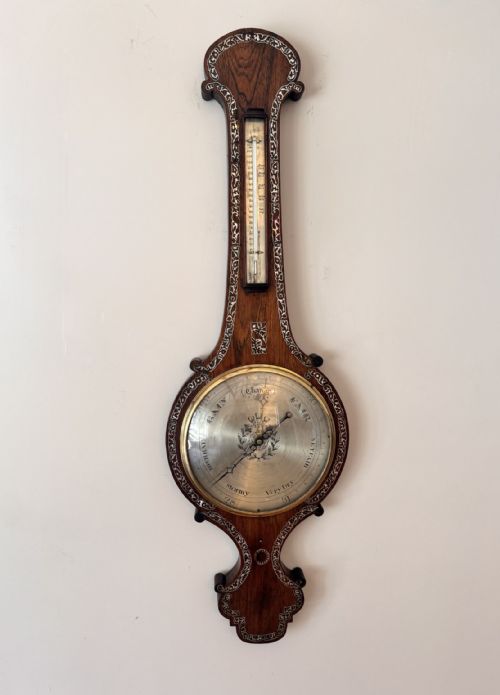


Traditional Wheel Barometer
A traditional wheel barometer measures atmospheric pressure while anchoring a hallway with dark timber and silvered dials.
Traditional Wheel Barometer
A traditional wheel barometer is a domestic weather glass designed to hang on a wall, commonly taking a banjo shape with a dry-and-wet dial below a hygrometer or thermometer. These instruments combine utility with domestic display, recording barometric pressure through a system of weights and pulleys.
The versions most likely to be met on this page date from the nineteenth century and the Georgian period, built in Britain by makers working in towns and cities. Mahogany, rosewood and walnut dominate the selection, often finished with mother of pearl inlay or carved details.
Buyers encounter forms that range from plain domestic wall pieces to larger examples incorporating thermometer scales and spirit levels. The dial sits at the centre, protected by a brass bezel and thick glass, presenting engraved numbers read with a manual pointer.
How they were made
Makers constructed the cases from seasoned mahogany, rosewood, walnut and burr walnut, shaping the timber into curved banjo profiles and smoothing the surfaces with polish. Cabinets often feature delicate line inlay in mother of pearl or contrasting wood veneers.
The internal mechanics rely on mercury within a glass tube, balanced with a float and pulley system that turns the central needle on the silvered metal dial. Engraved scales and maker signatures on the metal face add precision and detail to the instrument.
Listings feature instruments built from mahogany, rosewood, walnut and burr walnut, complemented by silvered metal dials and mother of pearl.
What varies in quality
The grade of timber and the crispness of the cabinet carving set individual pieces apart, with burr walnut and figured mahogany representing the more ambitious end of production. Simpler cases rely on plain grain and minimal stringing.
The legibility and condition of the silvered metal dial dictate visual success, alongside the presence of original brass bezels and recording thermometers. Maker signatures engraved onto the metal scale elevate a standard wall glass into a documented piece of regional craftsmanship.
Jenkins Of Old Swindon·James H Kelly·Vecchio And Co·Bianchi Ipswich·A Rivolta·Bassi·Negretti And Zambra·George Dollond Of London
The Traditional Wheel Barometer Glossary
- Banjo barometer
- A household weather glass housed in a case shaped like a banjo, featuring a narrow stem and a bulbous base for the dial.
- Silvered metal
- A brass or copper dial treated with silver powder to create a bright, matte surface for engraved weather scales and numbers.
- Hygrometer
- A secondary dial mounted on the upper stem to measure atmospheric humidity alongside barometric pressure.
- Bezel
- The brass ring that holds the protective glass cover securely in front of the dial face.
- Mercurial barometer
- An instrument that uses liquid mercury in a sealed glass tube to register changes in air pressure.
Traditional Wheel Barometer: Frequently Asked Questions
How do I read a traditional wheel barometer?
Read the main silvered dial by observing the fixed numbers alongside the movable pointer set by hand. Changes in pressure move the internal mercury, turning the needle towards set or stormy weather.
Secondary dials on the upper stem often indicate humidity or temperature, providing a fuller picture of atmospheric conditions inside the home.
Where should I hang a wheel barometer?
Hang the instrument on an interior wall away from direct sunlight, radiators and draughty doorways. Stable indoor temperatures help protect the wooden case and the sensitive internal glass tube.
Ensure the wall fixing supports the weight securely, as these wooden and glass instruments require a stable mount to remain level.
How do I tell a Georgian barometer from a Victorian one?
Georgian examples often display simpler mahogany cases with restrained stringing and arched pediments at the top. The lettering on the dials tends to be finer and more restrained.
Victorian pieces frequently introduce richer timbers like rosewood and burr walnut, alongside heavier carving, mother of pearl inlay and dampness indicators.
Are these barometers still accurate for weather forecasting?
They record current atmospheric pressure effectively, though they function primarily as historical domestic instruments rather than modern meteorological tools. Comparing the needle position over successive hours shows whether pressure is rising or falling.
Regular calibration against a known local reading keeps the movement responsive to weather shifts.