
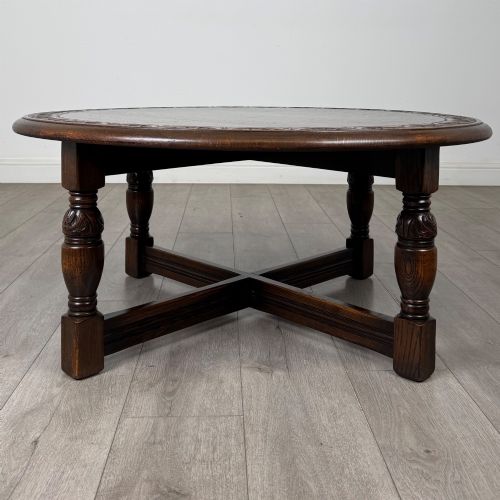


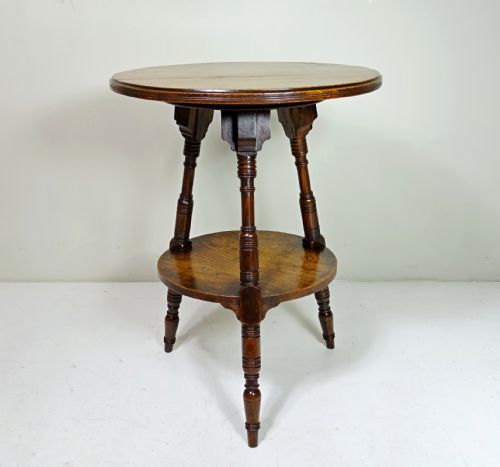

Traditional Round Coffee Table
A traditional round coffee table anchors a room with circular balance, offering walnut, mahogany, and hardwood surfaces suited to daily living.
Traditional Round Coffee Table
Buyers seeking a traditional round coffee table encounter circular low tables, occasional pieces, and nested sets spanning the nineteenth and early twentieth centuries. These items draw on revival styles including Victorian, Edwardian, Queen Anne, and Jacobean, alongside Chinese export designs.
The selections on this page range from solid yew wood and elm cricket tables to burr walnut veneered pieces with pie crust edges. Low coffee tables and lowered wine tables dominate the forms, providing compact centrepieces for seating areas.
How they were made
Craftsmen built these tables using timbers such as walnut, mahogany, oak, yew wood, and oriental hardwood, sometimes applying burr walnut veneer for figured surfaces. Construction methods combined solid wood frames with turned supports and carved detailing.
Workshop practices involved hand-carving decorative elements, such as pie crust rims on circular tops, and incorporating brass hardware where appropriate.
Periods represented include the nineteenth century, 1850, 1900, 1920, and 1930.
What varies in quality
Quality rests in the selection of timber and veneer, distinguishing plain hardwoods from richly figured burr walnut and solid yew. Finer examples display crisp hand-carving on edges and supports, whereas simpler pieces rely on plain turned legs.
Proportion and structural integrity separate standard utility items from more ambitious revival pieces. Well-executed joints and balanced circular tops ensure lasting stability in domestic use.
The Traditional Round Coffee Table Glossary
- Pie crust edge
- A raised, carved border shaped in undulating curves resembling pastry work. This decorative technique appears on circular table tops.
- Burr walnut veneer
- A thin slice of wood taken from a walnut tree growth, showing intricate swirling grain patterns. Cabinetmakers applied this to table tops for visual depth.
- Cricket table
- A small, round occasional table supported by three splayed legs. The design provides stability on uneven floors.
- Nest of tables
- A set of graduated tables designed to fit neatly beneath one another. They offer flexible surface space in compact rooms.
Traditional Round Coffee Table: Frequently Asked Questions
What is a traditional round coffee table?
A traditional round coffee table is a low circular surface used for drinks and display, originating from periods between the nineteenth and early twentieth centuries.
These pieces encompass various revival styles and materials, functioning as practical centrepieces in traditional interiors.
How do I date a round coffee table?
Dating relies on examining the timber, construction methods, and stylistic revival influences evident in the piece.
Items from the nineteenth century often show heavier hardwood construction, while early twentieth-century examples frequently feature figured walnut veneers and lighter frames.
Where should I place a round coffee table?
A round coffee table suits placement in the centre of a seating arrangement where curves soften linear room layouts.
Its circular shape facilitates easy movement around the perimeter compared to rectangular alternatives.
What woods were used for these tables?
Cabinetmakers utilised a range of timbers including walnut, mahogany, oak, yew, elm, and oriental hardwoods.
Some surfaces feature decorative burr walnut veneer to enhance the visual appeal of the circular top.