
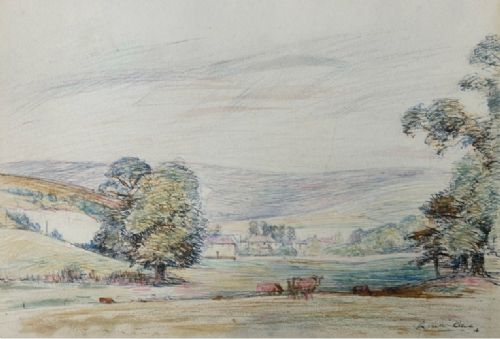
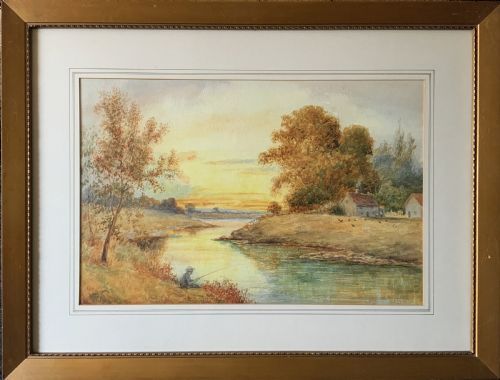


Traditional Pastoral Watercolour Landscape
Traditional pastoral watercolour landscape works capture rural English scenes through delicate pigment on paper, offering collectors a quiet window into historic countryside life.
Traditional Pastoral Watercolour Landscape
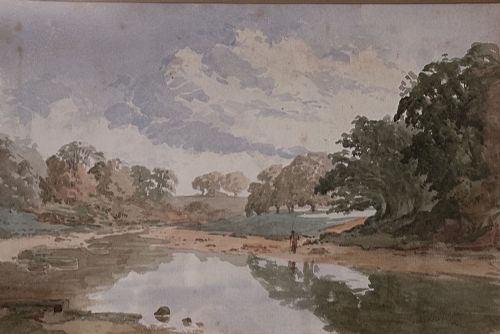
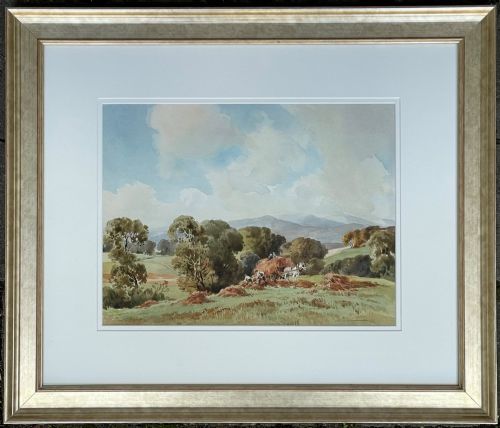
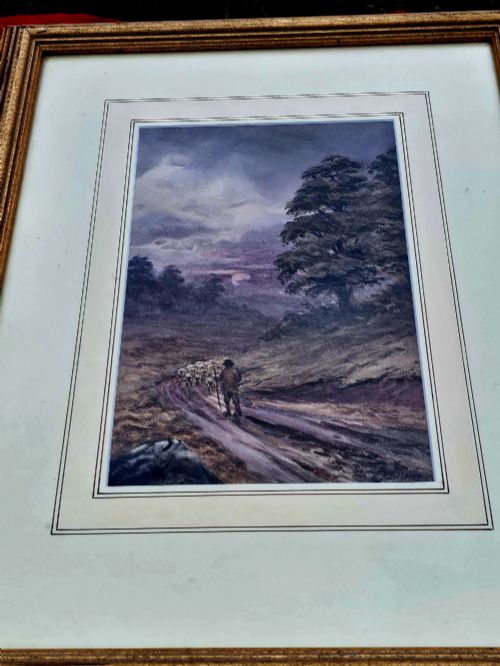
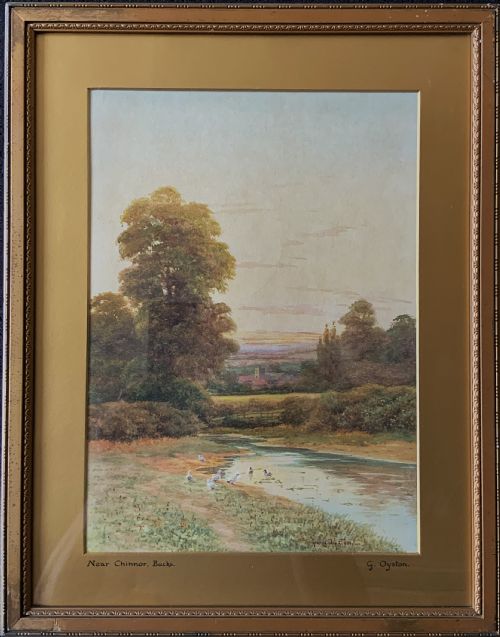
A traditional pastoral watercolour landscape depicts rural life, farming scenes, and countryside views across Britain, predominantly originating from the nineteenth and early twentieth centuries. These paintings frequently record agricultural activities such as herding sheep, hay cutting, and droving across moorlands, wetlands, and downs. Collectors encounter framed artworks spanning the Victorian and Edwardian eras, often categorised under traditional British fine art.
The compositions on this page lean heavily toward established regional views, capturing specific locales from Dorset and Devon to Yorkshire and Warwickshire. Many examples preserve vernacular rural architecture like cottages and ferry crossings alongside working figures and livestock. These framed paintings function primarily as wall art reflecting a gentler, agrarian past.
Materials and technique
Artists executed these works using watercolour pigment applied directly onto paper, often mounted beneath glass within wooden or burr frames. Many pieces incorporate subtle gold leaf or gilt details within the framing to complement the warm tones of the painted scenes.
The medium relies on washes of transparent pigment to build light and atmosphere, capturing sunset hues or overcast skies with notable fluidity. Surviving examples frequently retain their original period frames, which utilise traditional woodworking techniques.
Several sheep appear remarkably patient while being driven across nineteenth-century moorlands.
Gradations of quality
Quality in these watercolours rests upon the artist's handling of light, atmospheric depth, and tonal gradation across the paper surface. Finer examples display confident brushwork and precise topographical or anatomical detail in figures and livestock, whereas lesser works remain formulaic or stiff.
The integration of the painting with its original period frame and glass significantly elevates an object's integrity. Condition issues such as fading pigment or heavy foxing on the paper detract from the visual strength of the composition.
Percy Lancaster·George Oyston·Russell Sidney Reeves·Henry Charles Fox·Henry John Kinnaird·Frederick Septimus Lewis·James Orrock·James Hardy Junior·John Atkinson·Robert Hollands Walker·Thomas James Lloyd·John R K Duff·Henry Birtles·Walter Henry Sweet·Thomas Nicholson Tyndale·Frederick J Knowles·Charles James Adams·Sir Ernest Albert Waterlow·James Stephen Gresley·Arthur Willett·Edmund George Warren·Alfred Rimmer·George Graham·David Heward·Yeend King
The Traditional Pastoral Watercolour Landscape Glossary
- Watercolour pigment
- Finely ground colour particles mixed with a water-soluble binder, applied in translucent washes to paper. This medium allows artists to achieve luminous effects and delicate skies.
- Gilt
- A thin layer of gold leaf or gold-coloured paint applied to wooden frames. It adds a decorative border that enhances the warmth of the traditional pastoral scene within.
- Edwardian Pastoral
- A specific stylistic designation reflecting rural subjects painted during the reign of Edward VII and the early twentieth century. These works often exhibit a brighter, more expansive palette than their mid-Victorian predecessors.
- English School
- A collective term for artists working in Britain within traditional academic and regional landscape traditions. It groups together practitioners who shared common sketching grounds and compositional methods.
Traditional Pastoral Watercolour Landscape: Frequently Asked Questions
What subjects appear in these watercolours?
These paintings portray rural English countryside views, including farming activities, coastal settings, and village scenes. Common motifs feature shepherds with flocks, haymakers, cattle in fields, and horse-drawn carts.
Artists frequently recorded specific regional locations across Britain, capturing local architecture, rivers, and downs under changing daylight.
How should I hang watercolour paintings?
Watercolour pigments remain sensitive to strong ultraviolet light, so framing pieces behind glass and positioning them away from direct sunlight is essential. Proper placement prevents the delicate washes on paper from fading over time.
Maintaining stable indoor humidity levels also protects both the antique paper and its original wooden or gilt frame from environmental stress.
Are these paintings signed by the artists?
Many examples feature the artist's signature or monogram, often inscribed discreetly in the lower corner of the paper. Signed works frequently connect the painting to documented members of British art societies from the nineteenth and twentieth centuries.
Unsigned pieces still offer stylistic clues linking them to the broader English School or specific regional traditions of the period.
How do I distinguish Victorian from Edwardian pieces?
Victorian watercolours often utilise darker, more restrained tonal palettes with deep greens and browns reflecting industrial-era tastes. Subjects from this period frequently lean towards dramatic skies or heavily detailed narrative pastoral scenes.
Edwardian and early twentieth-century works generally adopt a lighter, brighter approach to colour and open-air atmosphere, mirroring shifts in contemporary British landscape painting.