
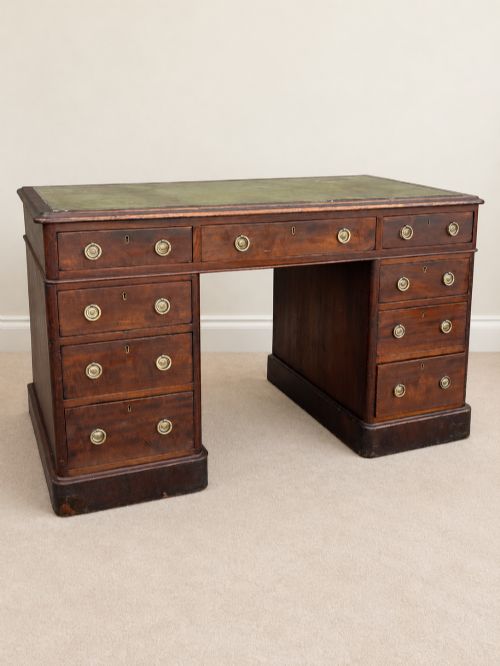
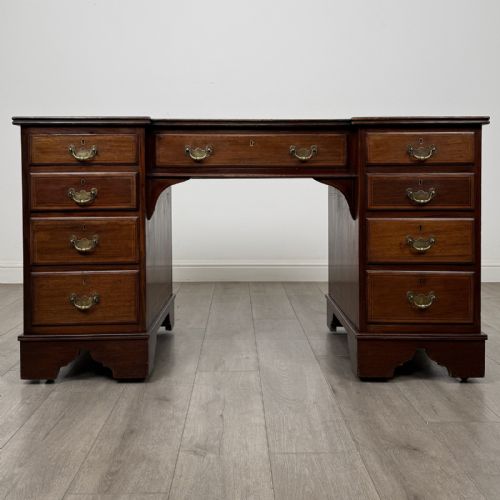
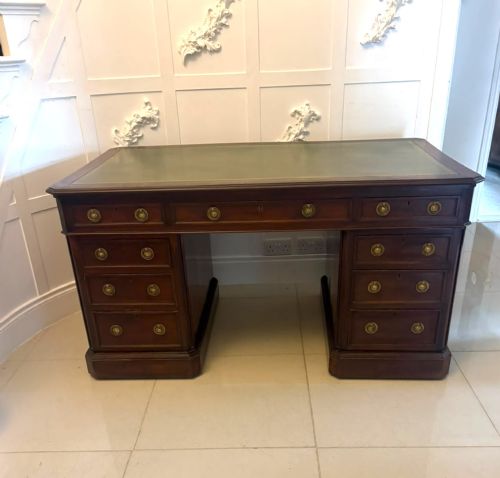
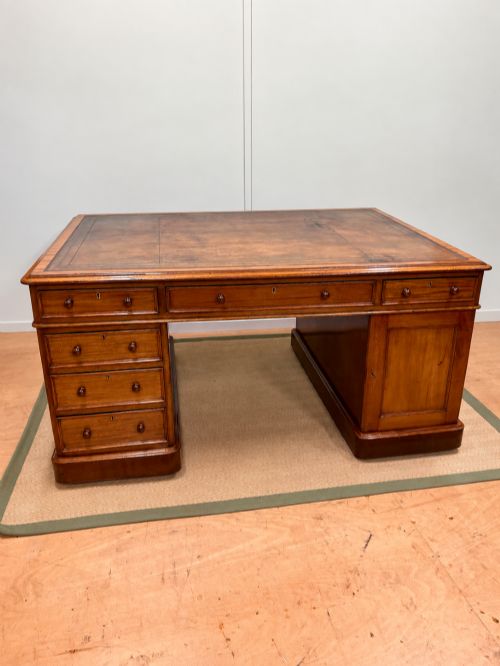


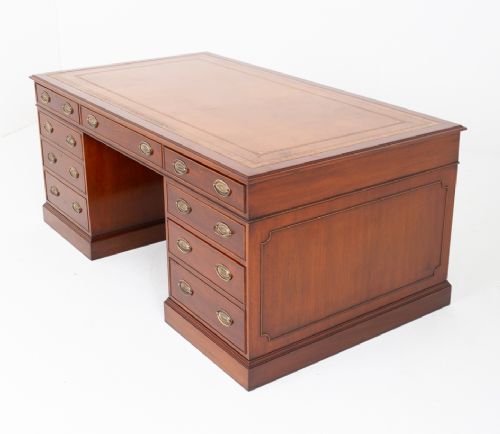
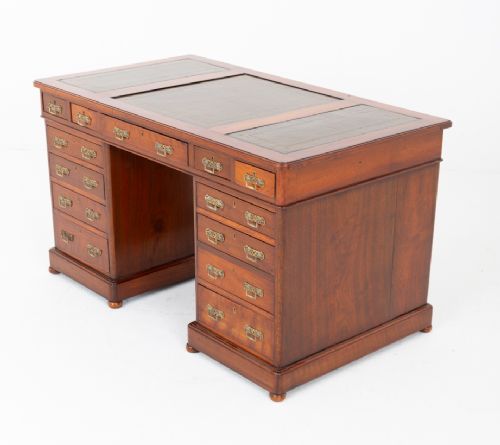
Traditional Partners Table
A traditional partners table provides dual workstations with opposing drawers, offering substantial proportions and period craftsmanship.
Traditional Partners Table
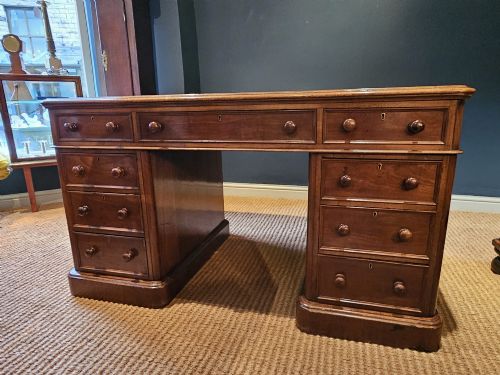
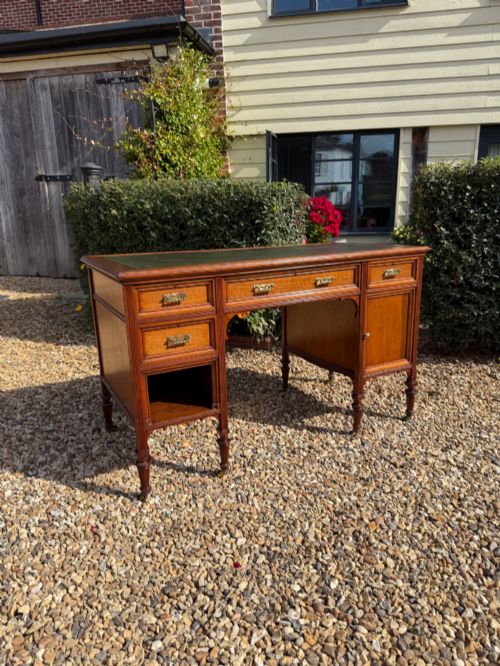
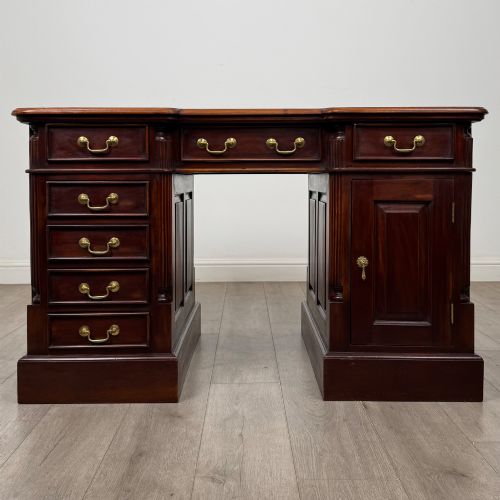
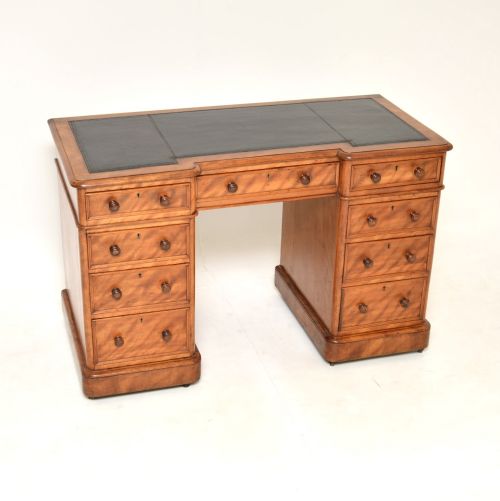
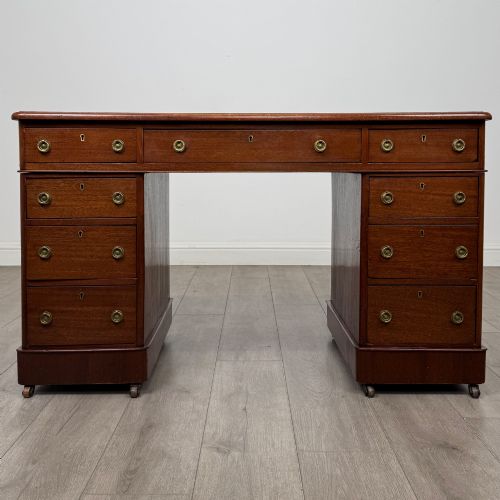
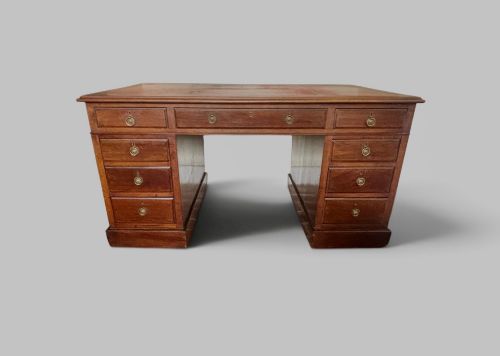
A traditional partners table is a large desk designed for two people to work opposite one another, featuring drawers and cupboards on both sides. These substantial pieces emerge primarily from the Victorian and Edwardian eras, alongside earlier Georgian iterations.
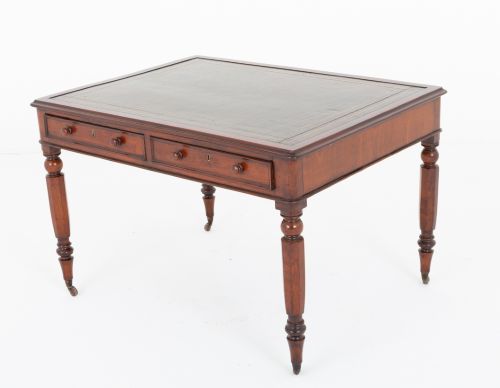
The inventory on this page displays various forms, including pedestal desks and library writing tables built to stand freely in the centre of a room rather than against a wall. Woods such as mahogany, oak and walnut dominate the selection, often accompanied by inset leather writing surfaces.
Makers and revival styles shape the offerings, ranging from plain functional oak to decorative Chippendale and Louis XIV revival designs. Buyers encounter both compact examples and large library desks measuring over six feet in length.
Materials and construction methods
Cabinet makers utilised dense hardwoods like mahogany, walnut and oak for the primary structures, applying burr walnut and satinwood veneers on finer surfaces. Brass hardware appears on drawer pulls and key escutcheons.
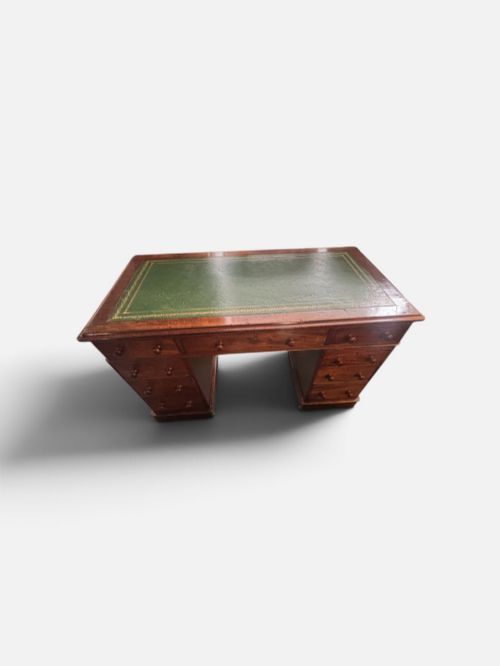
Writing surfaces typically feature inset panels of tooled leather, bordered by blind or gilt tooling. Drawers are constructed using traditional joinery techniques to withstand daily clerical or library use.
Opposing drawers mean two people can argue over misplaced paperclips from identical distances.
Distinctions in grade and execution
Quality separates pieces through the selection of timber figure, such as highly grained burr walnut or dense mahogany, and the crispness of carved details in revival styles. Finer examples exhibit superior symmetry and balanced proportions across both working sides.
The integrity of the original leather insert, the presence of matching keys for pedestal cupboards, and the weight of the timber used in the drawer linings distinguish high-status library tables from standard utilitarian desks.
Trollope & sons·Maple & Co
The Traditional Partners Table Glossary
- Partners desk
- A large freestanding double-sided desk designed with opposing sets of drawers and cupboards for two people.
- Pedestal desk
- A desk comprising a central writing surface supported by two independent columns of drawers.
- Leather top
- An inset writing surface made from cattle hide, frequently decorated with gold tooling around the perimeter.
- Kneehole
- The central recessed space beneath a desk top designed to accommodate the user's legs.
- Library table
- A large freestanding table utilised for reading and writing, often fitted with frieze drawers.
Traditional Partners Table: Frequently Asked Questions
What is a traditional partners table?
A traditional partners table is a large, freestanding double-sided desk featuring opposing banks of drawers and cupboards.
Designed for two people to sit and work facing one another, these substantial pieces typically occupy the centre of a room rather than resting against a wall.
How do I date a partners desk?
Dating relies on observing the prevailing timber choices, construction methods, and stylistic revivals present in the piece. Victorian and Edwardian examples show distinct handling of mahogany and walnut compared to earlier Georgian models.
Secondary woods inside drawer boxes and the style of brass hardware also offer clues to the decade of manufacture.
Can I place a partners desk in the middle of a room?
Yes, because these desks are finished on all sides with drawers or cupboards facing both directions, they are specifically intended for freestanding placement.
Placing them centrally allows access to the storage compartments from any angle within a library or study.
What woods were used for these desks?
Cabinet makers predominantly utilised mahogany, oak and walnut for the primary framework and drawer construction. Finer decorative surfaces frequently display burr walnut veneers, satinwood or maple.
Leather panels provide the contrasting writing surface on the top.