


Traditional Painted Bedside Lamp
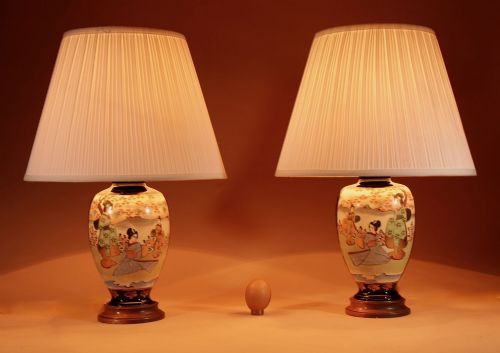
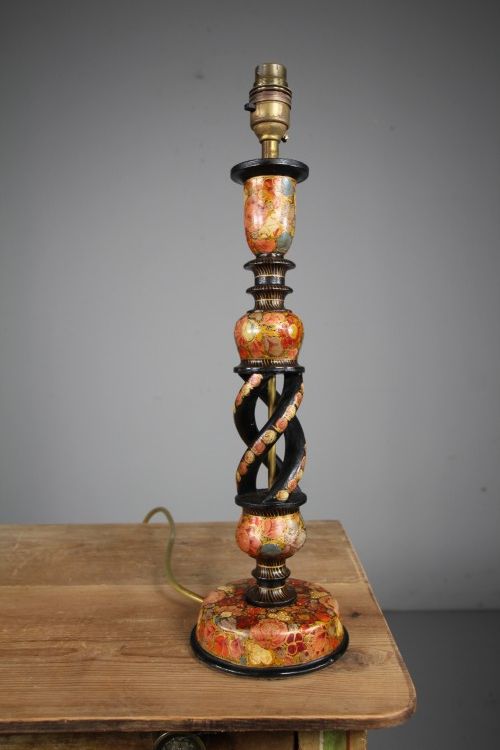
These traditional painted bedside lamp examples bring hand-finished character and rich colour to a room.
Traditional Painted Bedside Lamp
A traditional painted bedside lamp brings together decorative handwork and functional domestic lighting from the nineteenth and early twentieth centuries. When searching for a traditional painted bedside lamp, buyers encounter pieces transformed from earlier ceramic vessels, ginger jars, and vases, alongside purpose-built wooden and lacquered forms. The selection ranges from Kashmiri painted timber to Japanese Satsuma and Kutani porcelain and Chinese blue and white porcelain.
The periods represented span the Victorian era, the nineteenth century, and the early twentieth century up to nineteen thirty. Many examples reflect distinct global styles including Chinoiserie, Anglo-Indian, Japanese Meiji, and Neoclassical designs. Alongside standard table lamps, the grouping occasionally includes side tables and painted lamp tables suited for bedside placement.
How they were made
Makers utilised a variety of base materials such as brass, wood, fabric, porcelain, and papier-mâché. Wooden and papier-mâché structures often received layers of paint, lacquer, and intricate hand-applied surface decoration. Porcelains were shaped and fired before receiving detailed hand-painted motifs in blue and white, Famille Verte, or polychrome palettes.
Many ceramic lamp bodies originated as vases, ginger jars, or baluster vessels that were subsequently adapted for electrical wiring. Fabric and silk elements were introduced for shades, while structural fittings incorporated brass components to support the lighting apparatus.
Several lamps started life as ginger jars before finding a second career illuminating bedside reading.
What varies in quality
The standard of execution in the hand-painting separates simpler decorative pieces from finer artistic works. Precision in the brushwork of Kashmiri floral motifs or Japanese porcelain figures dictates the visual depth of the object. The integration of converted vases into lamps involves careful preservation of the original ceramic body.
Material richness also defines the upper tier, seen in the density of lacquer work, the clarity of porcelain glazes, and the weight of brass fittings. Consistency in period styling, whether Chinoiserie or Neoclassical, maintains the historical integrity of the piece.
The Traditional Painted Bedside Lamp Glossary
- Ginger jar
- A ceramic vessel originally used for storing spices, frequently converted into a lamp base. These jars typically feature rounded bodies and removable covers.
- Famille Verte
- A Chinese porcelain palette dominated by green enamels, developed during the Qing Dynasty. This colourful style appears on nineteenth-century vases adapted as lighting.
- Satsuma
- Japanese earthenware produced in the Satsuma province, known for its ivory crackle glaze and ornate polychrome decoration. Pieces from the Meiji period often serve as decorative lamps.
- Papier-mâché
- A composite material made from paper pulp or layers of paper bound with glue, used for lightweight Kashmiri lamp bodies. This surface accepts detailed painted and lacquered finishes.
- Chinoiserie
- European decorative style reflecting Chinese artistic traditions, popular in nineteenth-century furnishings. It appears on painted lamp bodies and occasional tables.
Traditional Painted Bedside Lamp: Frequently Asked Questions
Are these lamps converted from vases?
Many examples on this page began life as Chinese ginger jars, baluster vases, or Japanese porcelain vessels before being adapted as table lamps.
This conversion process preserves the original ceramic artistry while updating the object for modern domestic illumination.
What periods do these lamps date from?
The pieces span from the nineteenth century through the Victorian era and into the early twentieth century up to nineteen thirty.
Styles range from Neoclassical and Renaissance Revival to Japanese Meiji and Kashmiri decorative traditions.
How do I identify Kashmiri painted lamps?
Kashmiri lamps typically feature wooden or papier-mâché structures adorned with intricate hand-painted floral and botanical patterns.
These pieces often display rich surface colours and traditional regional craftsmanship from the nineteenth and early twentieth centuries.
Can I use these on a bedside table?
While many items are classified as table lamps suitable for side surfaces, the selection also includes small occasional tables.
These compact forms fit comfortably beside a bed to provide subdued ambient light and decorative surface space.