
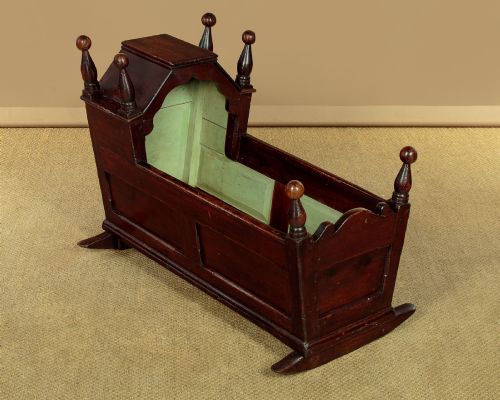


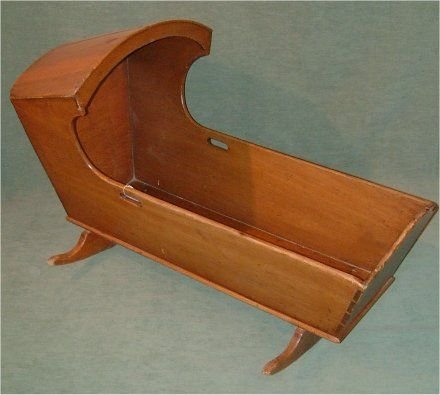
Traditional Hooded Wooden Cradle
These traditional hooded wooden cradles are early sleeping berths for infants, prized for their sturdy rockers and panelled timber construction.
Traditional Hooded Wooden Cradle
A traditional hooded wooden cradle is an infant sleeping vessel mounted on rockers, designed with a protective canopy or hood over the head end. When you search for a traditional hooded wooden cradle, you encounter forms spanning from the seventeenth century through to the Victorian era. The selection includes country pieces in pine and formal examples built from oak.
Most items on this page date from the nineteenth century or the Georgian period, alongside earlier styles such as William and Mary. These nursery items typically feature panelled construction or boarded sides, resting upon curved wooden rockers to soothe a child. Oak and pine dominate the materials, often augmented by original paint finishes.
Makers ranged from country carpenters working in pine to skilled joiners handling high-grade oak. You will find variations from rustic country cradles to structured panelled cribs reflecting seventeenth-century revival designs. Each piece combines domestic utility with period cabinet-making traditions.
How they were made
Construction relies heavily on solid timber boards, primarily oak and pine, joined by traditional panelling techniques. Master joiners utilised framed and panelled methods to build stable bodies that could withstand the movement of rocking. Selected pieces incorporate mahogany or retain traces of original blue paint.
Hoods and canopies were integrated into the structural framework to shelter the infant from drafts. The base of each cradle connects to curved wooden rockers, allowing a smooth motion. Metal fixings or glass elements appear rarely, as the vernacular design prioritises pegged and jointed wood.
What varies in quality
Quality rests in the selection of timber and the sophistication of the joinery. Oak panelled examples from earlier periods demonstrate finer hand-planing and more deliberate moulding compared to utilitarian pine versions. The presence of original paint finishes adds distinct character and integrity to country pieces.
Proportion and the execution of the hood separate standard items from superior works. A well-balanced canopy and crisp field panelling indicate a maker of greater skill. The retention of original rockers further defines the integrity of the piece.
The Traditional Hooded Wooden Cradle Glossary
- Rockers
- Curved wooden runners attached to the base of a cradle to allow a gentle swaying motion. They are shaped from solid timber to bear the weight of the structure.
- Hood
- A protective canopy built over the head end of the sleeping compartment. This feature sheltered infants from cold air in draughty rooms.
- Field panel
- A raised or recessed wooden panel set within a frame, frequently utilised in seventeenth-century and Georgian joinery. It adds structural rigidity and visual depth.
- William and Mary
- A style period spanning the late seventeenth and early eighteenth centuries, characterised by sober geometry and quality craftsmanship in native timbers.
- Original paint
- Pigment applied during the period of manufacture that has survived without later stripping or modern repainting. It provides authenticity to country pine furniture.
Traditional Hooded Wooden Cradle: Frequently Asked Questions
How do I date a wooden cradle?
Dating relies upon timber species, construction joints, and stylistic markers such as panel types. Seventeenth-century examples show heavy oak panelling, whereas nineteenth-century pieces often utilise pine or mahogany.
Examine the underside and the fixings for signs of hand-tooling or machine-cut elements. Pegged joints and original paint finishes also help determine the period of manufacture.
Were these cradles used for sleeping?
These pieces served as primary infant beds during the night and day, kept close to the family hearth. The rocking mechanism helped soothe babies to sleep.
The protective hood shielded the child from room drafts, a vital consideration in older homes before central heating.
What is the difference between oak and pine versions?
Oak examples tend to reflect formal cabinet-making traditions and earlier periods, often featuring intricate panel work. They were built to last through generations of a household.
Pine versions are typically associated with country workshops and later periods, sometimes retaining bright original paint surfaces. They offer a lighter aesthetic than heavy hardwood counterparts.
How should I care for an antique wooden cradle?
Keep the timber away from direct heat sources and dramatic humidity fluctuations to prevent wood splitting. Dust gently with a dry cloth and avoid harsh chemical polishes.
Preserve original paint or waxed surfaces by applying a microcrystalline wax sparingly if the timber appears dry. Regular gentle maintenance preserves the structural integrity.