
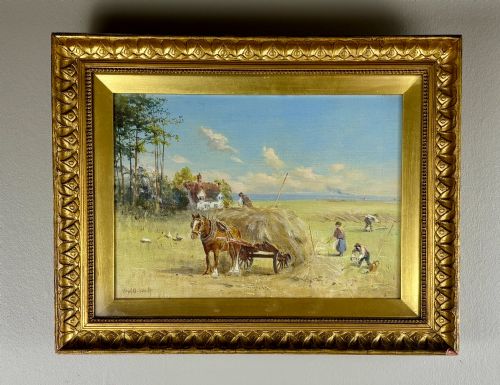
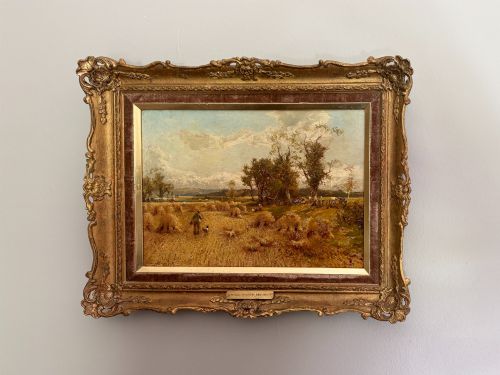

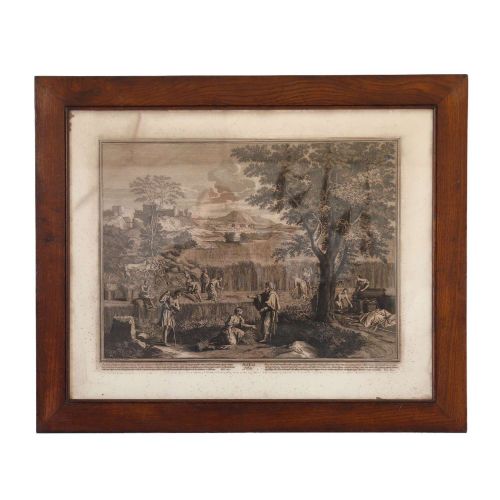


Traditional Harvest Landscape Scene
A traditional harvest landscape scene captures the agricultural labours of past centuries, offering collectors a window into rural heritage through oil and watercolour.
Traditional Harvest Landscape Scene
A traditional harvest landscape scene depicts rural agricultural workers, hay cutting, and cornfields across various periods including the nineteenth century and the Edwardian era. These works record agrarian life through traditional British and impressionist styles.
The versions most frequently met on this page are oil paintings on canvas and watercolours on paper. Artists from these periods focused on the seasonal rhythm of gathering crops and working the land.
Subjects range from expansive countryside views in Hampshire and Worcestershire to intimate portrayals of farmworkers with horses. Each piece documents a specific rural locality and its agricultural traditions.
Materials and technique
Painters used oil paint on canvas to build rich textures and deep colour fields for nineteenth-century pastoral scenes. Watercolours on paper suited lighter, more immediate atmospheric effects in Edwardian depictions.
Gilt frames often house these works, complementing the traditional palettes of rural landscapes. Paper supports in watercolours require careful protection behind glass.
Listings span from the seventeenth century to the mid-twentieth century, employing oil paint, watercolour, canvas, and wood.
Distinctions in quality
The success of a piece rests on the artist's handling of light across open fields and the natural depiction of working figures and horses. Weaker examples offer stiff, formulaic compositions that lack observational depth.
Skilled brushwork and confident handling of oil paint separate notable works from standard decorative items. The integration of landscape details with human activity demonstrates the painter's ability.
Percy Lancaster·Henry John Boddington·John Atkinson·William Grant Murray·James William Booth·Henry H Parker·Walter Heath Williams·Arthur Walker Redgate·George Cole·Alfred Augustus Glendening Snr·Wilmot Pilsbury·Robert Thorne Waite
The Traditional Harvest Landscape Scene Glossary
- Oil on Canvas
- Pigment mixed with drying oil applied to stretched woven fabric. This medium allows for rich colour blending and durable surface textures.
- Watercolour
- Pigments suspended in a water-based solution applied to paper. It produces transparent washes of colour suited to pastoral lighting.
- British Impressionism
- A painting style focusing on light and everyday subjects influenced by French movements. Artists recorded outdoor rural scenes with loose brushwork.
- Genre Painting
- Depictions of aspects of everyday life by depicting ordinary people engaged in common activities. Agricultural labour forms a primary subject here.
Traditional Harvest Landscape Scene: Frequently Asked Questions
What subjects appear in these scenes?
These works typically depict agricultural activities such as hay cutting, wheat harvesting, and farmworkers with horses in rural settings.
Artists recorded specific regional landscapes, from Hampshire cornfields to the Vale of Evesham, highlighting the seasonal rhythms of the countryside.
How do I display a watercolour?
Watercolours on paper require protection behind glass and mounting away from direct sunlight to prevent fading.
Maintaining stable environmental conditions in the room preserves the integrity of both the paper support and the pigments.
What periods are represented?
The selection spans from the seventeenth century through the Victorian and Edwardian periods into the mid-twentieth century.
Nineteenth-century Victorian Pastoral and early twentieth-century British Impressionism form the core of the available artistic approaches.
How do oil paintings differ from watercolours?
Oil paintings utilise pigment bound in drying oil on canvas, offering heavier texture and deeper colour saturation.
Watercolours employ water-soluble pigments on paper, creating translucent effects that capture subtle changes in atmospheric light.