
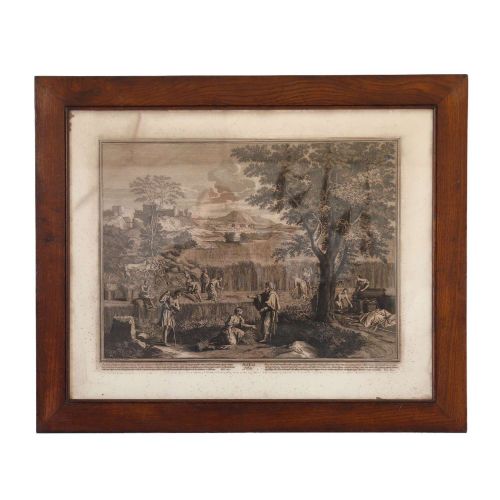


Traditional Harvest Landscape Artwork
Traditional harvest landscape artwork captures agricultural scenes of reaping and haymaking in oil and watercolour.
Traditional Harvest Landscape Artwork
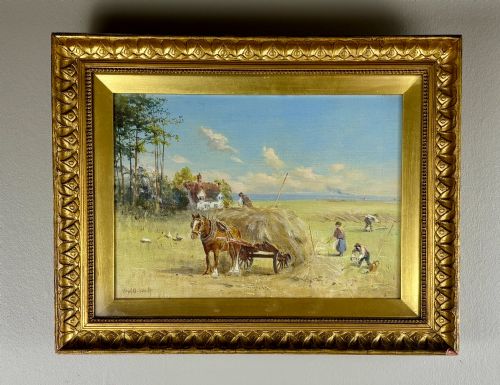
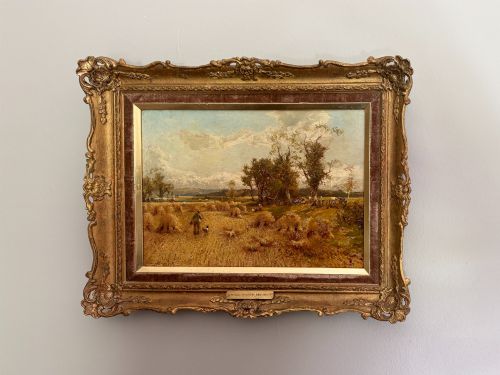
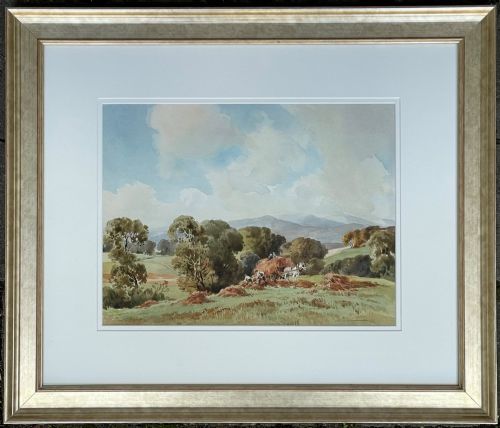
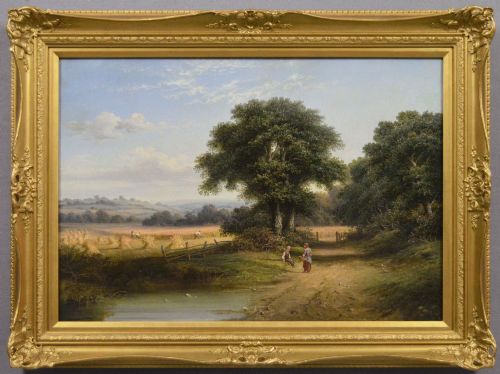
Traditional harvest landscape artwork depicts rural scenes involving hay cutting, wheat gathering and agricultural labour across the countryside. Buyers encountering this selection will primarily find oil paintings on canvas alongside watercolours on paper, framed within period wood and giltwood surrounds.
The material span covers works originating from the seventeenth century through to the mid-twentieth century, with strong representation from Victorian and Edwardian periods. Styles range from British and Scottish Impressionism to Victorian Pastoral and Baroque Classicism, reflecting diverse regional interpretations of agricultural life.
Common compositional subjects include figures near harvest fields, hay carts by rivers, and cornfields at sunset. These pieces document historical farming methods through the eyes of artists working directly from the British landscape.
What varies in quality
Depth of atmosphere and confidence of brushwork separate standard topographical records from masterful interpretations of harvest light. Works by accomplished painters handle the transition from sunlit fields to dusk skies with greater tonal subtlety.
The preservation of the original canvas, pigment stability and the integrity of the period frame influence the standing of an individual piece. Stronger examples maintain surface vibrancy without excessive intervention, retaining the painter's initial mark-making.
Listings span periods from the seventeenth century to the mid-twentieth century, utilising oil on canvas, watercolour, and engraved paper.
Percy Lancaster·Walter Heath Williams·John Atkinson·William Grant Murray·J.C. Grey·James William Booth·Henry H Parker·Helmut Reuter·Arthur Walker Redgate·Joseph Paulman·Joseph Thors·David Heward·Wilmot Pilsbury·John Clayton Adams·Robert Thorne Waite
The Traditional Harvest Landscape Artwork Glossary
- Giltwood
- Carved wood treated with a thin layer of gold leaf. This material frequently appears on the decorative frames enclosing period paintings.
- Watercolour
- A paint consisting of water-soluble pigments applied to paper. It provides a translucent finish often employed for lighter landscape studies.
- Oil on Canvas
- Pigment suspended in drying oil applied to a woven fabric surface. This combination forms the principal medium for the larger rural scenes.
- Victorian Pastoral
- An artistic style celebrating rural life and agricultural labour. Works in this category idealise the British countryside and farming traditions.
- Impressionism
- A style focusing on accurate depiction of light and its shifting qualities. British and Scottish variants apply this approach to local harvest fields.
Traditional Harvest Landscape Artwork: Frequently Asked Questions
What periods do these artworks cover?
The selection spans from seventeenth-century engravings to mid-twentieth-century watercolours and oils. Victorian and Edwardian pieces form the core of the available inventory.
Earlier works sit alongside twentieth-century interpretations, showing how the depiction of agricultural labour evolved over generations.
How should I care for these paintings?
Keep canvases and watercolours away from direct sunlight and fluctuating humidity to protect the pigments. Glass protects works on paper from atmospheric moisture and dust.
Maintain stable indoor temperatures to prevent the wood and canvas from expanding or contracting over time.
Are these works signed by the artists?
Many examples feature artist signatures, while others remain attributed through stylistic evidence and period records. Documentation often connects specific landscapes to known regional painters.
Signatures typically appear in the lower corners of the canvas or paper substrate.
What framing comes with the artwork?
Most pieces retain their period wood frames, frequently finished in giltwood that matches the era of creation. These surrounds complement the tonal qualities of the pastoral scenes.
Examine the frame construction to determine whether it dates from the same period as the canvas.