


Traditional Glass Barware
Traditional glass barware brings heavy cut decanters and crystal coupes to the table for serving drinks with period weight and sparkle.
Traditional Glass Barware
Traditional glass barware consists chiefly of decanters and drinking vessels designed for spirits and wine during the nineteenth and early twentieth centuries. These drinking items served formal dining rooms and drawing rooms, holding whisky, wine, and champagne.
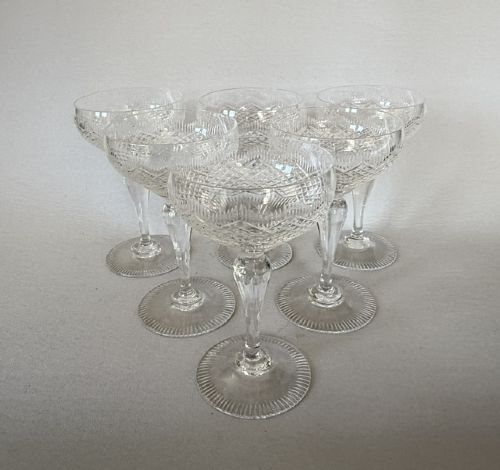
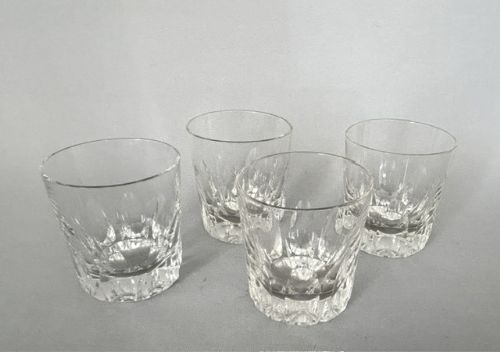
The versions most commonly met on this page are Edwardian and Victorian decanters alongside champagne coupes and small whisky tumblers. They reflect the entertaining habits of the late Regency, Victorian, and Edwardian eras.
Forms range from bell-shaped decanters to pairs of spirit decanters and sets of small champagne bowls. Each piece demonstrates the heavy glassware production characteristic of these historical periods.
How they were made
Pieces in this category utilise cut glass, lead crystal, and clear cut glass shaped into decanters and glassware. The material provides substantial weight and clarity.
Surface patterns are achieved through cutting and etching techniques, visible on the crystal champagne glasses and cut glass decanters. These methods create deep facets that catch the light.
Listings span the nineteenth and early twentieth centuries, featuring Victorian, Edwardian, and Regency periods in cut glass and lead crystal.
What varies in quality
Quality differences depend on the depth and crispness of the cutting, which determines how sharply the facets catch the light. Superior examples show precise geometric or floral work across the body.
The choice of material also influences the piece, with clear lead crystal offering greater brilliance and weight than standard glass. Sets that remain together, such as pairs of decanters or matched coupes, hold higher integrity.
The Traditional Glass Barware Glossary
- Decanter
- A vessel with a stopper used for holding and serving wine or spirits. They often feature cut glass decoration and heavy bases.
- Champagne coupe
- A shallow-bowled stemmed glass used for serving champagne. Edwardian sets frequently utilise this broad bowl form.
- Lead crystal
- Glass containing lead oxide, which increases the weight, refractive index, and clarity of the material. It is commonly found in nineteenth-century barware.
- Tumbler
- A flat-bottomed drinking glass without a stem or handle. Victorian examples include small sizes intended for whisky.
- Etched crystal
- Glass decorated with designs carved into the surface using acid or tools. This technique appears on fine sets of champagne glasses.
Traditional Glass Barware: Frequently Asked Questions
How do I clean old glass decanters?
Old glass decanters require careful hand washing with warm water and mild detergent. A bottle brush helps clean interior residues without scratching the glass.
Stoppers should be washed separately and left out until the interior dries completely. Avoid sudden temperature changes to prevent cracking the heavy lead crystal.
Can I use antique barware daily?
Traditional glass barware is robust enough for regular use if handled with care. Hand washing preserves the clarity and prevents damage to the cut surfaces.
Modern dishwashers can cloud antique glass and damage delicate rims on coupes. Storing them securely protects the sharp edges of the cut patterns.
How do I date an old decanter?
Dating relies on the shape of the body, the style of the cut glass, and the form of the stopper. Victorian and Edwardian pieces often display distinct facet-cutting and neck rings.
Regency examples tend to have heavier lead crystal and specific geometric proportions. Comparing the weight and silhouette helps place the piece within its proper era.
What is the difference between crystal and glass?
Crystal contains lead oxide, which gives the material greater weight and a clearer ring when struck. Standard glass lacks this additive and feels lighter in the hand.
Both materials appear frequently in traditional barware from the Victorian and Edwardian periods. Lead crystal allows for deeper and sharper cutting.