

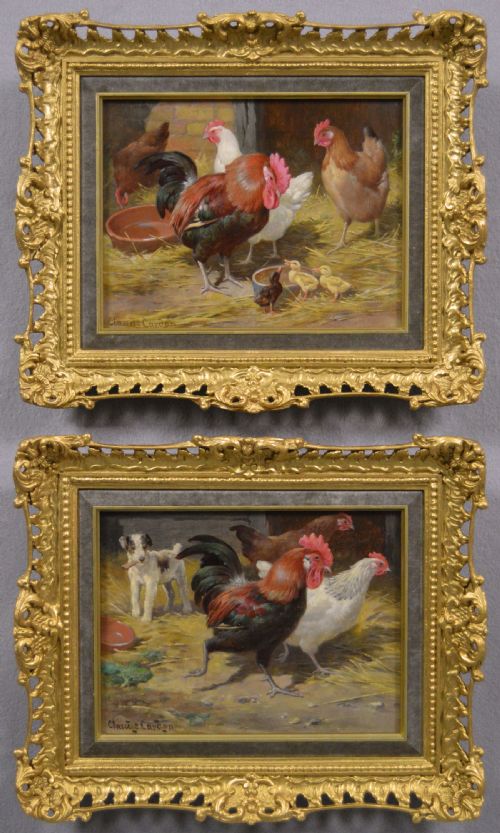


Traditional Farm Animal Art
Traditional farm animal art brings the rich, rural character of the nineteenth and early twentieth centuries straight into your home through oil on canvas.
Traditional Farm Animal Art
Traditional farm animal art captures the pastoral scenes of the nineteenth and early twentieth centuries, featuring horses, cattle, sheep, and poultry in oil on canvas. When you search for traditional farm animal art, you find works ranging from detailed Victorian depictions of prized livestock to bustling farmyard scenes.
The pieces on this page mostly span the Victorian and Edwardian eras, reflecting rural life through movements like nineteenth century realism and pastoral styles. These artworks record specific farm animals, from Shorthorn bulls to hens and chicks, set against countryside landscapes or sheltering barns.
How they were made
These works are executed in oil paint on canvas, mounted on wood frames, and often housed in giltwood and gesso frames enhanced with gold leaf. Artists built up rich textures using oil mediums to capture the detailed coats of horses, cattle, and sheep alongside the natural light of the landscape.
The framing technique typically involves heavy gesso moulding finished with gold leaf, which complements the warm earth tones and deep pigments of the oil paintings within.
Listed periods span from the 1830s through the Victorian and Edwardian eras up to the 1930s.
What varies in quality
Quality in these pastoral works rests upon the precision of anatomical rendering and the liveliness of the brushwork in depicting the animals. A stronger piece demonstrates careful observation of light across a Shorthorn bull's hide or the convincing plumage of poultry.
The sophistication of the background landscape and the integration of livestock into their rural surroundings further distinguish the works. Superior examples maintain balance between the central animal subjects and the wider farmyard or pasture context.
Claude Cardon·John Frederick Herring Jnr·Samuel Joseph Clark·Percival Glenfern·Pierre Emmanuel Dielmans·Thomas Sidney Cooper·Edgar Hunt·W. A. Clark·A Davis·Louis Marie Dominique Robbe
The Traditional Farm Animal Art Glossary
- Oil on canvas
- A painting medium where pigments are bound with drying oils and applied to a stretched woven fabric support. This combination allows for rich blending and deep colour saturation.
- Giltwood
- Wood that has been thinly coated with gold leaf or gold paint for decorative effect. It is commonly found on the ornate frames enclosing nineteenth century paintings.
- Gesso
- A plaster mix applied to wood frames to create a smooth surface for gilding. It enables intricate relief ornamentation around the edges of the artwork.
- Pastoral
- A genre of art depicting the rural lives of shepherds, farmers, and farm animals in idealized countryside settings. It emphasises peace and simplicity in nature.
- Realism
- An artistic movement focusing on everyday subjects and scenes as they actually appear, without idealization. In these pieces, it shows livestock and farmyards with careful attention to detail.
Traditional Farm Animal Art: Frequently Asked Questions
What animals appear most often?
Horses, cattle, sheep, and poultry dominate these pastoral scenes. Chickens, cockerels, and ducks frequently accompany larger livestock in farmyard settings.
Bulls and cows also feature prominently, often highlighted as prized agricultural specimens by nineteenth century artists.
How do I care for an oil on canvas?
Keep the artwork away from direct sunlight and dramatic shifts in temperature to protect both the canvas and the oil paint. Gentle dusting with a soft, dry brush maintains the surface.
Avoid moisture and chemical cleaners on the canvas and the giltwood frame.
Are these paintings signed by the artists?
Many of the works carry signatures or attributions to known painters of the period. Signatures often appear discreetly in the lower corners of the canvas.
Some pieces relate to the circles or followers of prominent nineteenth century animal painters rather than bearing a direct signature.
What periods do these artworks represent?
The pieces span the nineteenth and early twentieth centuries, capturing Victorian and Edwardian artistic sensibilities. Dates range from the 1830s through to the 1930s.
Realist and pastoral styles from these decades define the visual character of the collection.