



Framed Agricultural Canvas Painting
These framed agricultural canvas painting works capture rural life, farm animals and working horses across the nineteenth and twentieth centuries.
Framed Agricultural Canvas Painting
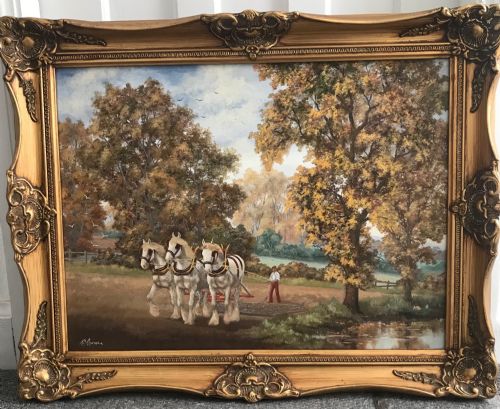
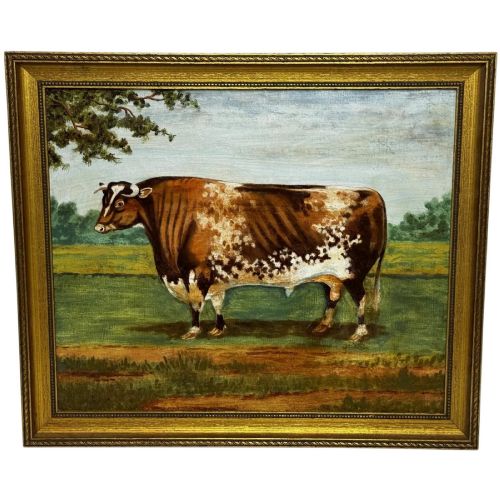
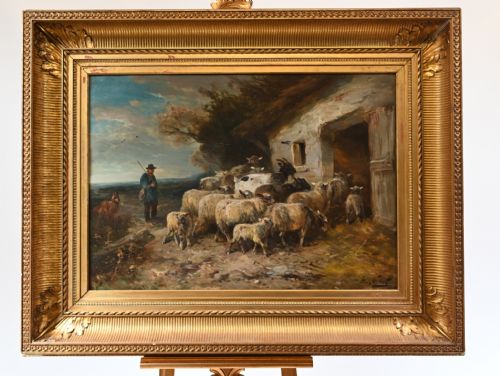
A framed agricultural canvas painting portrays rural working life, farm animals, and harvest scenes from the nineteenth and twentieth centuries. Buyers seeking these works will find heavy shire horses, cattle in stables, and pastoral landscapes rendered in oil.
The Victorian period and the early twentieth century supply the majority of these pastoral subjects. Painters from this era focused on the practical realities of farming, depicting shire horses ploughing fields, livestock in barns, and farmworkers gathering crops.
Works on this page range from detailed traditional realism to naive portrayals of rural trade. Canvas surfaces mounted in wood frames predominate, showing the daily routines of British and European countryside life.
Materials and Technique
Artists painted these rural scenes using oil pigments spread across woven canvas supports. Oil paint allowed workers to build rich textures for animal coats, harvested wheat, and heavy soil.
Makers housed these canvases within wooden frames, occasionally incorporating gesso moulding or gilt ornamentation to finish the edge. The combination of oil on canvas within a substantial wood boundary defined the presentation of nineteenth and twentieth century fine art.
The listings feature oil paintings on canvas across the nineteenth and twentieth centuries, capturing agricultural landscapes, shire horses, and farmyard animals.
Quality Variations
Anatomical precision in the rendering of shire horses, cattle, and sheep marks the distinction between standard pastoral records and accomplished fine art. Painters who understood bone structure and muscle movement produced convincing representations of working livestock.
The handling of natural light and atmospheric perspective across wide fields separates accomplished compositions from static village scenes. Superior canvases display careful tonal control within the sky and terrain, whereas simpler naive works rely on flat planes and direct outlines.
Henry Schouten·James Kyd·Herbert Royle·James William Booth·Thomas Sidney Cooper·George Cole·Owen Bowen·William Sidney Cooper·George Wright
The Framed Agricultural Canvas Painting Glossary
- Canvas
- A heavy woven fabric stretched across a wooden frame to serve as a painting surface. It provides the foundational texture for oil pigment.
- Gesso
- A plaster mixture applied to wooden frames or panels to prepare the surface for gilding or paint. It creates a smooth base for decorative mouldings.
- Genre painting
- A style depicting scenes from everyday life, including agricultural labour, farmworkers, and domestic animals. These works record ordinary activities without idealisation.
- Pastoral
- Relating to the countryside, farming, and rural landscapes. This term describes artwork focused on agricultural tasks and rural scenery.
Framed Agricultural Canvas Painting: Frequently Asked Questions
What periods do these paintings date from?
The works span from the nineteenth century through the Victorian era and into the mid-twentieth century. Most examples originate between eighteen-eighty and nineteen-sixty.
Victorian pieces often display traditional realism, while mid-century canvases showcase looser brushwork and naive interpretations of farming landscapes.
How should I care for an oil on canvas?
Keep the canvas away from direct sunlight and dramatic shifts in room humidity to prevent the paint surface from cracking. Gentle dusting with a soft, dry brush maintains the condition of the pigment.
Avoid using water or chemical cleaners on the painted surface or the surrounding wooden frame.
What subjects appear most often in these pastoral scenes?
Heavy shire horses, shorthorn bulls, flocks of sheep, and working farmhands dominate the compositions. Scenes often capture ploughing teams, harvest time, or livestock sheltered inside rustic barns.
Landscape elements such as rolling hills, rivers, and country cottages frequently frame the animals and workers.
Are the frames original to the paintings?
Some pieces retain their period wooden frames, occasionally finished with ebonised wood or gilt gesso details. Other works have been reframed over time to suit interior display preferences.
Examination of the rebate and canvas edges helps determine whether a frame has been paired with the artwork later in its history.