
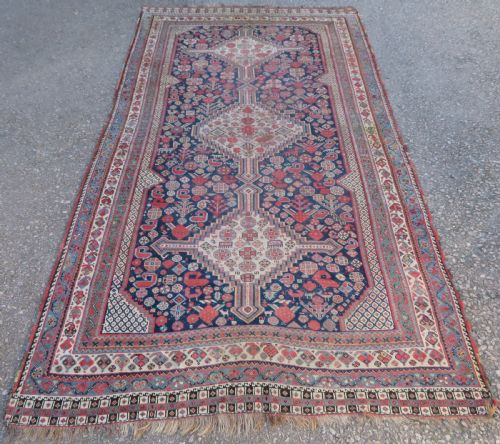


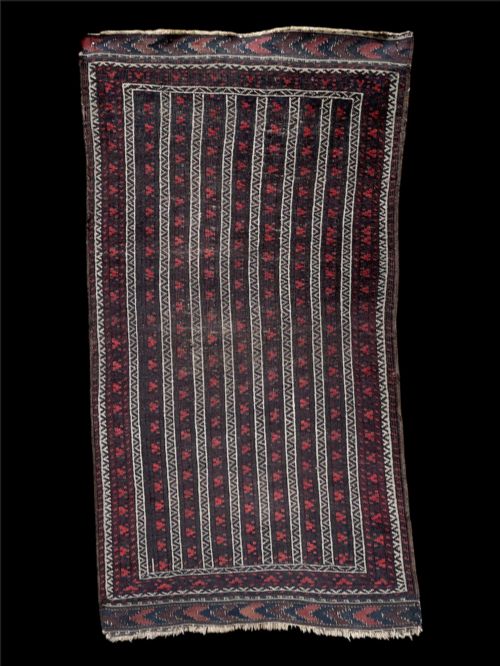
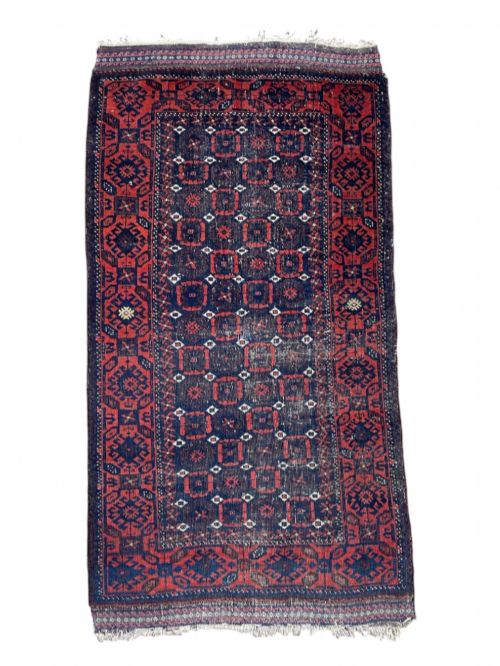


Traditional Dark Navy Carpet
A traditional dark navy carpet brings deep indigo ground work and tribal weaving tradition into a room.
Traditional Dark Navy Carpet
A traditional dark navy carpet encompasses hand-knotted room-sized floor coverings, area rugs and narrow hallway runners originating from Persian, Afghan, Anatolian and Caucasian villages and tribal regions. These pieces date from the nineteenth century through the early decades of the twentieth century, including productions from styles such as Baluch, Mahal, Tabriz, Bidjar and Hamadan.
Buyers encountering this group will find both expansive carpets designed for principal rooms and elongated runners suited for corridors. The palette frequently anchors deep indigo and navy fields with complex geometric medallions, all-over Herati patterns or repeating tribal motifs executed in wool.
Materials and Construction
These floor coverings are constructed primarily using wool for both the pile and the foundational structure, supplemented by cotton for foundations in specific town and workshop pieces. The materials are worked into hand-knotted piles that provide dense physical resilience and deep colour retention across decades of use.
Weavers utilised natural dyes to saturate the wool, yielding the rich dark navy and indigo tones characteristic of these rugs. The physical structure relies on tightly packed knots secured to warp and weft threads, resulting in durable textiles designed for sustained utility.
Object types span area rugs, large carpets and narrow hallway runners.
Quality Variations
Quality in these textiles depends heavily upon the precision of the knotting and the density of the weave, which dictate both structural integrity and the crispness of pattern definition. Finer knots allow intricate designs like the Herati or complex medallion layouts to render with sharp clarity rather than blurriness.
The choice and preparation of wool and dye stuffs also separate standard productions from superior examples. Even wear across a resilient wool pile combined with depth in the dark navy ground distinguishes master village and workshop outputs from simpler utilitarian rugs.
The Traditional Dark Navy Carpet Glossary
- Herati pattern
- A popular recurring ornamental motif consisting of a central rosette enclosed by a rectangle and flanked by curved leaves. It appears frequently across Persian and regional village carpets.
- Mihrab
- A niche design symbolising a prayer arch, often found on directional rugs made for devotional use. This architectural motif dominates the upper field of specific tribal prayer carpets.
- Warp
- The vertical foundation threads stretched tightly on the loom before knotting begins. The fringe of a finished carpet typically consists of these extended warp threads.
- Weft
- The horizontal threads passed back and forth through the warp threads after each row of knots. This technique binds the pile firmly into the structural foundation of the textile.
- Runner
- A long, narrow carpet format specifically proportioned for hallways, corridors and staircases. These pieces provide floor covering in confined spaces while displaying traditional repeating field designs.
Traditional Dark Navy Carpet: Frequently Asked Questions
How do I clean an old carpet?
Maintenance requires gentle surface care and specialist cleaning rather than immersion or aggressive mechanical washing. Professional treatment protects the historical wool pile and structural dyes.
Vacuuming should be done gently without a rotating beater brush catching the soft edges. Keeping the textile away from direct, prolonged sunlight preserves the deep indigo and navy hues.
Where were these rugs made?
The pieces originate across workshops and nomadic tribal territories in Persia, Afghanistan, Anatolia and the Caucasus. Different regions developed distinct weaving methods and recognisable design vocabularies.
Local materials and regional dyeing traditions shaped the final appearance of each carpet. Village weavers often worked from memory, incorporating tribal motifs specific to their communities.
What is a runner rug?
A runner rug is an elongated rectangular textile intended for narrow spaces such as corridors, hallways and entryways. Their proportions direct foot traffic while adding warmth to transitional areas.
These formats share the same wool pile and hand-knotted construction methods as larger room carpets. Regional weavers adapted their traditional patterns to fit these constrained dimensions.
How do I date a carpet?
Dating relies on assessing the structural materials, the chemical or natural nature of the dyes, and stylistic indicators within the weave. Subtle variations in knot density and wool preparation provide clues to the period of production.
Comparative study of known regional styles helps narrow down the decade or century of origin. Nineteenth and early twentieth-century examples display characteristic wear patterns and dye patination.