
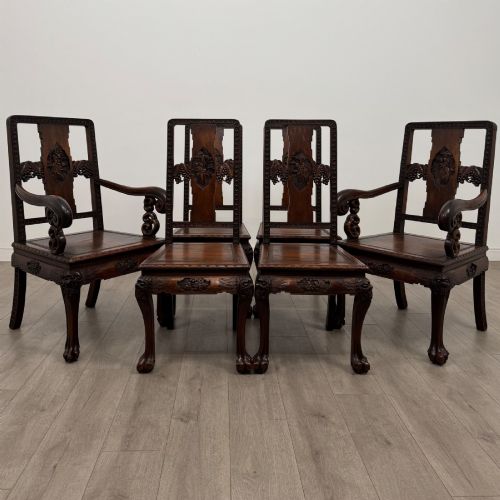
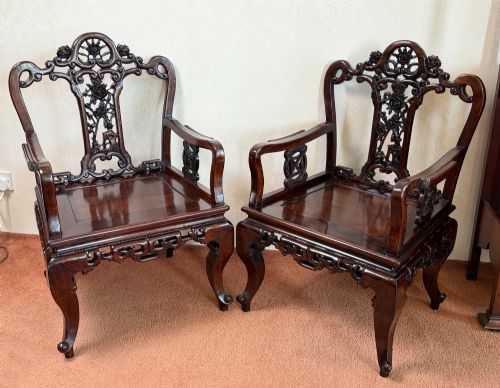


Traditional Chinese Side Chairs
Traditional Chinese side chairs bring distinct silhouettes and robust joinery to a room, offering functional seating rooted in centuries of craftsmanship.
Traditional Chinese Side Chairs
Traditional Chinese side chairs appear in various forms across this selection, ranging from nineteenth century examples to early twentieth century pieces. Buyers searching for traditional Chinese side chairs encounter styles spanning Qing Dynasty, Chinese Chippendale, and Victorian interpretations of oriental design.
The objects listed include pairs and individual pieces functioning as dining chairs, hall chairs, and lamp hanger chairs. Elm, hardwood, rosewood, and mahogany form the primary body of works available to collectors.
Makers and workshops across the nineteenth and early twentieth centuries produced these items using traditional joinery methods. The selection reflects both domestic Chinese forms and export pieces tailored for Western markets.
How they were made
Carpenters utilised dense timbers such as rosewood, mahogany, and elm to construct these chairs. Hardwoods provide structural stability, while softer woods like elm allow for intricate carved details.
Surfaces frequently receive treatments of lacquer, paint, or natural polish to seal the wood. Caning appears on elbow seats, woven through drilled frames to create resilient seating surfaces.
Periods represented span the nineteenth century, the Victorian era, and the early twentieth century.
What varies in quality
The depth and crispness of carved ornamentation distinguish finer examples from simpler production. Relief carving on back splats and crest rails demonstrates the hand of a skilled artisan.
The integrity of traditional joinery determines the structural longevity of each piece. Timber selection and the preservation of original lacquered or polished surfaces also influence the character of the chair.
The Traditional Chinese Side Chairs Glossary
- Hardwood
- Dense timber species utilised for durable furniture construction. These woods resist warping and support intricate carving.
- Elm
- A resilient domestic timber frequently employed in regional Chinese chair production. It offers a distinct grain pattern suitable for traditional forms.
- Cane
- Woven material utilised for chair seats, providing flexibility and breathability. Artisans thread split rattan through frames.
- Lacquer
- Protective and decorative coating applied to wooden surfaces. Layers create a smooth, durable finish.
- Qing Dynasty
- Historical period associated with specific aesthetic developments in Chinese furniture. Pieces from this era display characteristic regional motifs.
Traditional Chinese Side Chairs: Frequently Asked Questions
How do I identify a yoke-back chair?
Yoke-back chairs feature a distinctive crest rail curving upward and outward, resembling a traditional ox yoke.
This design provides ergonomic support for the sitter's upper back and shoulders.
What is a lamp hanger chair?
Lamp hanger chairs derive their name from the shape of the top rail, which resembles poles used for hanging lanterns.
They represent a specific traditional form originating in Chinese domestic interiors.
Are these chairs suitable for daily dining?
Many of these pieces function effectively as dining or hall seating when paired with appropriate tables.
Their robust hardwood construction supports regular use in modern residential settings.
How should I care for lacquered wood?
Maintain lacquered surfaces by dusting gently with a soft, dry cloth without chemical polishes.
Protect the finish from direct sunlight and extreme humidity fluctuations.