



Traditional Agricultural Oil Painting
Traditional agricultural oil painting captures the historic labour of the land through canvas, brush and pigment.
Traditional Agricultural Oil Painting
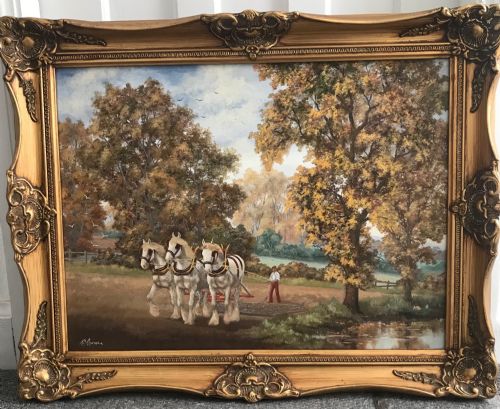
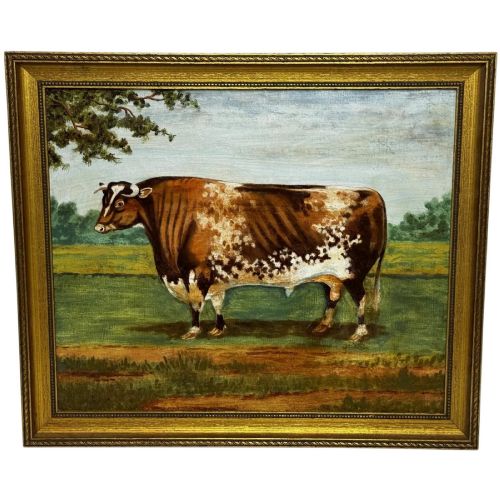
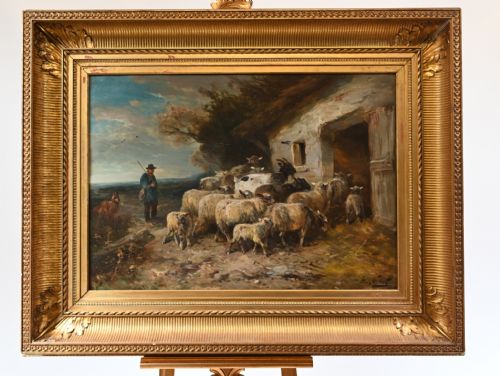
A traditional agricultural oil painting depicts the rural landscape, farmyards, ploughing teams and prize livestock across the nineteenth and twentieth centuries. These works record the daily realities of countryside life, farmworkers, harvest scenes and equine portraits.
Buyers will most frequently meet Victorian and Edwardian examples on this page. The compositions range from detailed depictions of shorthorn bulls and shire horses to sweeping pastoral views of haymaking and rural harvest.
The origins span British and continental schools, with artists capturing specific rural locales from Wharfedale to Belgium. These paintings serve as historical documents of traditional farming practices before mechanisation.
Materials and methods
These works are painted in oil on canvas, utilising wood stretchers and occasionally gesso grounds. The paint application varies from smooth academic realism to the looser brushwork of British Impressionism.
Frames often incorporate gilt mouldings that complement the warm earth tones of the rural subjects. Pigments are applied to woven canvas supports, capturing light across fields, livestock and farmworkers.
Periods represented span from eighteen-fifty through the Victorian era up to nineteen-sixty.
What distinguishes finer examples
The distinction in quality lies in the anatomical accuracy of the animals, the handling of light across the landscape and the depth of the composition. Master painters capture the muscular structure of shire horses and the characteristic stance of prize cattle with acute observation.
Compositional balance and atmospheric perspective separate standard topographical records from exceptional genre paintings. The articulation of texture in fleece, fur, wheat and weathered timber demonstrates the painterly skill of the hand behind the work.
Henry Schouten·James Kyd·Herbert Royle·Percival Glenfern·James William Booth·Arthur Winter Shaw·Thomas Sidney Cooper·Arthur Charles Dodd·Vernon Stokes·Joseph Paulman·J L VAN Leemputten·JOHN PERCY COOKE·Ernest Higgins Rigg·William Greaves·W A Clark·Owen Bowen·William Huggins·William Sidney Cooper·Louis Marie Dominique Robbe·George Cole·Frederick J Haycock·GEORGE WRIGHT·B J Burrows
The Traditional Agricultural Oil Painting Glossary
- Oil on canvas
- A painting medium where pigments are suspended in a drying oil, most commonly linseed, and applied to a stretched fabric support. This combination allows for rich colour blending and durability.
- British Impressionism
- A style of painting emerging in the late nineteenth and early twentieth centuries that focuses on light, brushwork and outdoor observation. It appears in several rural scenes of this period.
- Victorian pastoral
- A genre of art depicting idealised or realistic rural and agricultural scenes during the reign of Queen Victoria. These works frequently centre on farmyards, livestock and agricultural labour.
- Gesso
- A paint mixture consisting of a neutral binder mixed with chalk, gypsum or pigment, used as a prepared surface on wood or canvas. It provides a smooth foundation for oil painting.
- Equine portrait
- A painting dedicated specifically to the depiction of horses, often commissioned by owners to record prized working animals, hunters or shire horses.
Traditional Agricultural Oil Painting: Frequently Asked Questions
What periods do these paintings date from?
The works span from the mid-nineteenth century through the Victorian and Edwardian eras up to the mid-twentieth century.
Most pieces originate between eighteen-fifty and nineteen-sixty, reflecting traditional rural subjects across those decades.
Who are the typical subjects of these artworks?
The subjects include shire horses, shorthorn bulls, farmworkers, sheep flocks and harvest scenes.
Artists focused on the daily activities of the countryside, recording livestock, ploughing teams and rural landscapes.
How should I care for an oil painting on canvas?
Keep the canvas away from direct sunlight, damp environments and extreme temperature fluctuations.
Dust the surface gently with a soft, dry brush and avoid using water or chemical cleaners on the paint.
How can I identify the artist?
Look for signatures, monograms or inscriptions on the front of the canvas or on the stretcher bars at the back.
Examine the style, period details and framing, which often provide clues to the artist or school of painting.