



Traditional Agricultural Artwork
Traditional agricultural artwork records rural life, farming scenes and farm animals through oils and watercolours.
Traditional Agricultural Artwork
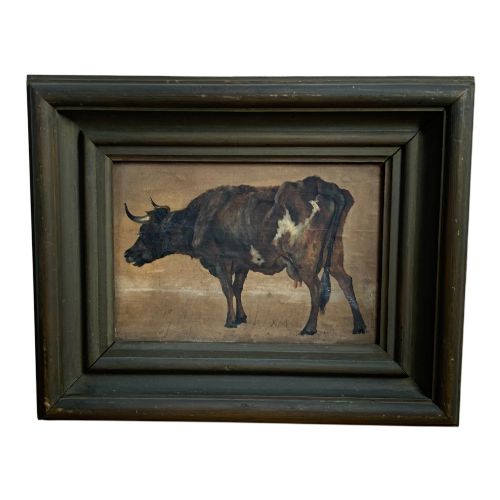
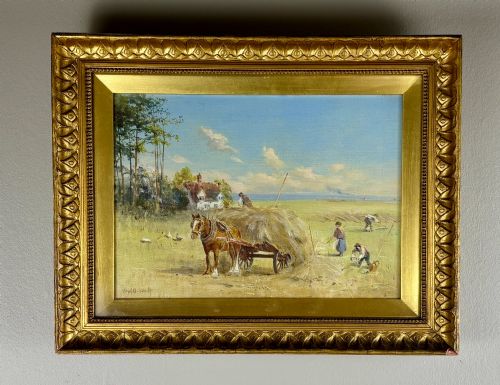
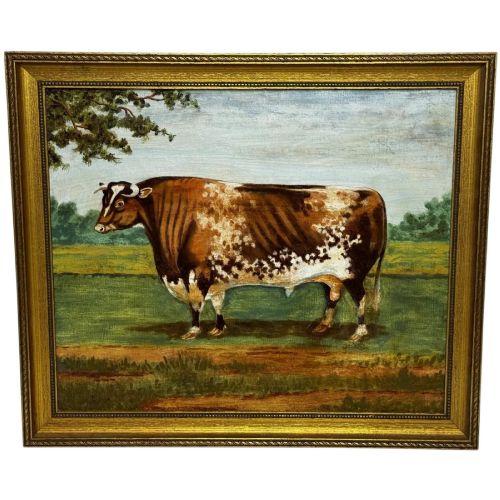
Traditional agricultural artwork centres on rural life, depicting plough teams, harvest fields, farmyards and livestock such as shire horses and shorthorn bulls. These paintings capture the labour and landscape of the countryside through the eyes of artists working from the nineteenth century into the mid twentieth century.
Buyers seeking traditional agricultural artwork encounter oil paintings on canvas alongside watercolours on paper. The works often bear signatures of named British artists and span periods from Victorian pastoral scenes to later rural realism.
Materials and construction
Painters used oil paint applied to canvas or wood panels, building rich textures for fields, animal coats and heavy horses. Watercolours on paper also appear frequently, often set within traditional burr frames alongside gesso mouldings.
Artists relied on traditional pigments and brushwork to render the light of hay times, farmyards and coastal towns. The support materials range from primed canvas to heavy paper, framed to suit domestic interiors.
Traditional Agricultural Artwork Retail Price Guide 2026
Typical asking prices for traditional agricultural artwork among the pieces listed under this phrase on Sellingantiques today, from the lower quarter to the upper quarter. They describe what is for sale here now, not the wider market.
Several canvases pay closer attention to the patient expression of farmyard poultry than to the farmers tending them.
Factors determining quality
Quality rests upon the artist's ability to render animal anatomy and rural movement convincingly, distinguishing skilled academic hands from simpler folk art. The precision in capturing light across a harvest field or the musculature of shire horses marks the upper tiers of the genre.
The integrity of the canvas, panel or paper together with the condition of the original frame influences the overall standing of a piece. Works by recognised regional painters command greater interest than unsigned or generic rural compositions.
A M Gauci·James Kyd·Herbert Royle·Percival Glenfern·John Atkinson·J C Grey·James William Booth·Arthur Winter Shaw·Thomas Sidney Cooper·Arthur Charles Dodd·Vernon Stokes·Joseph Paulman·J L Van Leemputten·John Percy Cooke·Ernest Higgins Rigg·William Greaves·W A Clark·Owen Bowen·William Huggins·William Sidney Cooper·George Graham·Louis Marie Dominique Robbe·George Cole·Fred Lawson·Frederick J Haycock
The Traditional Agricultural Artwork Glossary
- Oil on canvas
- A painting technique using pigments bound in a drying oil applied to a stretched canvas support. This method allows for deep colour blending and varied surface textures.
- Watercolour
- A paint medium where colourants are suspended in a water-soluble vehicle, typically applied to paper. It yields translucent washes suited to delicate landscape and sky effects.
- Gesso
- A plaster-like mixture applied to wood or canvas as a base for painting or moulded into decorative frame reliefs. It provides a smooth, stable surface for gilding and ornamentation.
- Burr frame
- A picture frame constructed from burr wood veneer, displaying swirling grain patterns. These frames add decorative depth to nineteenth and early twentieth-century watercolours and oils.
- British Impressionism
- An art style focusing on light and everyday subjects using looser brushstrokes. British practitioners applied these principles to rural landscapes and coastal views.
Traditional Agricultural Artwork: Frequently Asked Questions
What subjects appear in traditional agricultural artwork?
These works depict heavy shire horses, ploughing teams, cattle, farmyards and harvest scenes.
Artists focused on rural labour, livestock portraits and village life across British landscapes.
Which materials were used for these paintings?
Painters utilised oil paint on canvas and wood panels alongside watercolours on paper.
Frames frequently incorporated wood and gesso to house the finished artworks.
How do I date an agricultural painting?
Dating relies on dress, farming equipment, framing styles and artist signatures recorded in the work.
Pieces range from mid-nineteenth century Victorian canvases to mid-twentieth century rural watercolours.
How should I display these paintings at home?
Hang them on neutral walls away from direct sunlight to protect pigments and paper supports.
Ensure stable indoor humidity to preserve the canvas, wood panels and original frames.