




Three Piece Bronze Garniture
A three piece bronze garniture brings symmetry and weight to a room, anchoring a mantelpiece with a central clock flanked by matching candelabras or urns.
Three Piece Bronze Garniture
A three piece bronze garniture consists of a central mantel clock accompanied by two matching side pieces, most commonly candelabras, urns, or incense burners, designed to sit together as a unified decorative scheme. These sets emerge primarily from nineteenth-century French workshops, though examples span from the eighteenth century to the mid-twentieth century.
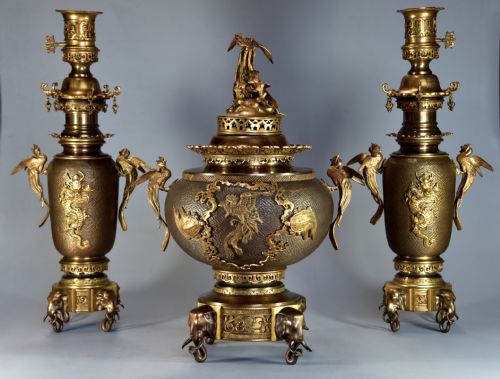
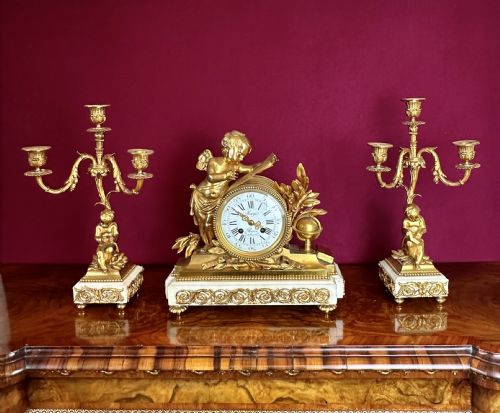
The dominant forms found on this page are French clock garniture sets executed in nineteenth-century styles such as Louis XVI, French Rococo Revival, and French Empire. Alongside these traditional designs, the selection includes Art Deco variations and Japonisme incense burner sets.
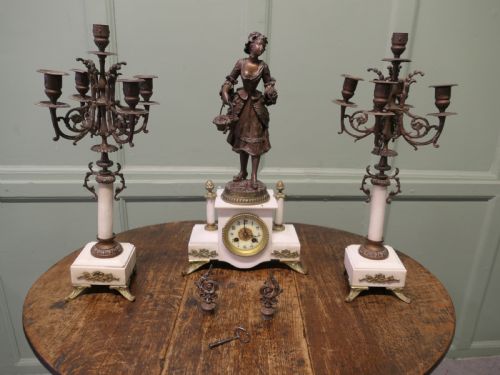
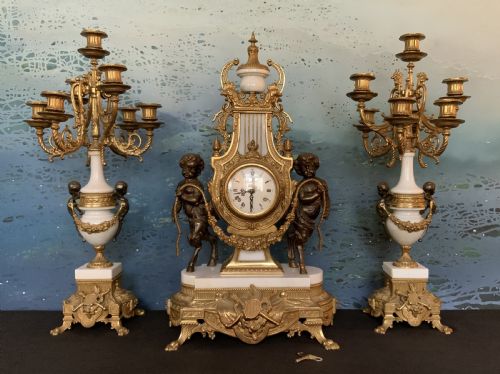
Materials extend beyond pure bronze to incorporate gilt bronze, ormolu, brass, white and grey marble, onyx, enamel, glass, and Paris porcelain. The side pieces repeat the motifs and materials of the central clock to create a balanced ensemble for a mantel or side table.
What varies in quality
The crispness of the bronze chasing and the depth of the gilding or ormolu separate standard production from exceptional pieces. Superior sets display sharp relief in cast foliage and figures, with hand-chasing that brings life to the metal surface rather than leaving it flat or soft.
The integration of materials dictates the overall harmony of the set, particularly where bronze meets marble, onyx, or porcelain. Higher quality garnitures employ substantial, well-polished stones and accurately fitted mounts that hold the composition securely without visible gaps.
Listings feature pieces spanning from the 18th century through the 20th century, dominated by 19th-century French designs in bronze, marble, and ormolu.
Ferdinand Berthoud·Japy Freres
The Three Piece Bronze Garniture Glossary
- Garniture
- A set of matching decorative ornaments designed to be displayed together, typically comprising a central clock and two side pieces. These arrangements gained immense popularity in European interiors during the eighteenth and nineteenth centuries.
- Ormolu
- Gilding technique involving the application of a finely ground gold-mercury amalgam to a bronze object, followed by firing to drive off the mercury. This historical method produces a deep, durable golden finish distinct from modern electroplating.
- Breccia marble
- A composite rock made of broken fragments of minerals cemented together by a fine-grained matrix, creating a variegated and mottled pattern. It appears frequently in nineteenth-century clock bases.
- Japonisme
- The influence of Japanese art and aesthetics on Western decorative arts, prominent in the late nineteenth century. In these garnitures, it manifests through distinct asymmetry and botanical motifs.
- Candelabra
- A branched candlestick holder designed to hold multiple candles, frequently used as the matching side pieces in a clock garniture. They mirror the decorative language of the central clock.
Three Piece Bronze Garniture: Frequently Asked Questions
What is a three piece bronze garniture?
A three piece bronze garniture is a matched decorative set containing a central clock and two flanking ornaments, such as candelabras or urns. They were created to sit together on a mantelpiece or console table as a balanced decorative display.
The style follows the dominant aesthetic of its period, ranging from the classical restraint of Louis XVI to the ornate curves of French Rococo Revival and the clean geometry of Art Deco.
How do I style a garniture set?
Place the central clock in the middle of a mantelpiece, sideboard, or large table, with the two matching side pieces arranged symmetrically on either side. Keeping the set together maintains the visual balance intended by the maker.
Ensure the surface is level and sturdy enough to bear the weight of heavy bronze and marble components. Avoid placing them in areas of direct, harsh sunlight that could affect sensitive enamel dials or delicate patination.
What materials are used in these sets?
These sets combine cast bronze, gilt bronze, ormolu, and brass with natural stones like white marble, grey breccia marble, and onyx. Some examples also incorporate Paris porcelain, Imari porcelain, enamel, and glass elements.
The metal components provide structural and sculptural detail, while the stone bases add visual weight and stability to the composition.
How can I tell the period of a garniture?
Dating relies on identifying the decorative style, such as neoclassical motifs, Japonisme elements, or Art Deco geometry, combined with the materials and manufacturing techniques. Nineteenth-century French pieces often exhibit distinct cast ornamentation and specific clock movement signatures.
Secondary clues include the type of marble used for the base, the formulation of the gilding, and the presence of maker signatures stamped on the bronze or movement plates.