
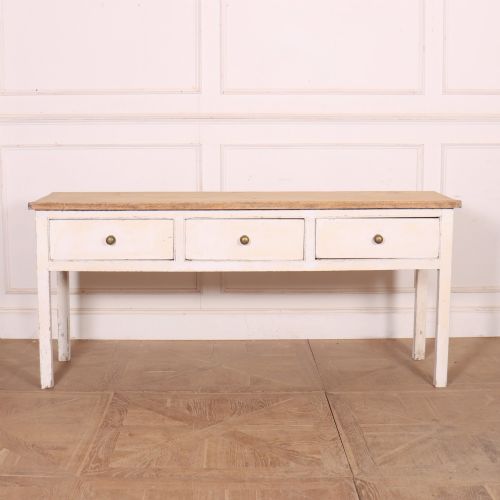
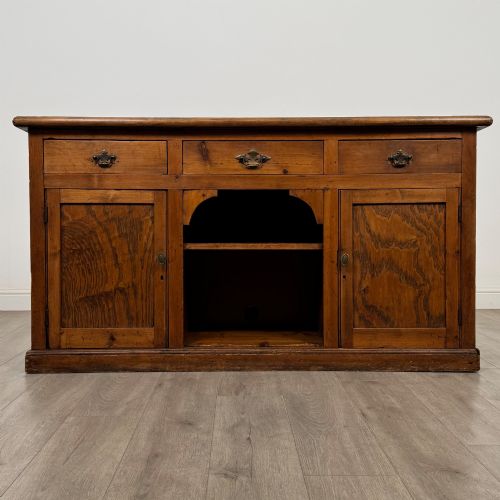

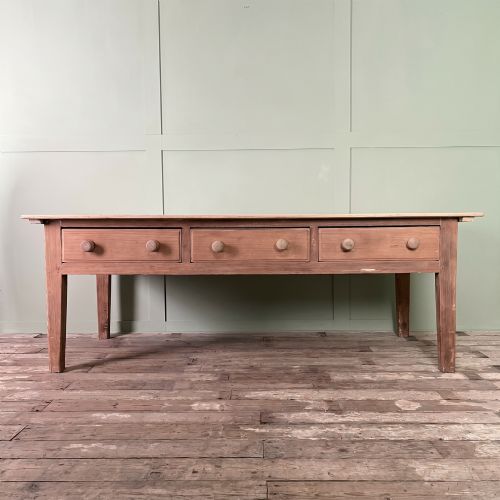
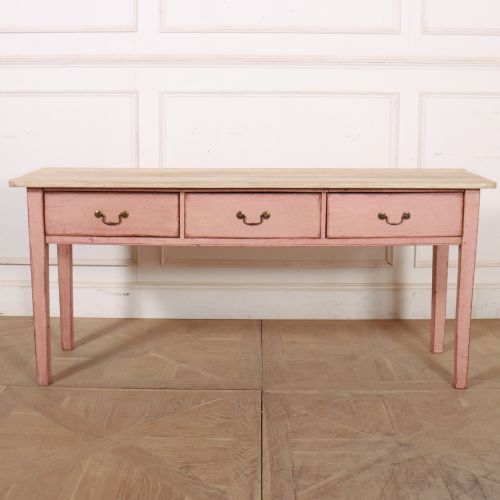


Three Drawer Pine Sideboard
A three drawer pine sideboard brings warmth and practical storage to a room, offering sturdy utility shaped by centuries of farmhouse and country tradition.
Three Drawer Pine Sideboard
A three drawer pine sideboard functions as a robust storage piece, appearing in forms such as dresser bases, servers, and low chests across this selection. These items emerge predominantly from the nineteenth and eighteenth centuries, reflecting traditional English, Welsh, and continental rural workshops.
Buyers frequently encounter English country examples alongside painted provincial pieces from Austria and Hungary. The standard configuration pairs a row of three drawers above cupboards or open potboard bases, built for heavy kitchen and dining service.
How they were made
Carpenters constructed these pieces primarily from solid pine and sycamore, utilising durable timber suited to daily domestic labour. Surfaces often received coats of paint or protective layers of wax to guard the wood against kitchen moisture.
Hardware typically included brass handles and ceramic pulls, secured to frame-and-panel doors and dovetailed drawer boxes. Construction relied on straightforward joinery designed for longevity rather than delicate ornamentation.
Listings span the eighteenth and nineteenth centuries, featuring pine, sycamore, and painted wood fashioned into dresser bases and servers.
What varies in quality
Quality rests upon the integrity of the timber and the preservation of original painted surfaces versus stripped wood. Pieces displaying authentic regional paintwork or rich undisturbed wax patination hold distinct character over later alterations.
Construction depth marks the difference between basic utility items and finer regional cabinetwork. Substantial proportions, original brass or ceramic hardware, and tight drawer joints elevate the standing of a piece.
The Three Drawer Pine Sideboard Glossary
- Dresser base
- A low kitchen or dining cabinet featuring drawers across the top, often accompanied by open potboards or cupboards below. This form served as a primary work surface in historic country houses.
- Potboard
- An open slatted lower shelf built into the base of a dresser to store pots and heavy kitchen utensils. It provides structural stability while keeping everyday vessels accessible.
- Sycamore
- A dense hardwood belonging to the maple family, frequently utilised alongside pine for tabletops and preparation surfaces due to its resistance to splitting. It develops a pale, smooth finish through years of scrubbing.
- Commode
- A low cabinet fitted with doors or drawers, originating as a bedroom or parlour piece. Continental examples often showcase regional folk art painting.
- Server
- A low side table or sideboard designed for holding dishes during a meal. These pieces prioritise surface area and accessible storage over height.
Three Drawer Pine Sideboard: Frequently Asked Questions
Where were these sideboards used originally?
These pieces worked primarily in farmhouse kitchens, dairies, and pantries as robust preparation surfaces and storage units. Their deep drawers held cutlery, linens, and dry goods for daily household management.
Over time, they moved into dining rooms and living spaces as tastes shifted toward rustic and country interior design styles.
How do I clean a waxed pine surface?
Maintain waxed pine by dusting with a soft, dry cloth and applying a quality beeswax sparingly when the wood appears dry. Avoid commercial silicone polishes that can degrade historic finishes over time.
Gentle care preserves the natural grain and builds a deeper patination across the timber.
What is the difference between a dresser base and a sideboard?
A dresser base traditionally originates from a kitchen or pantry context, frequently including potboards or heavy plank construction built for utilitarian tasks. Sideboards often emerged in more formal dining settings with refined proportions.
Both types share the characteristic three drawer layout across the upper section.
How can I tell if the paint is old?
Original paint shows natural wear, subtle crazing, and integration with the underlying timber through decades of exposure. Multiple historical layers often peek through worn edges where hands touched the wood.
Modern repainting sits uniformly on the surface without the authentic softening found on nineteenth and eighteenth-century examples.