




Thatched Cottage Wall Art
These thatched cottage wall art pieces bring pastoral English scenery into a room through watercolours and oils.
Thatched Cottage Wall Art
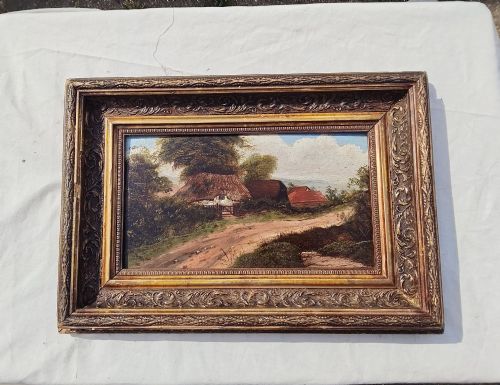
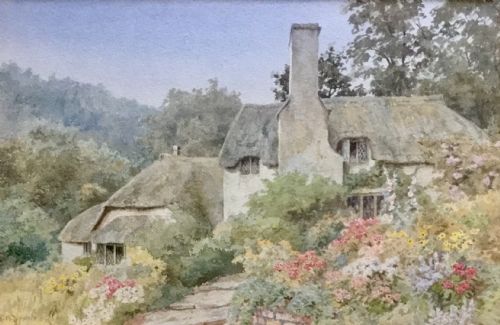
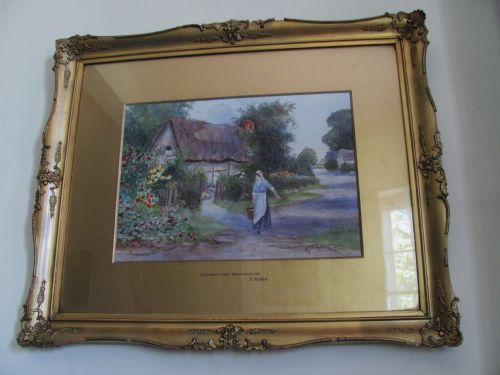
Thatched cottage wall art consists of framed paintings and watercolours depicting rural English country scenes and cottages. These works capture vernacular architecture and pastoral life through the eyes of various historical schools.
The versions most commonly met on this page span the nineteenth and twentieth centuries, taking the form of framed watercolours on paper and oil paintings on canvas or card. Painters from these periods focused heavily on rural idylls, gardens, and West Country villages.
The subjects range from detailed architectural studies of specific West Country locations to broader English pastoral realism. They offer a direct window into historical rural life and traditional building methods.
Materials and Construction
Artists utilised oil paint and watercolour on traditional supports such as canvas, prepared card, and heavy watercolour paper. These pigments were applied by hand using fine brushes to capture the texture of reed thatch and weathered stonework.
Many of these works are presented behind glass in gilt wood or timber frames that protect the delicate paper and paint surfaces. The framing materials reflect the aesthetic preferences of their respective periods, from Victorian moulded timber to later gilt moulding.
Pigs and dogs frequently wander into the background of these pastoral scenes, keeping the cottages company.
Judging Quality and Execution
Quality in these works rests upon the painter's brushwork and control of light, particularly in the rendering of atmospheric skies and complex textures like thatch. Superior pieces demonstrate confident handling of perspective and a coherent palette.
The strength of composition and the fidelity of the architectural depiction distinguish accomplished artists from minor or primitive hands. Condition also plays a role, with well-preserved paper surfaces and stable paint layers commanding greater appreciation.
Harry Sylvester Stannard·Thomas Nicholson Tyndale·Theresa Sylvester Stannard·Joseph Hughes Clayton·Alfred Leyman·Arthur Claude Strachan·Thomas Rowlandson·Joseph Paul
The Thatched Cottage Wall Art Glossary
- Watercolour
- A painting method where fine pigment is suspended in a water-based, translucent solution. It is typically applied to paper to achieve soft washes of light and colour.
- Oil on Canvas
- A traditional medium employing pigments bound in a drying oil, spread across a stretched fabric surface. This technique allows for rich texture and deep colour saturation.
- English Pastoral Realism
- An artistic approach focusing on the genuine representation of rural countryside life and landscapes. It avoids excessive romanticism in favour of observed detail.
- Gilt Wood
- Timber framing finished with a thin layer of gold leaf or metallic gilt. It provides a decorative border that complements the tones within the painting.
- Primitive Folk Art
- Painting created by self-taught or provincial artists working outside academic traditions. These pieces often feature charming perspective and direct, unpretentious execution.
Thatched Cottage Wall Art: Frequently Asked Questions
What periods do these paintings come from?
The works span from the eighteenth-century Georgian era through the Victorian period and into the mid-twentieth century. Each era brings distinct stylistic approaches to rural subjects.
Nineteenth-century examples often lean towards detailed realism, while twentieth-century pieces sometimes explore broader impressionistic or primitive styles.
How should I hang and protect watercolour art?
Watercolours are sensitive to bright sunlight and moisture, which can fade pigments and damage paper over time. Hang them away from direct sunlight on interior walls.
Ensure the framing uses acid-free mounts and protective glass to safeguard the paper surface from environmental degradation.
What is the difference between oil and watercolour?
Oil paintings use pigments bound in drying oil on canvas or card, offering rich texture and opaque coverage. Watercolours use translucent pigments on paper to create luminous, lighter effects.
Oils are generally more robust, whereas watercolours require protection behind glass.
Are these works signed by the artists?
Many pieces on this page feature artist signatures, attribution notes, or historical inscriptions on the front or reverse. Some are documented works by known nineteenth and twentieth-century painters.
Others represent provincial or school pieces created by anonymous hands working within regional traditions.