




Thatched Cottage Landscape Art
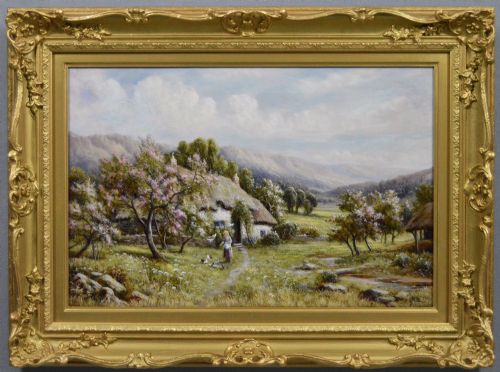
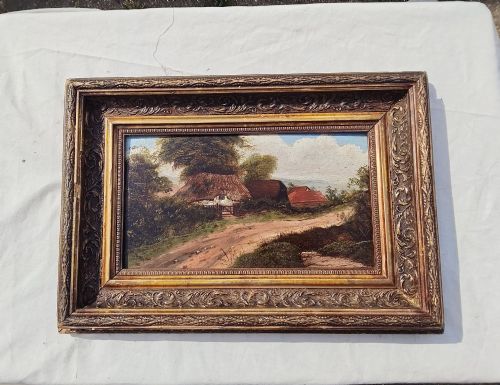
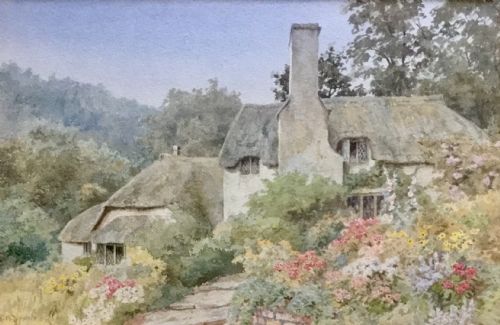
These thatched cottage landscape art pieces capture pastoral idylls through traditional watercolours and oil paintings.
Thatched Cottage Landscape Art
Thatched cottage landscape art depicts rural scenes featuring traditional dwellings across periods from the Georgian era through to the mid-twentieth century. Collectors encounter these works primarily as watercolours or oil paintings on paper, card, and canvas.
The material record spans nineteenth-century depictions alongside Edwardian and 1920s pastoral compositions. These fine art paintings document village life, rural street scenes, and figures outside country cottages in regions such as Devon, Somerset, and Warwickshire.
Works on this page range from primitive folk art paintings to detailed academic watercolours framed in wood and gilt. Buyers select these pieces to bring traditional English pastoral realism into domestic interiors.
How they were made
Artists executed these works using watercolour pigment on paper or oil paints applied to canvas, card, and wood panels. Many pieces employ traditional brushwork techniques to capture the detailed texture of rustic thatch and surrounding country gardens.
Completed artworks often reside within original or period wooden frames, occasionally accented with gilt mouldings and protected beneath glass. The support materials range from sturdy card to stretched canvas depending on whether the artist worked in oil or watercolour.
Several cottages share the landscape with domestic pets, from dogs resting outside doorways to children feeding farmyard hens.
What varies in quality
The distinction between standard works and superior examples rests upon the artist's handling of light, atmospheric depth, and structural perspective within the rural setting. Master painters render the complex textures of thatched roofs and foliage with convincing spatial awareness.
Material preservation also influences value, particularly the stability of watercolours against fading and the condition of the underlying paper or canvas. Original framing in period wood and gilt enhances the historical integrity of the piece.
Robert John Hammond·John McDougal·Harry Sylvester Stannard·Robert Hollands Walker·Thomas James Lloyd·Joseph Kirkpatrick·Arthur Claude Strachan·Walter Henry Sweet·Thomas Nicholson Tyndale·David Heward·Yeend King·Joseph Hughes Clayton·Alfred Leyman·Georgina Lara·Thomas Rowlandson·Joseph Paul·David Woodlock
The Thatched Cottage Landscape Art Glossary
- Watercolour painting
- A work created using water-soluble pigments suspended in a solution on paper. This medium allows for transparent washes of colour that capture delicate atmospheric effects.
- Oil on canvas
- A painting technique utilising pigments bound in a drying oil applied to a woven fabric support. This method offers rich texture and deep colour saturation.
- English pastoral realism
- An artistic style focusing on authentic, unidealised depictions of the English countryside. These scenes typically highlight rural labour, village architecture, and agricultural life.
- Primitive folk art
- Art produced by self-taught painters working outside academic traditions. These pieces often display charming perspective quirks and direct, unpretentious execution.
Thatched Cottage Landscape Art: Frequently Asked Questions
What is thatched cottage landscape art?
These works are historical paintings and watercolours depicting traditional rural English cottages within pastoral settings. They serve as visual records of nineteenth and early twentieth-century village life.
Collectors prize them for their nostalgic portrayal of the British countryside and traditional domestic architecture.
How should I frame these paintings?
Watercolours require framing behind glass with neutral mounts to protect the paper from moisture and ultra-violet light damage. Oil paintings on canvas generally stay unglazed in wooden frames that allow the surface to breathe.
Matching the period of the frame to the era of the painting preserves the historical aesthetic of the artwork.
How do I identify the period?
Dating relies on stylistic clues, framing materials, and artist signatures recorded in historical directories. Victorian and Edwardian works often feature specific regional notations in the titles.
Substrates like card or Academy boards also indicate manufacturing dates common to the nineteenth and early twentieth centuries.
Where were these scenes typically set?
Artists frequently painted specific West Country locations including Devon, Somerset, and Cornwall alongside Midland counties like Warwickshire. These rural hubs provided the picturesque thatched architecture favoured by pastoral painters.
Local landmarks such as inns and village streams appear regularly in the titles and subject matter.